
We publish original, first-party research on payment fraud and digital trust. Our datasets are free to download, re-analyse and cite. Journalists and researchers are welcome to use them with attribution — and to challenge them.
Media contact: contact page · Founder: Anis Ansari, A Square Solutions
Study 1 — Fraud hides below ₹1,000
Published 24 July 2026 · data window 28 June – 25 July 2026
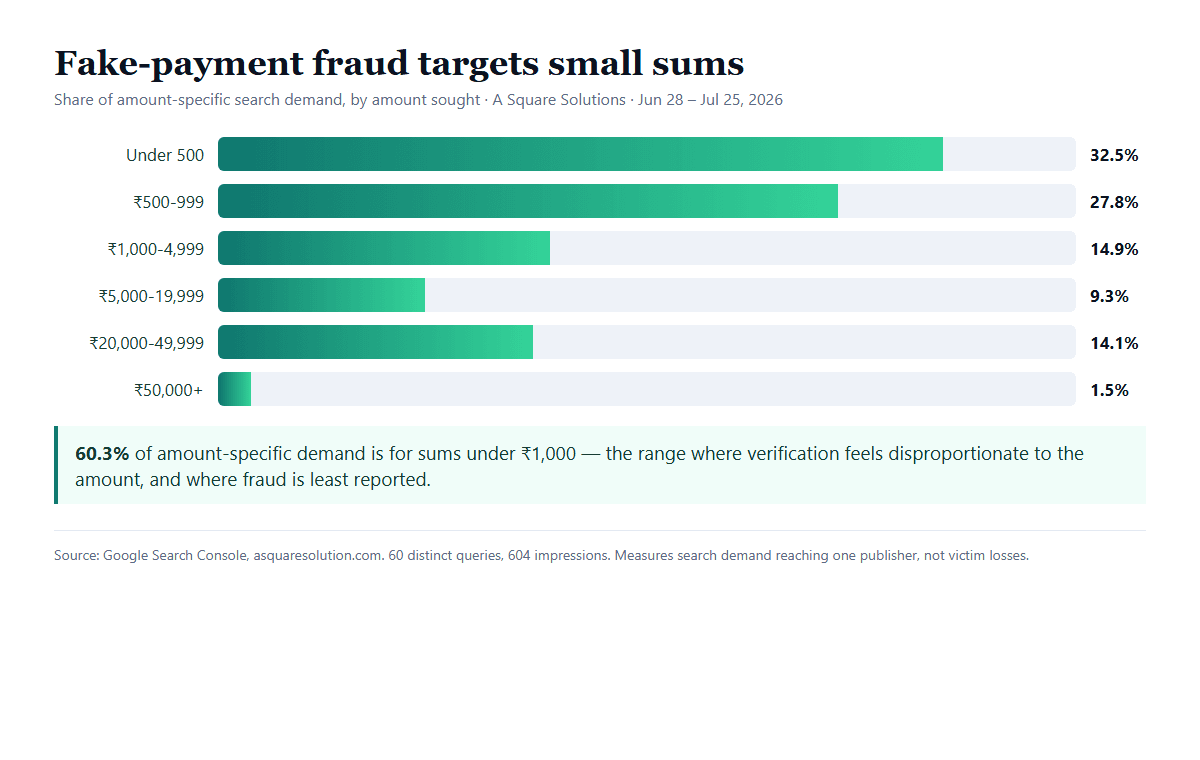
Executive summary. Official fraud statistics are built from reported losses, and small frauds are almost never reported — so the public picture of payment fraud is biased toward large cases. We approached it from the opposite direction, analysing search demand. Across 103,000 search impressions we isolated every query naming an explicit money amount alongside payment or screenshot terms.
Headline finding: 60.3% of amount-specific fake-payment search demand is for sums under ₹1,000, with a single most-searched figure of ₹500. A secondary peak appears at ₹20,000–₹50,000. Fraud concentrates where verification feels disproportionate to the amount — which is also the range least likely to be reported, and therefore invisible to loss-based statistics.
Downloads: dataset (CSV) · chart (PNG) · full methodology
Stated limitation: this measures search demand reaching one publisher, and cannot separate victims verifying a payment from actors seeking forgeries. We publish it as a demand-side signal, not a victim-loss estimate.
Study 2 — AI citations grew by breadth, not depth
Published 24 July 2026 · data window 28 April – 25 July 2026 (89 days)
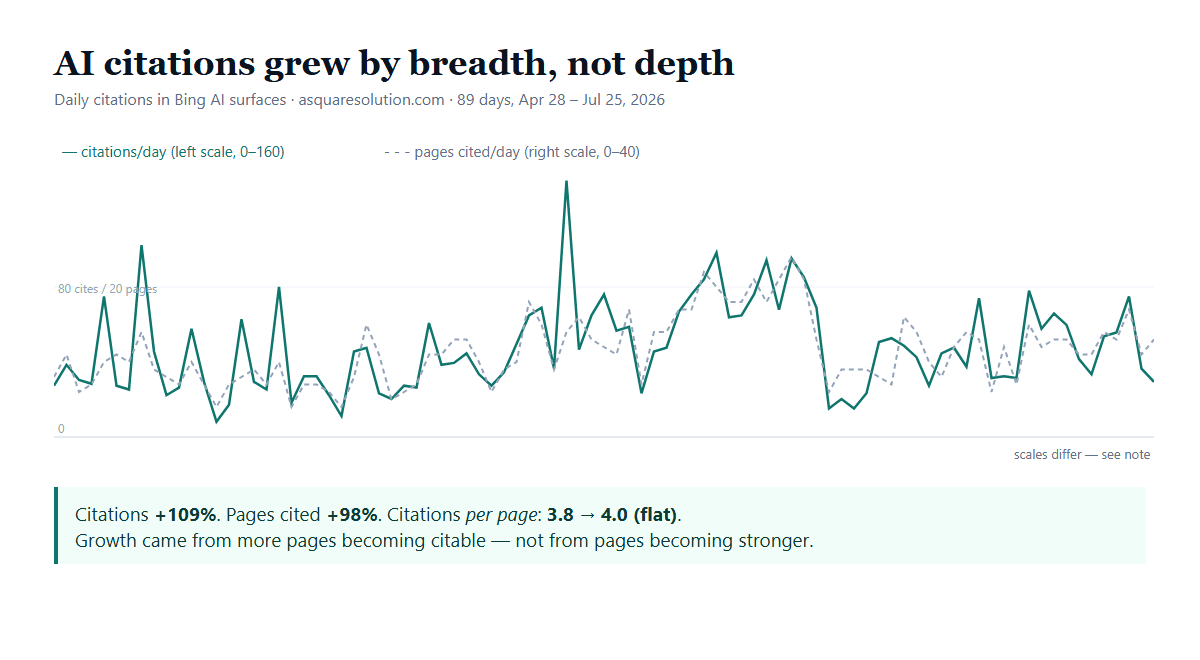
Executive summary. Most writing about generative engine optimisation is advice without measurement. We analysed 4,188 citations of our pages inside Bing’s AI experiences over 89 days.
Headline finding: citations rose 109% and the number of distinct pages cited rose 98% — but citations per cited page stayed flat, moving only from 3.8 to 4.0. Growth came almost entirely from more pages crossing into being citable, not from any page becoming stronger. If that generalises, the common advice to consolidate into fewer, longer pages optimises the variable that did not move.
Downloads: 89-day dataset (CSV) · chart (PNG) · full methodology
Open question we would like tested: is the ~4-citations-per-page ceiling a property of the engine, of our topic, or of our page quality? We would welcome comparison data from other publishers measuring the same metric.
Stated limitations: Bing AI surfaces only — no equivalent telemetry is published by ChatGPT, Gemini, Claude or Perplexity. Single property, one topical area, and our publishing volume rose during the window, which could partly explain the breadth gain on its own.
How to cite this research
Journalist / inline: “…according to analysis by A Square Solutions, 60.3% of amount-specific fake-payment searches are for sums under ₹1,000” (link to the study page).
APA: A Square Solutions. (2026). Fake-payment search demand by amount sought [Data set]. https://asquaresolution.com/research/
MLA: A Square Solutions. “AI Citations Grew by Breadth, Not Depth.” A Square Solutions Research, 24 July 2026, asquaresolution.com/research/.
Licence: our datasets and charts may be reproduced, re-analysed and republished with attribution to A Square Solutions and a link to the source page. No permission request needed. If you find an error, tell us and we will correct it publicly.
Why we publish limitations
Every study here states what it cannot show. That is deliberate. We build fraud-detection tools, and the same standard applies to our own claims: an answer is not the same as the truth. If a finding only survives when its weaknesses are hidden, it is not a finding.