
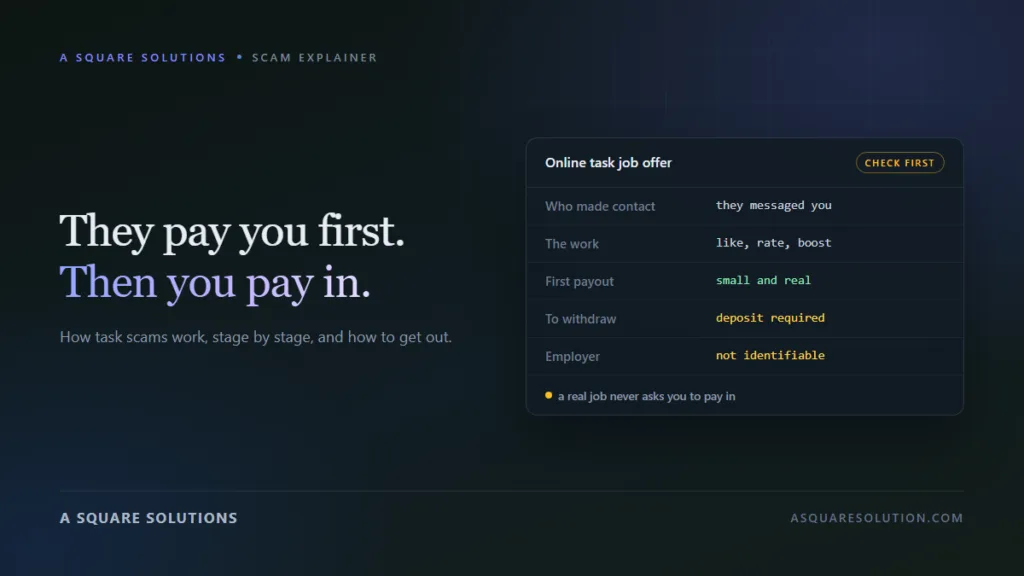
A message offers you easy money for liking videos or rating products. The first payout is real. The rest is designed to make you pay in. This guide explains how task scams work stage by stage, the point where the money turns around, and what to do if you are already inside one.
Task scams are one of the fastest-growing kinds of job fraud. The US Federal Trade Commission (FTC) counted about 20,000 reports of them in the first half of 2024, against roughly 5,000 in the whole of 2023, according to its December 2024 data spotlight. Reported losses to job scams as a whole reached $223 million in those six months.
Those are US figures, and only the cases people reported. The same script runs on WhatsApp and Telegram in India, the UK, Canada and Australia, usually under names like “part-time job”, “online tasks” or “product optimisation”.
What is a task scam?
A task scam is a fake online job. You are paid small amounts for simple, repetitive actions, then told to deposit your own money to keep working or to withdraw what you have “earned”. The earnings shown on screen are not real. The deposits are.
The FTC’s consumer alert on task scams describes the tasks as things like “optimization” or “product boosting” done in an app or on a website, with a balance that appears to grow with each click.
How a task scam works, stage by stage
1. The message you did not ask for
It arrives on WhatsApp, Telegram, text or social media. The sender may claim to be a recruiter and may name a well-known company. The offer is flexible work from your phone, with no interview and no experience needed.
2. The easy tasks
You are asked to like videos, follow accounts, rate products or click through listings. Each task takes seconds. You are often moved into a group chat where other “workers” post screenshots of their payouts.
3. The first payout
You receive a small, real payment. The FTC describes early payouts of around $5 to $20. This is the most important step in the scam. It is the proof that makes everything after it believable.
4. The dashboard
You are given a login to an app or website that shows your tasks and a balance. The balance climbs. Nothing on that screen is connected to a bank. It is a number the operators control.
5. The deposit
Now the rules change. To unlock the next set of tasks, to reach a higher “level”, or to withdraw your balance, you are told to add your own money first. The FTC notes this is usually asked for in cryptocurrency. The request can also be a bank or UPI transfer to a personal account.
6. The escalation
The first deposit is small and may even be returned with a “commission”. The next is larger. Then a task set is said to have failed, or the account shows a shortfall, and you must pay again to release what is now a large balance. People pay because they are trying to recover what they have already put in.
7. The end
When you stop paying, the withdrawal never arrives. You are removed from the group, or the account is frozen behind a new fee described as tax or verification. The money you sent is gone, and the balance on the screen never existed.
Why the scam is so convincing
- You are paid first. Most people believe that a scam takes money and never gives any. This one gives first.
- It feels like a game. Levels, streaks and a rising balance keep you clicking. The FTC calls these “gamified” job scams for that reason.
- The group looks busy. The other members praising the scheme are run by the same people.
- Each payment is framed as the last one. There is always one more step before the withdrawal.
Red flags you can check in a minute
- The job found you. You did not apply for it.
- The work is liking, rating, following or “boosting” things online.
- Pay is quoted per task or per day and is high for the effort.
- All contact is on a messaging app, with no company email, contract or interview.
- You are asked to register on an app or site you cannot find anything about.
- You are asked to deposit, “recharge” or “top up” before you can continue or withdraw.
- Payment goes to a personal account, a UPI ID or a crypto wallet.
The sixth one settles it. In the FTC’s words of advice, never pay anyone to get paid. A real employer pays you. It does not ask you to pay in.
It also helps to know that paying people to post ratings or likes is itself a problem. The FTC tells consumers not to trust anyone who offers to pay for ratings or endorsements. A job built on that is not a job worth keeping, even before the deposit request.
Got a job offer on WhatsApp or by text?
Paste the message into ScamCheck’s WhatsApp checker or the SMS checker for a free second opinion. It explains which parts of the wording look risky and needs no sign-up. It cannot confirm that an employer is real, so treat it as one check among several.
What to do if you are already in one
Stop paying, now. The next payment will not release the balance. No payment will.
Do not pay a “tax”, “verification” or “unfreezing” fee. These are the same scam asking again.
Contact your bank or payment app immediately. Tell them it was fraud and ask whether the payment can be stopped or disputed. Speed matters more than anything else here.
If you paid in crypto, report it to the exchange you used and keep the transaction IDs. Crypto payments are very hard to reverse, so report early.
Save the evidence. Screenshots of the chats, the group, the dashboard, the account details you paid, and every transaction reference.
Report it.
- India: the National Cyber Crime Reporting Portal at cybercrime.gov.in, or the 1930 helpline.
- United States: ReportFraud.ftc.gov.
- Other countries: your national fraud reporting service and your bank.
Leave the groups and block the contacts. Do this after you have saved the evidence.
Be ready for a second approach. People who have lost money are often contacted by someone offering to recover it for a fee. That is a separate scam aimed at the same victims.
If the “job” asked you to receive money and pass it on to someone else, stop and tell your bank. Moving other people’s money through your account can involve you in a crime, even if you were tricked into it.
Our step-by-step recovery guide covers the first hours in more detail.
How to check a job offer before you reply
- Find the company yourself. Search for its official website and careers page. Do not use a link from the message.
- Check the recruiter. A real recruiter can email you from the company’s own domain and name the role, the team and the hiring process.
- Ask for the contract first. Real work comes with terms, a pay method and an employer you can identify.
- Refuse any payment. Training fees, registration fees, deposits and top-ups all mean the same thing.
- Check the link. If you are sent to an app or website, look it up before you register. Our guide on how to check a link before you click shows how.
For the wider picture of fake job offers, see our guide to work-from-home and job scams.
The bottom line
A task scam does not start by asking for money. It starts by giving you some. That is why the usual instinct, “they paid me, so it must be real”, fails here.
The test that works is simple. The moment a job asks you to pay in, it has stopped being a job.
Frequently asked questions
What is a task scam?
It is a fake online job that pays small amounts for simple tasks such as liking videos or rating products, then asks you to deposit your own money to continue or to withdraw your earnings. The balance shown is not real and the deposits are not returned.
Why did the scammers pay me at the start?
The small early payout builds trust. It costs the scammers very little and makes the later deposit requests believable. The US Federal Trade Commission describes early payouts of around 5 to 20 dollars.
Can I get my money back from a task scam?
Sometimes, if you act fast. Contact your bank or payment app straight away, report it as fraud and ask about stopping or disputing the payment. Crypto payments are much harder to reverse. Do not pay anyone who offers to recover the money for a fee.
Are task scams only on Telegram and WhatsApp?
No. The FTC lists WhatsApp, Telegram, text messages and social media. The first contact can also be an email or a fake recruiter profile. The move to a messaging app usually happens early.
Is every online micro-task job a scam?
No. Genuine micro-task platforms exist and pay small amounts for small jobs. The difference is that they never ask you to deposit money to unlock tasks or to withdraw what you have earned.
Figures in this article come from the US Federal Trade Commission pages linked above and cover reports made in the United States. This article is educational and is not legal or financial advice. See our disclaimer.
Related reading: Work-from-home and job scams · Courier and parcel scam texts · How to check any link before you click · What to do after being scammed · How we built ScamCheck