
Generative Engine Optimization (GEO) is the practice of structuring content so that AI-powered search systems — Google AI Overviews, ChatGPT Search, Perplexity AI, and Microsoft Copilot — select it as a cited source. This guide covers the full implementation stack; for platform-specific SGE strategy see optimising for Google SGE and AI Overviews. This is the complete 2026 GEO guide: how it works across platforms, how it differs from SEO, and how to implement it for measurable results. See also: Google AI Search impact on digital marketing. The full operational framework for implementing GEO — including citation architecture, entity density, and AI search mechanics — is documented in the GEO + AI Search Systems track at AI Execution Lab.
Prefer to have experts handle this? A Square Solutions offers professional SEO services for growing businesses.
Original study: 89 days of AI citations, and what actually grew them
A Square Solutions original analysis · 28 April – 25 July 2026 · 4,188 recorded citations
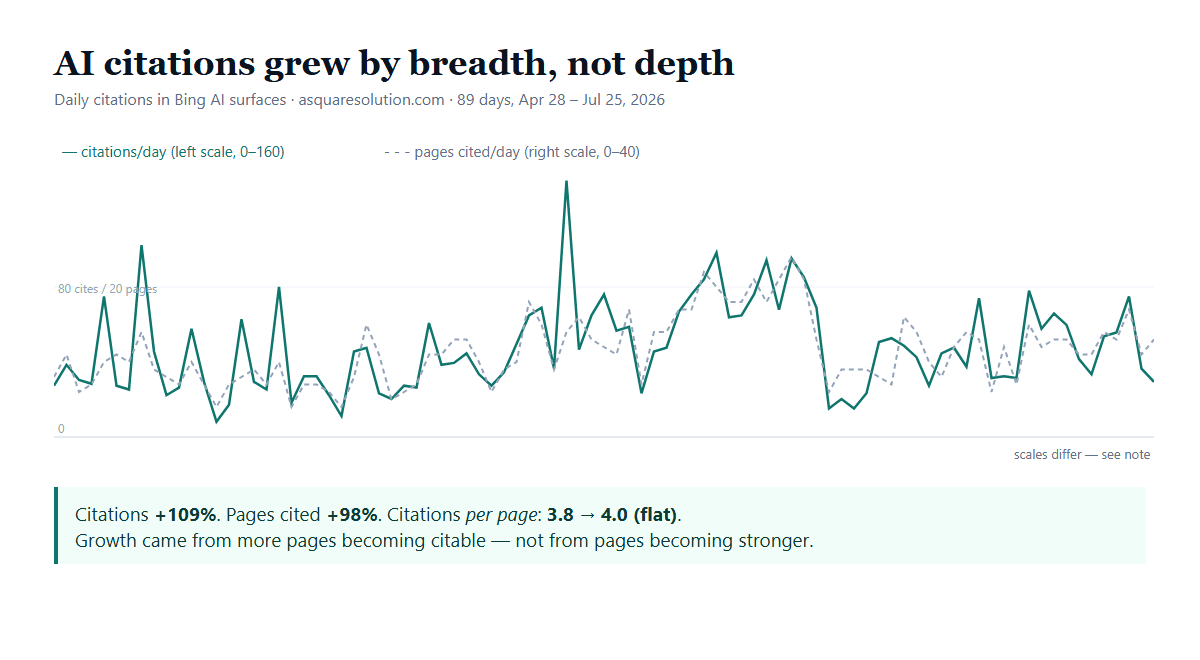
Download the data: 89-day AI citation series (CSV). Free to reuse and re-analyse with attribution to A Square Solutions.
Almost everything written about generative engine optimisation is advice without measurement. We had the rarer thing: a property with an AI-citation record long enough to analyse. Over 89 days we logged 4,188 citations of our pages inside Bing’s AI experiences, averaging 47 per day, and we looked at what actually changed.
The headline numbers
| Metric | First 14 days | Last 14 days | Change |
|---|---|---|---|
| Citations per day | 34.9 | 72.9 | +109% |
| Distinct pages cited per day | 9.3 | 18.4 | +98% |
| Citations per cited page | 3.8 | 4.0 | +5% (flat) |
The finding: breadth grew, depth did not
Citations doubled. The number of pages being cited also doubled. But the yield per cited page barely moved — from 3.8 to 4.0 citations a day.
That flat number is the result. Our citation growth did not come from individual pages becoming more authoritative, more comprehensive, or better optimised. It came almost entirely from more pages crossing the threshold of being citable at all. Each page that crosses it appears to settle at a similar, modest rate of roughly four citations per day.
If that pattern holds beyond one property, it has an awkward implication for the prevailing advice. The common counsel — consolidate into fewer, longer, stronger pages — optimises for the variable that stayed flat. What moved was coverage: how many distinct questions a site can answer well enough to be quoted on.
Why this is plausible mechanically
An AI answer engine assembles a response to one specific question. It does not rank a site; it selects passages. A page either contains a passage that answers the question cleanly, or it does not. Making an already-cited page longer does not create new questions for it to answer — but publishing a page on an adjacent question does. Breadth creates new citation surface; depth mostly deepens surface that is already claimed.
What we would test next
Whether the ~4 citations-per-page ceiling is a property of the engine, of our topic, or of our page quality. A site with substantially stronger individual pages would distinguish these. We would welcome comparison data from other publishers measuring the same metric.
Methodology and limitations
Source: Bing Webmaster Tools AI Performance report (beta) for asquaresolution.com, daily citation and cited-page counts, 28 April – 25 July 2026 (89 days). Comparison periods are the first and last 14 days of the window.
Stated limitations: this measures citations within Bing’s AI surfaces only — it does not observe ChatGPT, Gemini, Claude or Perplexity, which publish no equivalent telemetry. It is a single-property study: one site, one topical area (fraud and payment verification), and the growth period coincided with active publishing, which increases page count and could partly explain breadth gains. We report it as a measured observation from one property, not a general law.
Publishers and researchers may cite this analysis with attribution to A Square Solutions. We are happy to share methodology detail — see our contact page.
Generative Engine Optimization (GEO)
What Is Generative Engine Optimization (GEO)?
Generative Engine Optimization (GEO) is the practice of structuring web content so that large language models — including Google Gemini, ChatGPT, and Perplexity — select it as a cited source in generated answers. Unlike traditional SEO, which optimizes for ranked blue links, GEO optimizes for passage extraction: the AI reads your content, decides whether it’s authoritative, and either quotes it or ignores it.
The core GEO signals are: entity disambiguation (Google’s Knowledge Graph recognizes your brand), citation-density (your content is already referenced by authoritative domains), semantic chunk quality (individual paragraphs answer a single question completely), and structured data (FAQPage, HowTo, Speakable schema tell AI parsers which passages are answer-ready).
GEO vs Traditional SEO: Traditional SEO targets keyword-to-ranking position. GEO targets content-to-citation eligibility. A page can rank #1 in organic results and still never appear in an AI Overview — and a page at position #8 may be cited in every relevant AI answer if its passage structure is strong.
How AI search systems select, retrieve, and cite content — and how to position your pages for citation in Google AI Overviews, ChatGPT Search, and Perplexity.
📚 In This Cluster
Generative Engine Optimization (GEO) is the discipline of making content citation-worthy for AI-powered search systems. The optimization target is not a ranking position in a results page — it is citation: your content appears inside the AI-generated response, quoted or paraphrased, often with attribution and sometimes with a visible source link.
That distinction matters more than it might appear. Traditional SEO works on a pull model: you rank, users scroll, users click. GEO works on a push model: the AI system retrieves your content, synthesises it into an answer, and delivers it to users who may never visit your page. The click may not happen. The brand impression does — and for many queries, the impression is the primary value.
Between 2023 and 2025, four platform events made GEO unavoidable for any serious content strategy. Google launched AI Overviews across its core markets, inserting AI-generated answers above organic results for a substantial fraction of queries. OpenAI added live web search to ChatGPT, giving its 200+ million users an AI answer engine with real-time content retrieval. Perplexity AI crossed 100 million monthly queries with a high-engagement, professional user base. Microsoft embedded Copilot directly into Bing at the query level. These four systems now intercept a growing share of commercial queries — the kind that previously sent users directly to content and service pages. GEO is the discipline of positioning your content to be selected by those systems.
GEO vs. Traditional SEO — What Actually Changes
The surface differences between SEO and GEO are discussed widely. The deeper difference is frequently missed: they optimise for different systems with different evaluation logic.
Traditional SEO optimises for a ranking algorithm that evaluates pages holistically: backlink authority, keyword relevance, technical performance, E-E-A-T signals, user engagement. Google's algorithm produces an ordered list of pages. Users choose which pages to visit.
GEO optimises for retrieval systems that evaluate passages, not pages. When ChatGPT Search or Perplexity processes a query, it does not evaluate your entire 3,000-word article as a unit — it identifies which specific paragraphs contain content directly relevant to that query, then retrieves and cites those passages. Passage-level evaluation requires passage-level thinking about content structure.
The second key difference is the role of authority signals. In traditional SEO, domain authority built through backlinks is a dominant ranking factor. In GEO, source credibility is assessed through entity recognition, structured data, content specificity, author credentials, and source co-occurrence in training data. A small specialist site with genuinely deep expertise on a narrow topic can be cited in AI answers ahead of a major publication with generic coverage — something almost impossible in competitive organic search.
| Dimension | Traditional SEO | GEO |
|---|---|---|
| Optimization goal | Rank position in SERP | Citation in AI-generated answer |
| Evaluation unit | Entire page | Individual passages and sections |
| Authority signal | Backlink profile, domain authority | Entity recognition, structured data, specificity |
| Content format priority | Keyword coverage, internal linking | Direct answers, structured lists, parseable headings |
| Success metric | Clicks, CTR, organic sessions | Citation rate, branded search lift, AI source appearances |
| Small site advantage | Low — authority gap is hard to overcome | High — deep specificity can beat broad coverage |
| Relationship to clicks | Traffic-generating — ranking produces clicks | Impression-based — citation may not produce a click |
GEO does not replace SEO. Traditional ranking determines which pages AI systems can access — an unindexed or uncrawlable page cannot be cited regardless of content quality. GEO determines which content within those indexed pages gets selected and surfaced. Both disciplines are necessary; they operate at different levels of the same system.
The Four AI Search Platforms That Matter in 2026
Each major AI search platform has distinct source-selection logic, a distinct audience, and distinct citation behaviour. A GEO strategy that only accounts for Google AI Overviews is leaving significant citation opportunity untapped — particularly in professional and B2B contexts where Perplexity and ChatGPT Search have strong penetration.
Google AI Overviews
Google AI Overviews appears at the top of results for queries where Google's systems determine an AI-generated summary adds value. It uses Gemini, Google's multimodal model, combined with live web retrieval. Source selection prioritises pages that already rank in the top results for the query — AI Overviews is layered on top of organic ranking, not a separate channel. Being indexed and ranking well for a topic is a prerequisite for citation. For detailed data on how AI Overviews is affecting traffic patterns, see our Google AI Overviews traffic analysis.
ChatGPT Search
ChatGPT Search uses Microsoft Bing's web index as its primary source pool, combined with real-time crawl capability. Source selection is influenced by Bing authority signals (which correlate with but differ from Google's), content recency, and the relevance of specific passages to the query. ChatGPT Search tends to cite fewer sources per answer than Perplexity but provides more prominent attribution to those it does cite. For businesses not optimising their Bing presence, this is an immediate and underexploited gap.
Perplexity AI
Perplexity uses its own web crawler (PerplexityBot) combined with index partnerships. Its user base skews heavily toward researchers, analysts, and technically sophisticated professionals — making it high-value for B2B content. Perplexity cites multiple sources per answer with visible numbered attribution. It has a strong preference for content with specific data, named sources, and clearly structured information. It tends to cite pages that answer questions completely and directly rather than pages that rank well for broad keywords but provide vague answers.
Microsoft Copilot
Microsoft Copilot is embedded in Bing, Windows 11, and Microsoft 365 applications. It is powered by the same OpenAI infrastructure as ChatGPT Search and shares similar source-selection logic through Bing's index. Its distinguishing characteristic is context-awareness: Copilot answers queries with awareness of what the user is currently doing — documents they are editing, emails they are writing. This makes it particularly influential for professional queries with business context.
| Platform | Index source | Primary audience | Citation style |
|---|---|---|---|
| Google AI Overviews | Google index + Gemini + live retrieval | General search users | Inline attribution, carousel of sources |
| ChatGPT Search | Bing index + live crawl | ChatGPT subscribers, broad consumer | Footnotes, fewer sources, prominent |
| Perplexity AI | Own crawler + partnerships | Researchers, professionals, B2B | Numbered references, multiple per answer |
| Microsoft Copilot | Bing index + OpenAI | Enterprise, Microsoft 365 users | Contextual citations, document-aware |
How AI Citation Systems Select Sources
The core mechanism behind every AI search platform's source selection is Retrieval-Augmented Generation (RAG). When a user submits a query, the system does not generate an answer purely from training data — it first retrieves relevant content from its index, then uses that retrieved content as context for generation. The quality of your content's retrieval at the passage level determines whether it appears in the generated answer.
Passage-Level Indexing: The Critical Insight
Most GEO guides describe optimisation at the page level. That framing misses the most important operational detail: AI systems retrieve at the passage level. When ChatGPT Search or Perplexity processes a query, it does not evaluate your entire article as a unit — it identifies which specific paragraphs or sections contain content directly relevant to that query, then retrieves and cites those passages.
A page can therefore be partly cited and partly ignored. Your section on “how to structure content for AI parsing” might be retrieved for one query while your section on “entity SEO” is retrieved for a completely different query — both on the same page. Each section must be independently citation-worthy: able to stand alone as a complete, useful answer without requiring the reader to have read surrounding content for context.
The practical implication is straightforward: every major section in a GEO-optimised article should open with a direct statement of what that section answers, contain at least one specific and verifiable fact, and close with a complete thought that does not depend on the next section to make sense. This is what we mean by “citable passage” architecture.
Source Credibility Signals in AI Retrieval Systems
AI citation systems evaluate source credibility through signals that overlap with but differ from traditional Google ranking signals. The key factors include entity recognition (is the publisher a clearly defined, recognisable entity?), author credentials (is the author a named, verifiable person with relevant expertise?), content specificity (specific claims and precise figures signal expertise; vague generalities do not), citations within the content (referencing verifiable external sources signals that the author has done research), and structural parsability (clean HTML structure and proper schema make content significantly easier to extract and cite).
The GEO Ranking Stack
GEO performance is determined by five layers, each of which must be adequate before the next layer adds meaningful value. Weaknesses in lower layers cannot be compensated by strength in upper layers.
The GEO Ranking Stack — Five Layers
Layer 1: Indexability
Is the page crawlable, indexed, and accessible to AI systems? A page blocked by robots.txt, marked noindex, or behind a login cannot be cited regardless of content quality.
Layer 2: Entity Recognition
Is your organisation a recognised entity? Consistent Organisation schema, NAP data, and cross-platform mentions are the trust foundation AI systems rely on before citing a source.
Layer 3: Source Credibility
Does your content signal expertise? Named authors, specific claims, cited sources, and verifiable data increase credibility scores in AI retrieval systems.
Layer 4: Passage Relevance
Does a specific section of your content directly and completely answer the query? Passage-level relevance, not page-level topical coverage, determines citation selection.
Layer 5: Structural Parsability
Can AI systems extract your content cleanly? Proper heading hierarchy, schema markup, and well-formed HTML make your content easier to retrieve and cite accurately.
Entity SEO for AI Systems
Entity SEO is the practice of establishing your business, product, or person as a clearly defined and trustworthy entity in AI knowledge systems. It is Layer 2 of the GEO Ranking Stack, and it is the most durable GEO investment available — entity recognition compounds over time as your mentions spread and are reinforced across sources.
The Six Entity Signals That Matter for AI Citation
- Organisation schema on your homepage or About page: Structured data that explicitly states your organisation's name, URL, founding date, address, service area, and social profiles. This is the machine-readable entity definition that AI systems parse directly.
- Consistent NAP data: Name, Address, Phone number must be identical across your website, Google Business Profile, LinkedIn, and any directory listings. Inconsistency creates entity ambiguity that AI systems resolve by reducing source trust.
- Cross-platform entity mentions: When Crunchbase, LinkedIn, Product Hunt, industry publications, and business directories all reference the same entity with the same name and URL, AI systems accumulate confidence that the entity is real, verifiable, and trustworthy.
- Named author profiles: Articles attributed to a named person with a verifiable author profile — name, photo, bio, LinkedIn link — carry higher credibility than articles attributed to a corporate name or no author at all.
- About page as entity definition: Your About page should contain a clear, machine-parseable entity definition: “[Organisation] is a [category] business based in [location], providing [specific services] to [specific audience] since [year].” This is the passage AI systems use to form entity definitions when your brand is encountered in retrieval.
- SoftwareApplication schema for tools: If you operate a software tool or application — such as TrustSeal (business trust verification for Indian markets) or ScamCheck (AI-powered scam detection) — SoftwareApplication schema makes these tools recognisable entities in AI knowledge systems, increasing the probability of citation for relevant tool-category queries.
Structured Data for AI Citation
Structured data is the direct communication channel between your content and AI retrieval systems. The most impactful schema types for GEO differ somewhat from those for traditional rich results.
| Schema type | GEO impact | Priority use case |
|---|---|---|
| Article | High — establishes content as editorial, dated, authored | All blog posts and long-form content |
| FAQPage | High — Q&A format maps directly to AI query-answer logic | Any page with question-and-answer sections |
| HowTo | Very high — highest citation rate for instructional queries | Guides, tutorials, and step-by-step processes |
| SoftwareApplication | High for tool pages — makes apps recognisable entities in AI systems | SaaS products, web apps, mobile apps |
| Organisation | Foundation — entity recognition prerequisite for all GEO | Homepage and About page |
| BreadcrumbList | Medium — helps AI systems understand content hierarchy and context | All pages with clear site hierarchy |
Article schema should always include datePublished, dateModified, author (type Person, not just Organization), and publisher. FAQPage schema works best when each question is phrased the way a user would actually ask it conversationally, and each answer is a complete, standalone statement that does not require the question for context to make sense.
Content Architecture for AI Parsing
GEO-optimised content follows a different structural logic than content written primarily for human reading. The governing principle is independent section integrity: every major section should be independently useful without requiring context from other sections to be understood.
The Citable Passage Framework
Every major section in a GEO-optimised article should contain at least one citable passage — a 2–4 sentence block that opens with a complete, standalone statement (not “As mentioned above” or “Building on this…”), contains at least one specific and verifiable fact or named entity, names the topic explicitly rather than relying on pronoun references, and could appear in an AI answer verbatim without being misleading or incomplete.
This is not about keyword repetition — it is about information density and self-containment. A paragraph that requires five other paragraphs of context to make sense is invisible to AI retrieval. A paragraph that is immediately useful as a standalone answer is highly citable.
Heading and Paragraph Discipline
Use H2 headings as explicit question or topic statements, not thematic labels. “How AI search platforms select sources” is parseable — it tells the retrieval system exactly what the section answers. “Platform overview” is an opaque label with no retrieval value. Keep paragraphs under 120 words. AI retrieval systems have difficulty extracting useful passages from dense prose blocks. Use lists for any content that has three or more parallel items — lists are significantly more parseable than prose sentences that list items with commas or semicolons.
Zero-Click Search — Defend and Adapt
Zero-click search is the outcome where a user's query is fully resolved by the AI-generated answer without visiting any source page. It is the most visible consequence of the AI search transition, and it is frequently mischaracterised as a pure loss.
Zero-click is unavoidable for certain query types, but its value depends on your business model and query intent:
- Informational queries (“What is GEO?”) will increasingly resolve as zero-click in AI Overviews. The value is brand impression — your site is cited as a source, driving branded searches and direct visits from users who want more than the AI answer provides.
- Commercial intent queries (“Best GEO agency India,” “GEO implementation service”) — AI systems are substantially less likely to fully resolve these, as they involve evaluation and decision-making that users prefer to do themselves. These queries remain high-value click generators.
- Tool-based queries (“scam detection tool India,” “business trust verification India”) — AI systems will describe and link to tools, generating referral traffic. Pages for specific tools with SoftwareApplication schema are naturally zero-click-resistant because the AI answer reinforces rather than replaces the tool visit.
The strategic implication: build brand awareness through AI citation on informational queries, but focus conversion architecture on commercial-intent content that AI cannot fully resolve for the user.
Measuring GEO Performance
There is no direct measurement tool equivalent to web analytics for AI citations. AI systems do not send referral traffic in the conventional sense — a user who sees your content cited in a ChatGPT answer and then visits your site appears as direct traffic in GA4, not as ChatGPT referral. This is not a temporary gap in tracking tools; it is a structural feature of how AI intermediation works.
The five most reliable indirect signals:
- Branded search volume lift: Users who encounter your brand in AI answers frequently search for your brand name directly thereafter. Sustained growth in branded query impressions in Google Search Console — not correlated with any paid campaign — is a strong GEO indicator.
- Direct traffic growth: For the same reason, unexplained direct traffic growth correlates with AI citation, particularly for brands that have not recently run awareness campaigns.
- GSC zero-click fingerprint: In Google Search Console, queries where impressions grow while clicks remain flat or decline indicate Google AI Overviews is surfacing your content without generating clicks. This is evidence of citation activity, not ranking failure.
- Manual citation checks: Search your target queries directly in Perplexity, ChatGPT Search, and Google AI Overviews. Note whether your site appears in cited sources. This is the most direct check available — run it monthly for your top 10 target queries.
- Brand mention velocity: An increase in mentions across forums, social platforms, and publications where your brand was not previously discussed suggests AI-driven awareness spreading.
GEO in India — Context and Opportunity
The AI search transition in India is following a distinct trajectory that creates specific GEO opportunities not present in Western markets. Google AI Overviews rolled out across Indian markets later than in the US, but adoption has accelerated rapidly, particularly for English-language queries from urban and professional users. ChatGPT's Indian user base is among the largest globally by absolute user count.
GEO adoption is accelerating in UK and European markets on a parallel trajectory. For businesses targeting those regions, our AI search and GEO services for UK businesses apply the same citation architecture and entity optimisation used in this guide to international markets.
Several characteristics of Indian market queries create specific GEO opportunities:
- Compliance and regulatory queries: Indian businesses frequently query AI systems for GST filing procedures, business registration requirements, and compliance guidance. This category is GEO-rich — high query volume, specific informational needs, strong preference for authoritative local sources over generic international content.
- Digital fraud and trust queries: The rapid growth of UPI payments and digital finance has created a large category of fraud-related queries: “is this payment link safe,” “how to check if a message is a scam,” “how to report UPI fraud.” AI systems answer these from sources they trust. Tools like ScamCheck, which detects Indian scam patterns in real time, are positioned directly in this query category — but only if surrounding content is GEO-optimised to be cited.
- Business verification queries: As India's digital economy matures, businesses and consumers increasingly ask AI systems to help verify whether a company is legitimate before transacting. TrustSeal's business trust verification function maps directly to this query category, making it a natural GEO candidate for queries about verifying Indian businesses online.
- English-regional language context: Indian AI search queries increasingly mix English with regional language terms, or use transliterated terms. This creates GEO opportunities for content that addresses Indian audiences in natural, culturally specific contexts rather than formal international English.
The GEO Implementation Checklist
Apply this checklist to every article targeting AI citation. It is structured as a stack — each layer must be complete before the next layer adds meaningful value.
GEO Implementation Checklist
Foundation
- Page is indexed and crawlable (verify via GSC URL Inspection)
- Page loads in under 3 seconds on mobile (Core Web Vitals)
- Organisation schema on homepage with name, url, logo, address, sameAs links
- Named author with credentials and bio on article byline
Schema
- Article schema: datePublished, dateModified, author (Person type), headline, publisher
- FAQPage schema with minimum 4 conversationally-phrased Q&As
- HowTo schema if article includes any step-by-step process
- SoftwareApplication schema if article features a tool or app
Content structure
- H2 headings phrased as explicit questions or topic statements, not vague labels
- First 100 words contain a direct answer to the article's primary query
- At least one citable passage per H2 section (standalone, specific, complete)
- No paragraph longer than 120 words
- Lists used for all content with three or more parallel items
- At least one comparison table for topics with options or trade-offs
Authority signals
- At least one specific, verifiable data point not sourced from a generic summary
- At least two external sources cited with links
- Content updated within the last 6 months (dateModified in schema reflects this)
- At least one internal link to a topically related cluster post
Measurement
- Target queries manually checked in Perplexity, ChatGPT Search, Google AI Overviews
- Branded query impressions tracked in GSC
- Direct traffic trend monitored in GA4
- Content scheduled for quarterly review and freshness update
Final Perspective
Generative Engine Optimization is not a replacement for foundational SEO practice. It is an additional optimisation layer that addresses the structural reality that a growing share of search journeys now resolve at the AI-generated answer rather than at a source page. The businesses that understand this transition early — and build content that is structurally suited to AI retrieval at the passage level — will accumulate citation authority that compounds over time as the AI search platforms grow their user bases.
The transition is gradual enough that ignoring GEO carries no immediate penalty, and fast enough that deferring it past 2026 will leave you behind competitors who moved earlier. The checklist above is the operational starting point. The deeper work — entity reinforcement, content architecture, schema implementation, measurement infrastructure, and cluster authority building — is what separates sustained AI citation authority from occasional citation luck.
For detailed data on how AI Overviews is affecting organic traffic in real terms, see our Google AI Overviews traffic analysis. For the broader arc of how search is evolving from blue links to AI answers, see the search engine's endgame. For the digital marketing strategy implications of this transition, see digital marketing in the age of AI.
-
November 6, 2025 -
10:45 am