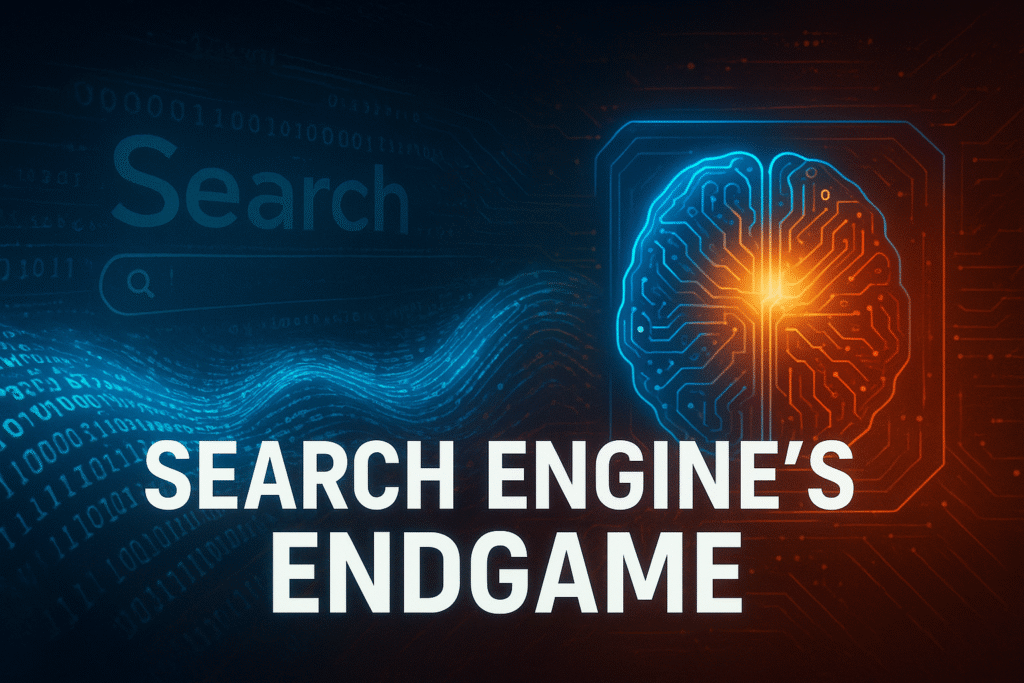
The search engine’s endgame is not the death of Google — it’s the death of the blue link. For thirty years, search worked the same way: enter a query, receive a list of links, click one. That model is being replaced by AI systems that synthesise answers, attribute sources, and eliminate the click for a growing share of queries. The question for every business with a digital presence is no longer how to rank — it’s how to remain visible in a search environment that increasingly doesn’t send traffic.
From Links to Answers: What Actually Changed
Google’s transition from link aggregator to answer engine began in 2012 with Knowledge Graph. It accelerated with Featured Snippets (2014) and language models BERT (2019) and MUM (2021) — each update making Google better at synthesising content rather than just matching keywords. The launch of AI Overviews in 2024 is the inflection point: for the first time, Google generates original text that answers queries directly, drawing from multiple sources, rather than just surfacing the best existing answer.
BrightEdge data shows AI Overviews now appear on over 85% of informational queries. For publishers ranking in positions 1–5, CTR has fallen 30–60% on those queries. The traffic exists — users are still searching — but Google is now the destination, not the gateway. For the full data, see our AI Overviews traffic analysis.
The Three Phases of Search’s Evolution
- Phase 1 (1998–2012): Directory model. Search engines indexed pages and ranked them by relevance signals. The user found content; the web received the traffic.
- Phase 2 (2012–2023): Answer integration. Knowledge panels, featured snippets, and People Also Ask answered simple queries directly. Zero-click search grew from 34% to over 60% of all searches by 2023.
- Phase 3 (2024–present): Generative synthesis. AI models generate complete answers from multiple sources. Citations appear, but the click is optional. Transactional and navigational queries still drive clicks; informational queries increasingly do not.
What This Means for Publishers and Content Sites
The revenue model for ad-supported content publishing — create informational content, rank for high-volume queries, monetise the traffic — is under structural pressure. The queries that drove the most traffic (“what is,” “how to,” “best way to”) are precisely the queries AI Overviews handle best. Publishers whose content is cited in Overviews receive a brand signal and occasional click-through from users seeking depth — but not the same volume that keyword ranking alone previously delivered.
The publishers adapting successfully are building assets that AI search cannot easily substitute: original research, primary data, practitioner expertise, tools, and community — things that a synthesising model can cite but cannot replicate.
What This Means for Businesses
For businesses using search as a discovery and marketing channel, the shift creates both risk and opportunity. The risk: prospects researching your category may get their questions answered by an AI Overview that doesn’t cite your content, reducing top-of-funnel visibility. The opportunity: businesses that become the consistently cited source in their domain earn a form of brand positioning that compounds over time — every citation is an implicit endorsement to every user who sees it.
Transactional intent — “buy,” “hire,” “pricing,” “compare” — still drives clicks. A business focused on capturing in-market buyers is less exposed to the AI Overview shift than a pure content publisher. The most exposed businesses are those relying on informational content as their primary acquisition strategy without a clear path from information to transaction.
How to Adapt: Five Priority Actions
- Shift content investment toward original insight. Publish primary research, case studies, and data that AI cannot synthesise — because the data doesn’t exist anywhere else yet.
- Optimise for AI citation, not just ranking. Structure content with direct answers in opening paragraphs, clear H2/H3 sub-questions, and strong E-E-A-T signals. See our guide to Generative Engine Optimisation for tactical detail.
- Build direct audience relationships. Email, community, and owned channels are not subject to AI Overview displacement. Traffic that comes to you directly is outside the zero-click dynamic entirely.
- Focus SEO on commercial and navigational intent. Queries where users need to choose, compare, or act still drive clicks. Double down on the queries that convert, not just those that generate impressions.
- Monitor GSC for the AI Overview fingerprint. Stable rankings with falling CTR is the signal. Address those pages first — they are your highest-opportunity pages for GEO restructuring.
Conclusion
search engine endgame redefining — Google’s dominance isn’t ending—it’s evolving. The question for businesses, creators and brands is not who wins the search game—but who adapts to its new rules.
Adapting to AI search means optimizing for answers, not just rankings — invest in structured data, trusted sources and multi-modal assets to remain discoverable.
The era of links and rankings is giving way to answers and action.
If you want to remain visible, relevant and trusted—now is the time to prepare for the new front of discovery.
“The search paradigm isn’t broken—it’s being rebuilt.”
For a broader look at how AI cycles mirror past tech booms, see our article What If AI Is the Next Dot-Com Bubble?.