
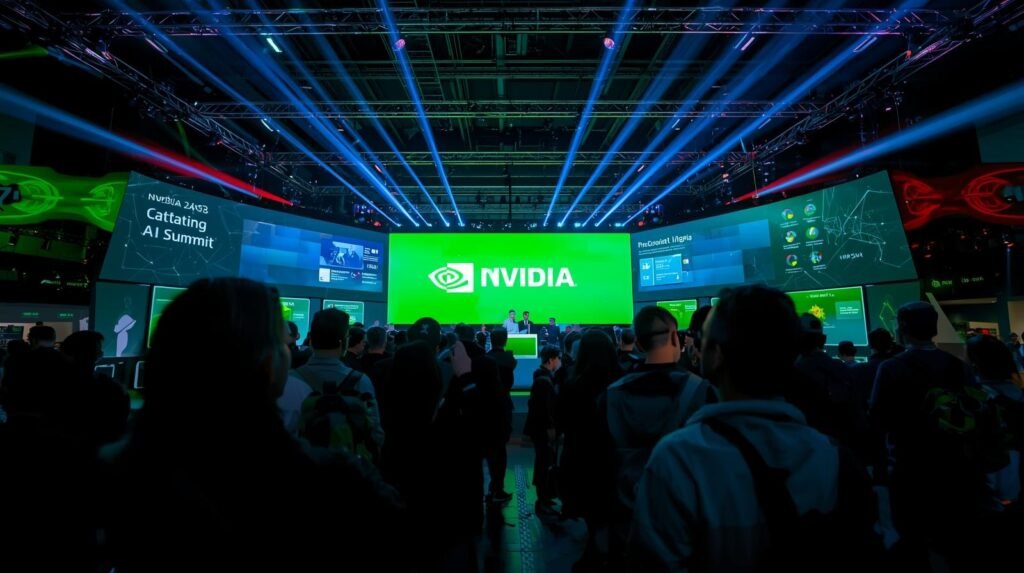
NVIDIA AI Summit Japan: Powering Japan’s Bold AI Future
Introduction: Japan’s AI Ambitions Take Center Stage
The NVIDIA AI Summit Japan has become one of the most important milestones in Japan’s artificial intelligence journey. It is more than a tech event. It is a signal of how serious Japan is about building an AI-powered future.
The summit brings together government leaders, researchers, startups, and global technology companies. They discuss how AI can reshape Japan’s economy, society, and core industries. From healthcare and mobility to robotics and manufacturing, AI is now part of Japan’s long-term growth story.
NVIDIA, known worldwide for its AI and GPU leadership, sits at the center of this strategy. Its platforms power many of the AI systems and models used in Japan today. At the summit, NVIDIA showcases how its hardware and software are enabling Japanese companies to build smarter products, faster services, and more efficient operations.
At the same time, the summit is not only about technology. It also addresses ethics, governance, data protection, and sustainability. Japan wants AI progress that supports people, protects rights, and reflects the country’s values.
In short, the NVIDIA AI Summit Japan is a snapshot of a nation that wants to lead in AI, not just follow it.
Japan’s Grand AI Vision
Japan is at a turning point. The country faces a mix of unique strengths and deep challenges. AI sits in the middle of both.
On one hand, Japan is famous for its engineering, robotics, and manufacturing quality. On the other hand, it faces an aging population and a shrinking workforce. AI is seen as a powerful tool to deal with this reality.
Key goals in Japan’s AI vision
Japan’s national AI vision focuses on:
Supporting an aging society with assistive robots, smart healthcare, and predictive systems
Boosting productivity in factories, logistics, and offices
Strengthening global competitiveness in cars, electronics, and industrial tech
Creating new industries around smart cities, mobility, and digital services
AI is not just about automation. It is also about keeping Japan’s economy dynamic in a world where demographics are shifting fast.
NVIDIA’s role in that vision
NVIDIA provides the compute backbone for many of these initiatives. Its GPUs, AI platforms, and SDKs power:
Research labs that train large models
Hospitals that use AI for imaging and diagnosis
Robots that navigate factories and homes
Autonomous vehicle platforms for Japanese automakers
NVIDIA also runs training and developer programs in Japan. By doing this, it helps build local AI talent and gives engineers direct access to cutting-edge tools.
Key Highlights from the NVIDIA AI Summit Japan
The latest NVIDIA AI Summit Japan focused on real-world deployments rather than just abstract demos. Several themes stood out.
1. AI for healthcare and aging society
Japan’s aging population is one of the biggest issues shaping policy and innovation. At the summit, NVIDIA and its partners showcased:
AI-assisted medical imaging that supports doctors in reading X-rays, MRI, and CT scans
Predictive models for early disease detection
Elderly monitoring systems using AI vision and sensors to detect falls, irregular patterns, or emergencies
These solutions aim to reduce the pressure on healthcare workers while improving outcomes for patients.
2. AI in education and research
Another focus area was education. NVIDIA announced and highlighted partnerships with universities across Japan to:
Build AI labs and supercomputing clusters
Train students on AI frameworks and tools
Support joint research in fields like robotics, smart cities, and environmental modeling
This investment in talent ensures that Japan has the workforce needed to sustain its AI growth.
3. Scaling AI infrastructure with GPUs
Finally, the summit reinforced the central role of NVIDIA GPUs in AI infrastructure. From data centers to edge devices, these GPUs power:
Large-scale model training
Real-time inference in factories, vehicles, and hospitals
High-performance computing for simulations and science
This hardware foundation enables Japan to execute its AI projects at scale.
Future Implications of the Japan–NVIDIA Collaboration
The relationship between Japan and NVIDIA is not limited to a single summit. It represents a long-term strategic partnership.
Transforming core industries
Several major sectors stand to benefit:
Automotive:
Japan’s auto giants already use NVIDIA platforms for driver-assistance systems and autonomous driving research. AI enables better perception, safer driving, and smarter in-car experiences.Manufacturing:
Smart factories can use AI to predict equipment failures, optimize workflows, and reduce waste. Combining sensors, robots, and AI turns traditional plants into flexible, data-driven systems.Logistics:
AI can optimize routes, warehouse operations, and inventory planning. This is vital for a country that relies heavily on efficient supply chains.
Building a robust AI ecosystem
The collaboration also supports:
Startups working on new AI applications
SMEs that want to embed AI into their tools and workflows
Public projects such as smart cities and digital government services
By aligning hardware, software, education, and policy, Japan and NVIDIA are building an ecosystem rather than isolated projects.
New AI Solutions for Healthcare
Healthcare was a central theme at the NVIDIA AI Summit Japan, especially in the context of Japan’s aging society.
AI in diagnostics
AI tools are now capable of:
Detecting anomalies in imaging scans
Flagging early signs of cancer or other diseases
Prioritizing critical cases for human review
These systems do not replace doctors. Instead, they act as intelligent assistants that reduce workload and improve accuracy.
Personalized treatment and predictive care
Using patient data, AI can:
Recommend more tailored treatment paths
Predict the risk of complications
Support long-term care planning
For elderly patients, predictive analytics can warn caregivers before a health condition becomes severe. That is vital in a system where doctors and nurses are already stretched.
AI for elderly support
The summit also highlighted AI tools for:
Home monitoring
Safety alerts
Social robots that help reduce isolation
The goal is to help older adults live independently for longer, with technology acting as a quiet safety net.
Partnerships with Japanese Universities
Universities are the engine of Japan’s long-term AI progress.
Research and development
NVIDIA collaborates with top institutions like:
The University of Tokyo
Keio University
Osaka University
(and others)
These partnerships focus on:
Robotics and autonomous systems
Smart city infrastructure
Climate, energy, and disaster modeling
New AI algorithms and architectures
With access to NVIDIA GPUs and AI platforms, researchers can move faster from concept to prototype.
Building AI talent
The partnerships are also about people:
Students learn with real-world tools, not just theory.
Professors co-develop curricula around modern AI frameworks.
Joint labs allow students to work on industry-grade projects.
This closes the gap between academic research and industry needs and helps Japan grow a strong AI workforce.
The Role of NVIDIA GPUs in Japan’s AI Development
At the technical core of all this progress sit NVIDIA GPUs.
Why GPUs matter for AI
AI training and inference require massive parallel computation. GPUs are designed to process many operations at once, which makes them ideal for:
Training deep neural networks
Running large language models
Processing video, sensor, and image data in real time
NVIDIA’s latest architectures, with Tensor Cores and specialized AI features, accelerate this even further.
Hardware plus software ecosystem
NVIDIA pairs its GPUs with a full software stack:
CUDA for parallel computing
cuDNN for deep learning
TensorRT for optimized inference
NVIDIA AI Enterprise for end-to-end workflows
This ecosystem allows Japanese developers to build, train, deploy, and scale AI models across clouds, data centers, and edge devices with less friction.
Transforming Industries with AI-Driven Innovations
Beyond healthcare and automotive, AI is touching almost every major industry in Japan.
Logistics and retail
AI optimizes delivery routes and warehouse layouts.
Computer vision tracks inventory in real time.
Recommendation systems personalize offers in e-commerce and physical stores.
Finance and insurance
Fraud detection models analyze patterns in transactions.
Risk models help insurers price products more accurately.
AI assistants support customer service and onboarding.
Agriculture and environment
AI helps monitor crops and soil conditions.
It assists with yield prediction and resource planning.
Environmental models help manage climate risks, floods, and natural disasters.
In each case, NVIDIA-powered AI systems allow companies to automate tasks, improve decision-making, and reduce waste.
Fostering a Strong AI Ecosystem in Japan
A single company or government cannot build an AI future alone. It requires a full ecosystem.
Elements of Japan’s AI ecosystem
Japan and NVIDIA are working to build:
Academic partnerships that push research and talent
Industry collaborations that turn ideas into products
Startup support through accelerators and grant programs
Government backing via policy, funding, and regulatory support
Events like the NVIDIA AI Summit Japan act as connectors. They help startups meet enterprises, researchers meet industry leaders, and policymakers learn from practitioners.
The aim is clear: make Japan not only a user of AI but also a creator of world-class AI technologies and solutions.
Conclusion: Japan’s Bold AI Future
Japan’s AI story is still being written, but the direction is clear. With strong industrial foundations, a deep engineering culture, and support from global partners like NVIDIA, the country is well-positioned to lead in AI innovation.
The NVIDIA AI Summit Japan shows what this future could look like:
Hospitals supported by intelligent diagnostic tools
Factories that adapt in real time
Cities that are safer and more efficient
Universities that produce world-class AI talent
At the same time, Japan is thinking carefully about ethics, privacy, and the human impact of AI. This balance of ambition and responsibility may become its greatest strength.
As AI continues to evolve, the collaboration between Japan and NVIDIA will likely shape not only Japan’s economy, but also global conversations about how AI should be built and used.