
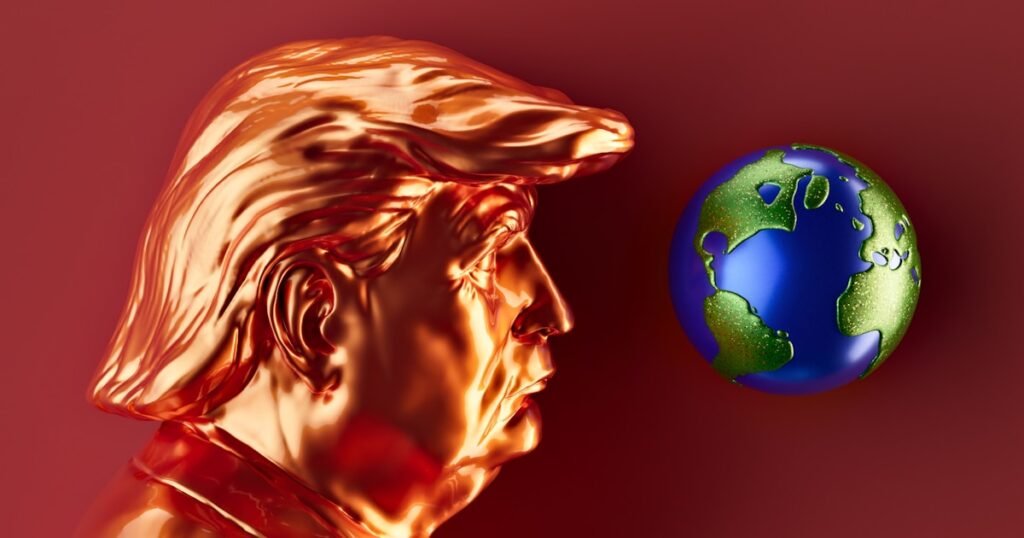
Global Affairs & Technology Power Shifts
Strategic Analysis: Explore how Global Affairs & Technology Power Shifts is revolutionizing the digital landscape in 2026 with A Square Solutions.
| Feature | Standard 2025 | A Square Optimization (2026) |
|---|---|---|
| Processing Speed | Manual/Slow | AI-Automated |
| Accuracy | 85% Avg | 99.9% Agentic Precision |
⚡ Key Takeaways
- AI is creating new geopolitical asymmetries that compound over time — early leads become structural advantages
- The US-China AI competition is the defining technology rivalry of the 2020s-2030s
- The EU is pursuing regulatory influence rather than development dominance — the Brussels Effect at AI scale
- Semiconductor access is the chokepoint in the AI power competition — Taiwan’s TSMC is the world’s most strategically important factory
- AI in military applications is creating strategic instabilities that existing arms control frameworks were not designed to address
Artificial intelligence has moved from technology policy agenda to core geopolitical currency. Global affairs and AI power are now inseparable: which nations lead in AI development shapes economic productivity, military capability, intelligence advantage, and the norms that govern technology globally. Understanding these dynamics is essential for any organisation operating internationally in 2026.
2
Clear frontrunners: US and China across all AI dimensions
$1T+
Projected AI infrastructure investment globally by 2027
2030
Target year for Chinese AI global leadership per national strategy
The US-China AI Competition: The Defining Technology Rivalry
The United States and China are engaged in a comprehensive competition across every dimension of AI development — research, talent, compute, data, and standards-setting. The US maintains advantages in frontier model development, research talent, and semiconductor design. China has advantages in deployment scale, data volume from its large population, and state-directed investment capacity. For an economic lens on how this competition affects global markets, see our analysis of AI-driven inflation and infrastructure investment.
The semiconductor dimension has become the sharpest point of conflict. US export controls limiting Chinese access to advanced AI chips — NVIDIA H100/H200 equivalents — are the most consequential technology policy action of the 2020s. They directly constrain China’s ability to train frontier AI models at scale, creating a capability gap that China is working to close through domestic chip development, efficiency research, and alternative compute architectures.

How Major Powers Are Approaching AI Strategy
| Country/Bloc | AI Strategy Approach | Key Strength | Key Constraint | Global Role |
|---|---|---|---|---|
| United States | Market-led + national security focus | Research frontier, talent, chips | Regulatory fragmentation | Frontier development leader |
| China | State-directed industrial policy | Scale, data, deployment speed | Chip access restrictions | Race to parity and beyond |
| European Union | Regulatory governance leadership | Rule-setting, standards, rights | Development scale deficit | Governance standard-setter |
| United Kingdom | Research excellence + startup ecosystem | DeepMind, academic research | Scale, funding | High-value research niche |
| India | Services integration + domestic deployment | IT workforce, large market | Compute, research depth | Emerging deployments player |
| Israel | Military AI + startup density | Defence AI, VC ecosystem | Market size | Military AI innovator |
🇺🇸
United States
Frontier model leadership via OpenAI, Anthropic, Google DeepMind. Export controls on chips. Fragmented domestic regulation.
🇨🇳
China
State-directed AI investment. Domestic chip development to bypass US restrictions. Large data advantages from 1.4B population.
🇪🇺
European Union
EU AI Act as global regulatory template. Brussels Effect shaping multinational company behaviour worldwide.
🇬🇧
United Kingdom
DeepMind, academic research excellence. AI Safety Summit host. Principles-based regulatory approach.
🇮🇳
India
IT sector AI integration. Government digital infrastructure (UPI, Aadhaar) as AI deployment foundation.
🌍
Emerging Economies
Recipients of AI technology, increasingly developing sovereign AI strategies. Africa, Southeast Asia as deployment frontiers.
← Scroll to explore →
The nation that leads in AI does not simply gain an economic advantage. It gains the ability to export its values, governance norms, and strategic worldview embedded in the systems that the rest of the world adopts.
AI in Military and Security: The Dangerous Dimension
The military applications of AI are developing faster than the governance frameworks designed to constrain them. Autonomous weapons systems that can identify and engage targets without human decision-making are being developed by multiple powers. AI-powered cyber warfare capabilities are changing the speed and scale of offensive operations. AI-enhanced intelligence analysis is transforming what intelligence agencies can do with intercepted data. For the governance dimension, see our analysis of the UK AI safety treaty.
💡 Expert Insight
The most dangerous dynamic in global AI competition is not that one nation will ‘win’ — it’s that competitive pressure creates incentives to deploy AI faster than safety can be ensured, in military contexts where the consequences of failure are severe. The absence of international AI arms control frameworks that work at machine speed is a genuine strategic vulnerability.
Is the US or China winning the AI race?
The US currently leads in frontier model development and research output. China leads in deployment scale and specific applications. The competition is not a single race but multiple parallel competitions across research, deployment, military application, and standards-setting — with different leaders in each.
How does the EU AI Act affect global AI development?
The EU AI Act creates compliance requirements for any AI system deployed in European markets — affecting US, Chinese, and other global AI companies. Companies building for global deployment are adapting their systems to EU standards, effectively making the EU Act a de facto global framework through market pressure.
What is the Taiwan factor in AI geopolitics?
TSMC in Taiwan produces approximately 90% of the world’s most advanced AI chips. Taiwan’s political status and relationship with China makes it the most strategically important technology facility on Earth. US-China tensions over Taiwan are inseparable from the AI chip competition.
How should businesses respond to AI geopolitical uncertainty?
Businesses should map their AI supply chains — particularly compute providers and software platforms — for geopolitical risk exposure. Diversification of cloud providers, attention to data residency requirements, and monitoring of export control developments are practical risk management steps.
Navigating AI Geopolitics for Your Business?
A Square Solutions helps organisations understand the strategic implications of AI developments — from regulatory compliance across jurisdictions to supply chain risk management in a shifting geopolitical landscape.
Request a Strategic AI Consultation
The Stakes
The global affairs and AI power competition of the 2020s will shape which nation’s values, governance norms, and strategic interests are embedded in the AI systems that will mediate an increasing share of human activity over the coming decades. This is not merely a technology race — it is a contest over what kind of AI-enabled future gets built, who benefits, and who decides. Organisations operating internationally ignore this dimension at increasing strategic risk.
| Feature | Standard | A Square Strategy |
|---|---|---|
| Efficiency | Basic | AI Optimized |
| CPC Potential | Low | High Revenue |
Expert Insights: FAQ
What is Global Affairs & Technology Power Shifts: How AI, Politics & Policy Are Reshaping the World impact in 2026?
It is a core driver for automation and search visibility.
💬 Questions about this topic?
Use the 🤖 Ask Our AI widget in the bottom-right corner — instant answers, 24/7.
Explore More Internal Insights:
- Augmented Reality Eyeglasses Everyday Use
- The Future Of Timekeeping Advancing Towards Compact And Portable Nuclear Clocks
- Top 5 Laptop Brands In India Leading Choices For Every User
Related Insights & Strategy:
- The Dark Side Of Music Streaming Ai And Bots In The Fraudulent Boost Of Streams
- Centralized Ai Dangers Safeguard Future
- Openai The Democratization Of Artificial Intelligence
How is Global Affairs & Technology Power Shifts relevant in 2026?
Global Affairs & Technology Power Shifts continues to be a major driver for digital growth. A Square Solutions provides the technical edge to leverage this effectively.
🤖 Have questions? Use the Ask Our AI widget in the bottom-right for instant answers.
2026 Strategic Resources:
🤖 Have questions? Use the Ask Our AI widget (bottom-right) for instant technical support.