
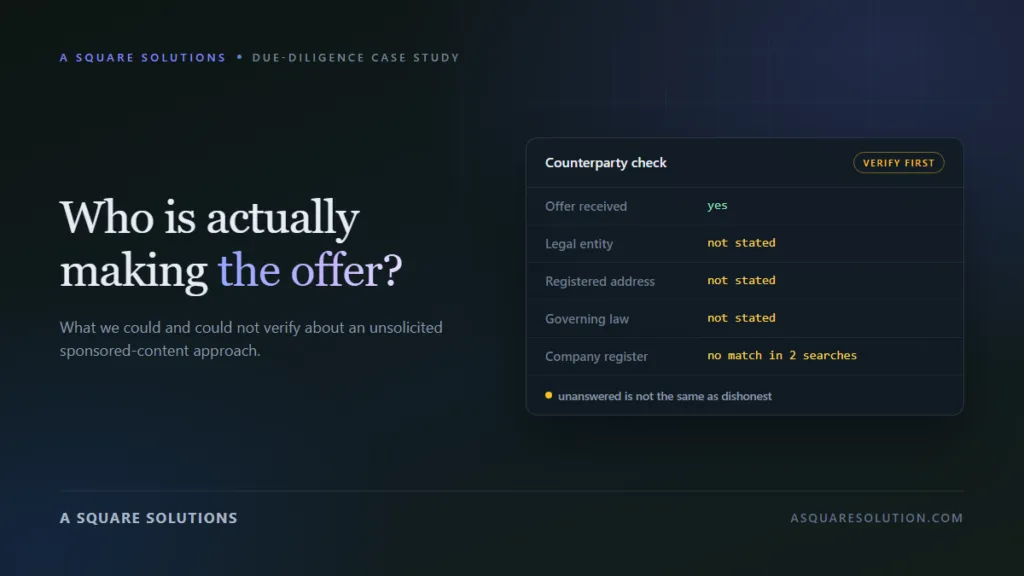
In late September 2026, two unsolicited sponsored-content approaches reached our business inbox. Before answering either one, we tried to establish a simple thing: who would we actually be dealing with? This is what we checked, what we could verify, and what we still cannot say.
A paid article sounds like easy money for a small publisher. Someone else writes it, you publish it, and a fee arrives. Most of these approaches are ordinary marketing outreach, and a sponsored content offer is not a warning sign in itself.
But a paid placement is still a business deal. It puts another company’s message in front of your readers, under your name. So the first question is not “how much?” It is “who is the other party?”
This is a first-person case study, not a verdict. Throughout, we separate four things: what we observed directly, what we checked in public records, what we infer, and what remains unresolved. We are not accusing any person or business of wrongdoing, and nothing we found shows that anyone broke a law.
How the offers arrived
On 29 September 2026, an email reached our public contact address from a sender using an address on the domain contelink.com. By 30 September, a second approach had arrived from an address on a different domain, nextalias.com. We are not publishing the senders’ names or their individual addresses.
The first message offered to supply a researched, original article written to suit our audience. It asked whether we accept guest posts or sponsored content, and it asked for three things: our publishing guidelines, our pricing and our turnaround time.
Two details stood out straight away:
- The subject line was unfinished. It read “Content Partnership with” and stopped there. The opening sentence had the same gap, at the point where a website name would normally sit.
- It named no advertiser, no topic and no budget. It asked for our price before saying who would be paying.
Our inference from the unfinished subject line is that the message came from a template sent to many sites. That is common in outreach and proves nothing bad on its own. It did tell us the approach was not written for us in particular.
The first message did not ask us for money, passwords or account access. We mention that because it matters: this was not a request for payment. This case study relies on that first message and on the two public websites. We do not quote the second message.
What the two websites say they are
We read the two websites on 29 and 30 September 2026 and saved fresh copies of the pages on 1 October 2026. Everything in this section is what the sites themselves state.
Both present themselves as outreach agencies that place guest posts and sponsored articles for brands. The page titles describe one as a “white label” outreach business and the other as an outreach partner. Both list the same six services, and both publish a page inviting website owners to join a publisher network.
According to those pages, publishers are paid per accepted placement, there is no fee to join, and payment follows seven days after a published article is confirmed. The stated payment methods are PayPal, bank transfer and USDT, a cryptocurrency. The publisher policy says the network accepts followed, nofollow or sponsored link labelling, according to the publisher’s own policy, and that paid content must be disclosed.
Both sites also publish the same price list for advertisers: three tiers, at $80, $150 and $280 per placement, set by a third-party authority score for the publishing site. Those are the prices a brand would pay the agency. Neither site states what a publisher receives.
Both sites state that they work with more than 3,200 verified publishers and report a 98% client satisfaction rate. We found no independent source for either figure, so we treat them as the sites’ own claims.
None of this is improper in itself. Paying a publisher for a clearly labelled sponsored article is a normal part of online advertising. Google’s guidance says paid links should be marked with rel="sponsored", and its spam policies treat buying or selling links for ranking purposes as link spam unless the links are qualified in that way. The outbound links guide explains the labels.
What we checked about identity
We wanted to know which legal person we would be contracting with, where it is registered, and which law would apply if something went wrong. These are the checks we ran and what each one returned.
| What we looked for | First site (contelink.com) | Second site (nextalias.com) |
|---|---|---|
| Legal entity name or company number | Not stated on the pages we read | Not stated on the pages we read |
| Postal address or phone number | Not stated on the pages we read | Not stated on the pages we read |
| Governing law in the terms | No governing-law or jurisdiction clause found | No governing-law or jurisdiction clause found |
| Privacy policy | Published. It names no company or address | The footer link returned “page not found” (HTTP 404) on 30 September and again on 1 October 2026 |
| Contact page | Published | The site’s own contact link returned HTTP 404 on 1 October 2026 |
| Named staff | Team shown by single initials and job titles | Team shown by single initials and job titles |
| Domain registration | Registered 22 June 2024. Registrant name withheld | Registered 25 July 2025. Registrant hidden behind a privacy service |
A missing page is only a missing page. We report the 404 results as observations on those dates. We do not know why the pages were absent, and they may have been restored since.
Domain records. Public registry data showed different registrars for the two domains and no registrant name for either. For the first domain, the registrar’s own record lists the registrant’s country as Pakistan, with the name withheld. That is information the registrant supplied. It is not independently verified, and it tells us where a registrant said they are, not where a company is incorporated. For the second domain, our 30 September lookup showed a privacy service in place of the registrant. On 1 October the registrar’s lookup server did not respond, so we could not repeat that check.
Company registers. We ran two name searches, on 30 September and again on 1 October 2026:
- UK Companies House, the official register of UK companies. A search for each of the two brand names returned zero results.
- OpenCorporates, a public database that gathers company records from many national registers. A search for each brand name returned zero companies.
We also tried the online name search of Pakistan’s corporate regulator, the SECP, because of the country shown in the domain record. We could not retrieve results from that portal, so that check was not completed.
These searches are narrow, and we want to be exact about what they mean. They show that neither brand name appeared in those two databases on those dates. They do not show that no legal entity exists. A business can trade under a brand that differs from its registered name. It can be registered in a country we did not search. It can be a sole trader, which many company registers do not list at all.
We did not ask. We did not contact either sender or either website. So neither has had the chance to tell us its registered name, and nothing here should be read as a refusal on their part.
How the two websites are connected
The two approaches came from different domains with different names. When we compared the public source code of the two websites, we found that they are closely linked. Each point below is something we observed directly in the pages as served on 30 September and 1 October 2026.
- The same theme folder. Both sites load their design from a WordPress theme folder named
contelink-theme. The stylesheet identifier and the page body class are identical on both. - The same logo drawing. Both sites use the same inline vector graphic for the logo mark.
- The first brand’s name on the second site. The footer of the second site carried a copyright line in the first brand’s name. Its home page had a section headed “Why Contelink”, and its three customer testimonials each named the first brand.
- The first brand’s mailbox on the second site. On the second site’s two publisher pages, the address given for joining the network was a
partnerships@mailbox on the first site’s domain. - The first brand in the second site’s terms. The terms and conditions on the second site opened by binding the reader to the first brand’s website and services, by name.
- The same commercial terms. The price list, the publisher payment terms and the publisher policy text matched across the two sites.
- The same nameserver pair. Both domains use the same two Cloudflare nameservers.
The sites also differ. They use different registrars, they were registered about thirteen months apart, and their email is set up through different providers.
What those connections do and do not show
Taken together, the observations support one firm statement: on those dates, the second website carried the first brand’s theme, text and contact details, and still pointed publishers to the first brand. A publisher who applied through the second site would have been writing to the first brand’s mailbox and agreeing to terms in the first brand’s name.
They do not tell us why. Several ordinary explanations fit:
- one business running two brands;
- a white-label or reseller arrangement, which is the model the first site’s own title describes;
- a shared developer or template, with an unfinished rebrand;
- one site copied from the other.
We cannot tell these apart from the outside. A shared theme and shared text do not prove common ownership. The matching nameservers are consistent with one hosting account, but separate accounts can be given the same pair, so that point is supporting detail and nothing more. None of it shows bad intent.
What it did change, for us, was the value of the second approach. It was not independent confirmation of the first. And it left an open question: if we had agreed terms with the second brand, which business would have been bound by them?
What we could not verify
- Who operates either website. We found no named person or registered company for either.
- Whether the two brands share an owner. The technical links are real. Their explanation is unknown.
- Whether a registered entity exists. Our register searches were limited to the two databases named above.
- The figures the sites publish. We could not confirm the publisher count, the satisfaction rate or the anonymised case studies.
- Who the advertiser would have been. Neither approach named an end client.
- How either party would have behaved. We never negotiated, so we do not know what would have been offered, whether sponsored labelling would have been accepted, or whether payment would have arrived.
- Email authentication. We did not keep a record of the technical authentication results for the two messages, so we make no claim about them.
Why we chose not to proceed
We decided not to reply to either message and not to take the offer further. The reason was not a finding of wrongdoing. It was the absence of answers to basic questions.
We could not name the other party. With no legal entity, no country and no address, there was nobody to put on an invoice or a contract.
The published terms pay in arrears. Payment seven days after publication means the publisher delivers first. With a business we could identify, that is a normal credit risk. With one we could not identify, there would be no clear route to follow up a missed payment.
The written terms named a different brand. On the second site, the only published terms referred to the first brand.
Our readers come here for scam-prevention advice. A sponsored link from this site is a recommendation of sorts. We are not willing to make one for an advertiser we cannot name, on behalf of an intermediary we cannot identify.
Another publisher could reasonably decide differently, or reply with questions first. With a named advertiser and a registered counterparty, we might have too.
A due-diligence checklist for sponsored-content offers
Most of these checks are free and take only a few minutes each.
- Ask who you are contracting with. Get the full legal name, the country of registration, the registration number and a postal address, in writing.
- Look the entity up yourself. Use the official company register of the country they name. Do not rely on a link they send.
- Read the terms on their website. Check which business the terms name and whether they state a governing law.
- Open the policy pages. A privacy policy and a contact page should exist and should identify the business.
- Check the domain record. A public lookup such as the ICANN registration data tool shows when a domain was registered. Treat it as context, not proof.
- Ask who the advertiser is. You are lending your reputation to the end client, not to the agency.
- Agree the link labelling first. Confirm in writing that paid links will carry
rel="sponsored"and that the article will be visibly labelled as sponsored. - Settle payment terms before you publish. Know who pays, by what method and when. For a first deal with an unknown party, payment in advance removes the main risk. If cryptocurrency is proposed, ask your accountant first.
- Keep control of your own site. You publish the article yourself. Nobody needs a login, a tracking script or access to your analytics to buy a sponsored post.
- Save what you see. Keep dated copies of the pages and messages you relied on. Websites change.
- Decide your own threshold in advance. Ours is simple: if we cannot name the counterparty, we do not proceed.
Not sure what to make of an unexpected business email?
Paste the text into ScamCheck’s email checker for a free second opinion on the wording, or run any address it contains through the link checker. Neither tool can tell you who is behind a business. That part still needs the checks above.
What remains unproven
This matters more than a confident-sounding verdict.
Directly observed: the wording of the first message; the public pages, source code, terms and policies of both websites on 29 and 30 September and 1 October 2026; and the HTTP 404 responses on the dates given.
Checked in public records: domain registration and DNS records for both domains, and name searches on UK Companies House and OpenCorporates on 30 September and 1 October 2026.
Our inference: that the first message was templated outreach, and that the second website was derived from the first and had not been fully rebranded. Both conclusions rest on several observations pointing the same way.
Still unknown: who owns or operates either site; whether they are one business, partners or unrelated users of the same material; whether either is a registered company somewhere we did not search; and what would have happened had we replied. We saw no payment request and no request for credentials in the first message.
Final takeaway
What a placement might pay was never the interesting question. The interesting part was how quickly we reached the limits of what we could confirm, using nothing more than two websites and a handful of public records.
An offer does not have to be fraudulent to be one you should decline. If you cannot say who you are dealing with, you cannot say what you are agreeing to.
Frequently asked questions
Is an unsolicited sponsored-content offer a scam?
Not usually. Paying publishers for sponsored articles is a normal part of online marketing, and most approaches are routine outreach. The point of checking is to find out who you would be dealing with and on what terms, before you agree to anything.
What should I verify before accepting a sponsored post?
Confirm the legal name and country of the business paying you, the name of the end advertiser, the exact links and how they will be labelled, and the payment terms. Get each of these in writing before you publish.
If two websites share the same design and text, are they the same company?
Not necessarily. Shared code and wording can come from common ownership, a reseller arrangement, a shared developer or simple copying. It shows the sites are connected. It does not show who owns them.
Does a company-register search with no results mean a business is not real?
No. It means that name was not in that register on that date. The business may be registered under a different name, in another country, or as a sole trader that the register does not list.
Do paid links have to be labelled?
Google’s guidance says links that are advertisements or paid placements should be marked with the sponsored attribute, and that nofollow is also acceptable. Many countries also have advertising rules that require paid content to be disclosed to readers.
Is it risky to reply to an offer like this?
A plain-text reply does not give anyone access to your website or accounts. The risks come later, from opening attachments, following links, sharing logins or publishing before you have been paid. You can ask questions safely if you keep to those limits.
Disclaimer: This case study documents what we observed on two public websites and in public records on the dates stated. It does not establish that any named business or any individual acted unlawfully or dishonestly, and it does not establish who owns or operates either website. We did not contact the parties, so they have not had the opportunity to respond. If either business sends us registration details or a correction, we will review it and update this article. Senders’ names and addresses have been withheld. This article is educational and is not legal advice. See our disclaimer.
Related reading: The vendor registration invite that failed verification · The web design lead that didn’t survive a background check · How we spotted three fake hosting billing emails · How to check any link before you click · How we built ScamCheck, our AI scam detection platform
Run an online business that handles supplier onboarding or partner checks? We build fraud-prevention and verification automation for exactly these checks.