
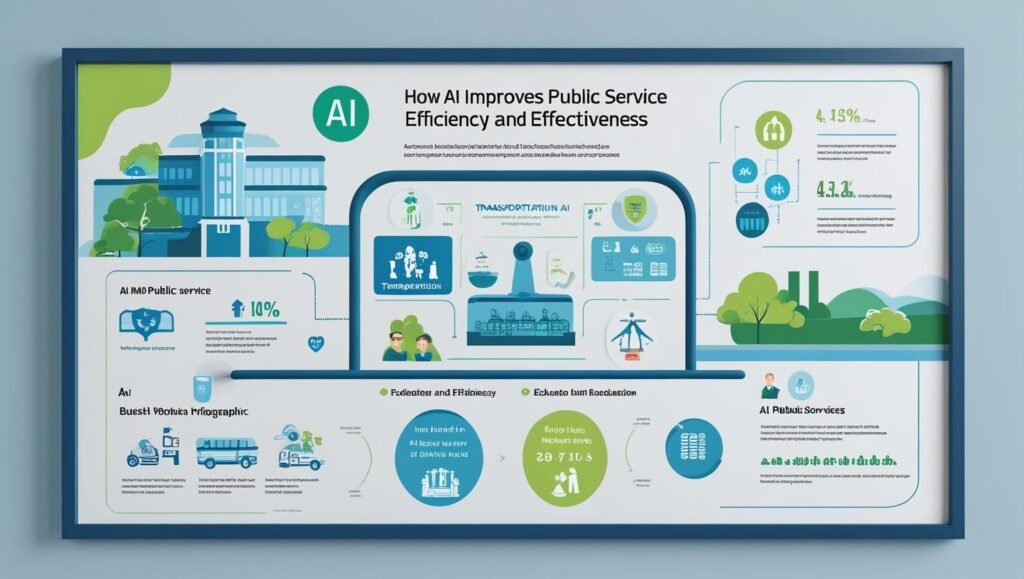
can improve efficiency effectiveness —
How AI can Improve the Efficiency and Effectiveness of Public Services
📚 Further Reading

Governments worldwide are moving beyond digitization toward intelligent service delivery models powered by artificial intelligence. Instead of simply putting forms online, agencies are deploying predictive analytics, automation workflows, and real-time citizen data systems to optimize how services are designed, delivered, and improved.
⚙️ Automating Administrative Workflows
AI-driven automation reduces processing time while improving compliance accuracy across high-volume government operations.
📊 Predictive Resource Allocation
🌐 Citizen Access Through Conversational Interfaces
AI chat systems now act as the first layer of government interaction, reducing dependency on physical offices while improving response consistency.
One of the key ways that AI can improve public services is by automating repetitive and time-consuming tasks. This can free up public sector employees to focus on more complex and value-added tasks, such as interacting with citizens, developing new policies, and providing strategic advice.
how AI enables personalized governance models
For example, AI is already being used to automate tasks such as processing tax returns, issuing permits, and managing social benefits programs. This has led to significant savings in time and money, and to improved accuracy and speed of service delivery.
AI can also be used to improve the accuracy and speed of decision-making in the public sector. For example, AI can be used to analyze large amounts of data to identify trends and patterns, and to develop predictive models. This information can then be used to make more informed decisions about how to allocate resources, target services, and prevent problems.
AI applications addressing broader societal challenges
For example, AI is already being used to predict crime rates, identify students at risk of dropping out of school, and develop preventive healthcare programs. This has led to improved outcomes for citizens and to a more efficient and effective use of public resources.
Here are a few specific examples of how AI is being used to improve the efficiency and effectiveness of public services around the world:
- In the United States, the Internal Revenue Service (IRS) is using AI to automate the processing of tax returns. This has helped the IRS to reduce the backlog of tax returns and to improve the accuracy of tax refunds.
- In Canada, the city of Toronto is using AI to predict and respond to traffic congestion. This has helped to reduce travel times and improve the efficiency of the city’s transportation system.
- In the United Kingdom, the National Health Service (NHS) is using AI to develop new diagnostic tools and treatments for diseases. This has helped to improve the quality of care for patients and to reduce the cost of healthcare.
- In Estonia, the government has developed an AI-powered chatbot called e-Estonia that can provide citizens with information about a variety of government services. This has made it easier for citizens to access the services that they need and has improved the efficiency of government service delivery.
These are just a few examples of the many ways that AI is being used to improve the efficiency and effectiveness of public services. As AI continues to develop, we can expect to see even more innovative and transformative applications of AI in the public sector.
Public-sector transformation increasingly depends on scalable digital infrastructure, data engineering, and automation design delivered through specialized technology partners.
Learn how AI-led digital solutions are implemented.
Overall, AI has the potential to revolutionize the way that public services are delivered, making them more efficient, effective, and responsive to the needs of citizens. By automating repetitive tasks, improving decision-making, and developing new tools and services, AI can help to create a more equitable and prosperous society for everyone.