piloting robot iss —
🤖 AI Piloting Robot on ISS: A Historic Leap for Space Robotics
📚 Further Reading
📚 Related:
brain-computer interfacesquantum information breakthroughsmushroom-powered computersgravitational wave research
AI piloting robot on ISS has officially marked a turning point in space exploration.
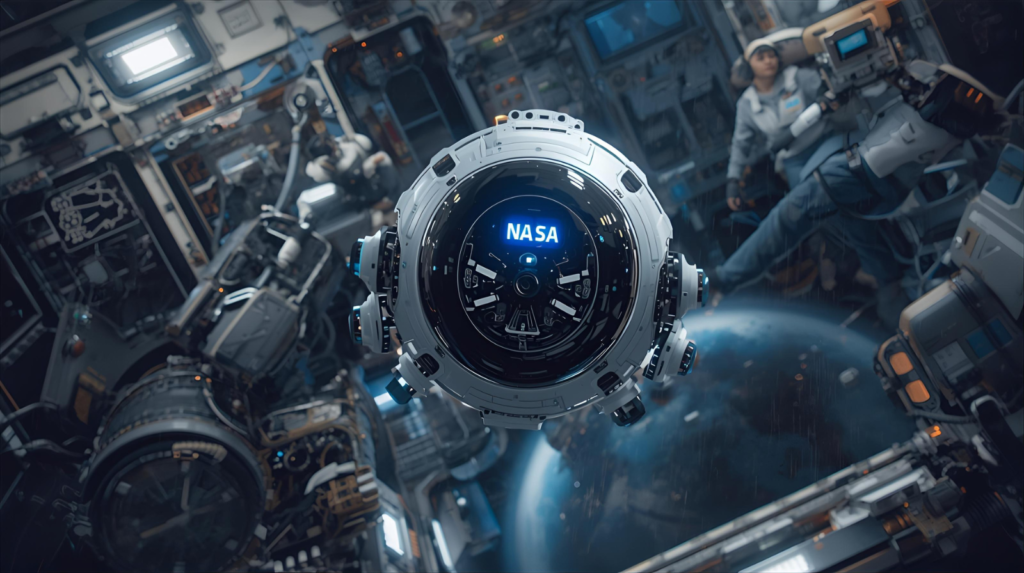
For the first time, artificial intelligence has successfully piloted a free-flying robot aboard the International Space Station (ISS) without direct human control. This breakthrough signals the beginning of true autonomous space robotics, where machines can think, navigate, and act independently in orbit.
The achievement is being hailed as a milestone for future space missions, deep-space exploration, and long-duration human presence beyond Earth.
🚀 What Is the Free-Flying Robot on the ISS?
The robot involved is a free-flying assistant, designed to move independently inside the ISS without wheels or tracks. Instead, it uses propulsion systems and sensors to navigate the station’s microgravity environment.
Previously, astronauts manually controlled such robots. With AI piloting robot on ISS, the system can now:
Navigate complex interiors autonomously
Avoid obstacles and crew members
Respond to real-time environmental changes
This reduces astronaut workload and increases operational efficiency.
🧠 How AI Pilots a Robot in Space
The AI system combines:
Computer vision
Reinforcement learning
Real-time sensor fusion
By analyzing camera feeds and spatial data, the AI makes split-second decisions on movement and orientation. Unlike Earth-based robots, space robots must adapt to microgravity, confined environments, and constant motion.
This same class of AI-driven decision-making is also reshaping autonomous systems on Earth, as explained in Agentic AI Systems
🛰️ Why This Breakthrough Matters
The success of AI piloting robot on ISS goes far beyond one experiment.
Key implications include:
Reduced astronaut cognitive load
Faster response to emergencies
Continuous monitoring of station systems
Autonomous maintenance and inspections
NASA and international partners see this as a foundational step toward AI-driven space infrastructure.
According to NASA’s official research on AI in space systems
AI autonomy is essential for missions where communication delays make human control impractical.
🌌 Preparing for Deep-Space Missions
As missions extend to the Moon, Mars, and beyond, communication delays can stretch from minutes to hours. Human operators cannot pilot robots in real time.
That’s where AI piloting robot on ISS becomes a testbed for:
Lunar habitat maintenance
Mars station operations
Autonomous cargo handling
Similar AI-powered space intelligence is already being used in planetary discovery, as seen in AI Discovering Exoplanets
🤖 AI + Robotics = The Future of Space Work
Space agencies increasingly rely on AI-robot collaboration:
Robots handle repetitive or dangerous tasks
Humans focus on research and strategy
This mirrors trends on Earth, where AI systems now dominate data-heavy tasks — a shift discussed in AI Now Writes Most of the Internet
⚠️ Challenges and Risks
Despite its promise, autonomous space robotics faces challenges:
Software reliability in extreme environments
AI decision transparency
Cybersecurity risks in orbit
For now, humans remain in the loop for supervision and override. Full autonomy will require years of testing and refinement.
🔮 What Comes Next?
Following the success of AI piloting robot on ISS, future developments may include:
AI-controlled robotic arms
Autonomous spacewalk assistance
Self-repairing orbital stations
Fully robotic deep-space probes
The ISS continues to serve as humanity’s proving ground for technologies that will define the next era of space exploration.
🧠 Final Thoughts
AI piloting robot on ISS is more than a technical experiment — it’s a glimpse into a future where artificial intelligence and robotics operate as trusted partners in space.
As humanity pushes farther into the cosmos, autonomy will no longer be optional. It will be essential.
The age of intelligent space machines has officially begun.