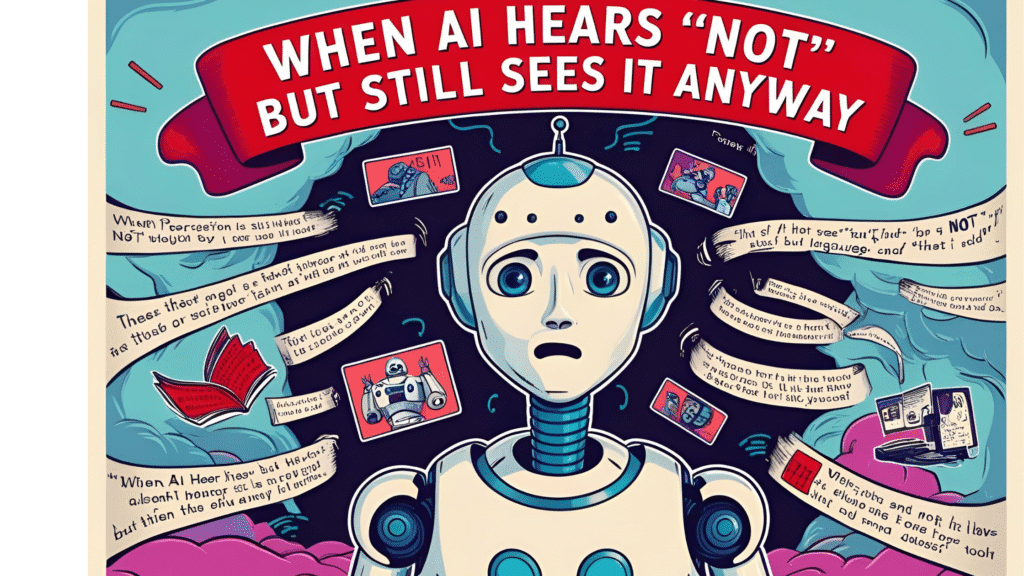
hears not still sees — But recent research by MIT’s Computer Science and Artificial Intelligence Laboratory (CSAIL) revealed something alarming:
These systems, as intelligent as they may seem, consistently fail to understand negation words like “not” and “no.”
That’s right — if you ask these models to show an X-ray without tumors, chances are, it might still show you one with tumors.
This AI negation blind spot shows that even advanced vision-language models can miss simple logical cues and behave unexpectedly. Until we solve this AI negation blind spot, deploying vision-language models in high-stakes environments will always carry hidden risk.
🔍 What Are Vision-Language Models?
VLMs combine computer vision (understanding images) with natural language processing (understanding text). They’re trained to:
Caption images (e.g., “A cat sitting on a couch”)
Answer questions about pictures (e.g., “What is the man doing?”)
Retrieve specific images from a database based on descriptions
But the new research points out that these models don’t actually understand logic — especially when it comes to negation.
❗ The Core Finding: “No” Gets Ignored
MIT’s team tested six top-tier models — BLIP, GIT, ALBEF, ViLT, SimVLM, and CLIP — using real-world medical image datasets. They posed queries like:
“Show a chest scan with fluid but not a mass.”
“Find an X-ray showing pneumonia but no fibrosis.”
Shocking result:
In 79% of the tests, the models returned images that included the very object the user explicitly said to exclude — a classic case of AI hallucinations and misinterpretation.
📊 Visual Evidence: How Negation Impacts Accuracy
To visualize the findings, the chart below compares how models perform on negated queries with and without a special negation-handling module:
As you can see, every model significantly improves when equipped with the negation reasoning module. For example, ALBEF’s accuracy jumped from 24% to 50%.
🏥 Why This Matters in Healthcare and Beyond
In domains like medicine, these errors aren’t just technical bugs — they can be life-threatening.
In diagnostics: “No signs of fracture” vs. “fracture present” are fundamentally different.
In clinical decision-making: Misinterpreting “no cancer” can lead to wrong treatment.
In safety-critical applications: From self-driving cars to military drones, misreading negation can cause irreversible damage.
These models are not just tools — they are decision-making aids that must be trustworthy.
🧠 Why Can’t AI Understand Negation?
This isn’t about lazy coding — it’s about how current AI learns:
| Cause | Explanation |
|---|---|
| Imbalanced data | Most training datasets focus on what is present, not what is absent. |
| Surface-level learning | VLMs match images based on keywords, not logical structure. |
| Lack of symbolic logic | Unlike humans, they don’t process language like “NOT this AND that.” |
This makes them vulnerable to semantic illusions — they ‘see’ based on pattern recognition, not comprehension, highlighting limits on the path to AGI.
🛠️ The Fix: A Plug-In for Logic
Researchers didn’t just identify the problem — they proposed a solution.
They created a lightweight logic module trained to interpret negation, conjunctions (AND), and disjunctions (OR).
🔄 What Changed?
✅ Accuracy rose by 25–30% on negated queries
✅ The module plugged into existing models — no full retraining needed
✅ Worked across various datasets, proving generalizability
This makes it a scalable patch for improving real-world reliability in AI systems.
🌐 #KnowledgeIsPower: A Wake-Up Call for AI Developers
This study highlights a critical lesson: Advancing AI is not just about bigger models — it’s about ethical and human-aligned understanding.
If we want AI to work with us in critical settings — from hospitals to homes — it needs to understand language the way we do. Especially when it comes to small words that carry massive meaning.
🔍 Recommendations for Developers and Researchers
If you’re building VLMs, keep these guidelines in mind:
Test your models for logical queries, not just keyword matches
Balance training sets with negation and edge cases
Incorporate symbolic logic layers or hybrid models
Use explainability tools to trace where logic fails
💬 Let’s Talk: What Do You Think?
We’d love to hear your thoughts.
Should AI be used in high-stakes decisions before it understands language logic?
What other linguistic gaps might models struggle with?
👇 Comment your thoughts, share this article, and help us bring more awareness to the reality of current AI systems.