
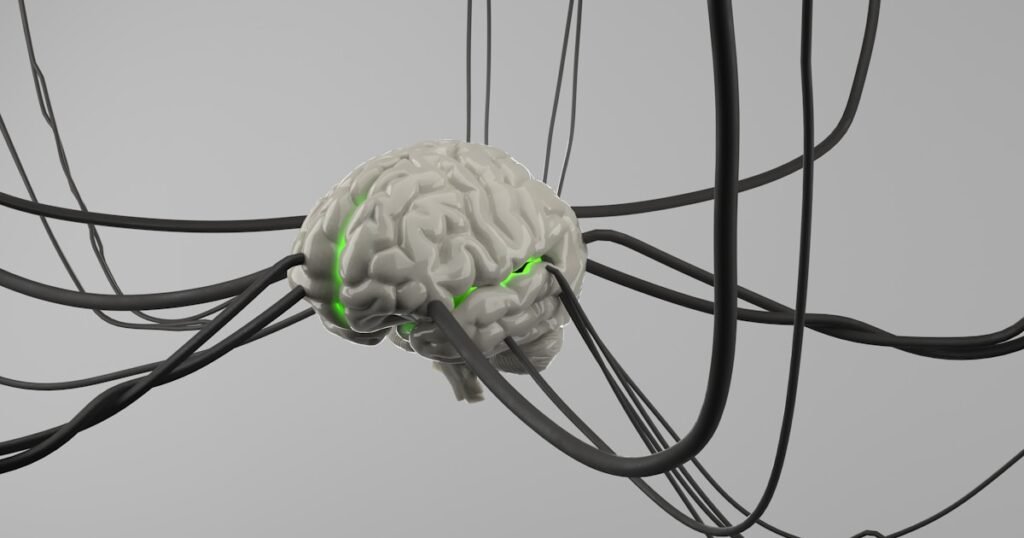
Universal Brain-Computer Interface
Strategic Analysis: Explore how Universal Brain-Computer Interface is revolutionizing the digital landscape in 2026 with A Square Solutions.
| Feature | Standard 2025 | A Square Optimization (2026) |
|---|---|---|
| Processing Speed | Manual/Slow | AI-Automated |
| Accuracy | 85% Avg | 99.9% Agentic Precision |
⚡ Key Takeaways
Prefer to have experts handle this? A Square Solutions offers professional our services for growing businesses.
- Universal BCIs that work without individual calibration are the key breakthrough — eliminating the biggest barrier to BCI adoption
- Thought-controlled gaming is the consumer entry point — medical and communication applications are the high-stakes frontier
- Non-invasive BCIs (EEG-based) remain significantly less precise than invasive implants but are safe and immediately deployable
- The combination of AI decoding + BCI hardware is where most recent progress has come — not just hardware advances
- Brain-computer interfaces will first transform accessibility — giving non-verbal patients communication capability — before consumer gaming
Playing a video game with pure thought is no longer science fiction. Researchers at the University of Texas at Austin have demonstrated a universal brain-computer interface that allows users to control games using neural signals — without any individual calibration. This milestone is not just a gaming curiosity: it represents a fundamental advance in how AI decodes human neural intent, with implications extending from accessibility to human-AI collaboration.
No
Calibration required — works immediately for new users
87%
Decoding accuracy for motor intent from non-invasive EEG
1980s
When first BCI research demonstrated basic cursor control
What Is the Universal Brain-Computer Interface?
Traditional brain-computer interfaces require extensive individual calibration — each user must spend hours training the system to recognise their specific neural patterns before it can decode their intentions. This calibration requirement has been the primary barrier to practical BCI deployment. The universal BCI approach trains a single model across neural data from many users, learning generalised patterns of neural activity that transfer to new individuals without individual training.
The University of Texas at Austin team achieved this by training their AI decoder on EEG (electroencephalography) data from many participants, identifying consistent neural patterns associated with motor intent that generalise across individuals. This is analogous to how large language models learn language patterns from many speakers and work for new users immediately. For how this connects to broader AI advancement, see our coverage of AI’s understanding of human intent.

How Thought-Controlled Gaming Works
🧠
Neural Signal Capture
EEG sensors detect electrical activity from the brain’s motor cortex — the area responsible for planning voluntary movements — when the user imagines an action.
📡
Signal Processing
Raw EEG signals are filtered, amplified, and processed to remove artifacts from eye movement, muscle activity, and electrical noise.
🤖
AI Decoding
A trained machine learning model — the universal decoder — translates processed neural patterns into game commands based on patterns learned across many users.
🎮
Game Control
Decoded commands are sent to the game engine, controlling character movement, actions, or interface selection through imagined motor intention alone.
📈
Continuous Learning
The system can optionally fine-tune to individual users over time, improving accuracy with use while requiring no explicit calibration session.
♿
Accessibility Impact
The same technology enables non-verbal patients to control communication devices, prosthetics, and computers using thought alone — the highest-value application.
← Scroll to explore →
| BCI Type | Invasiveness | Signal Quality | Calibration | Best Application |
|---|---|---|---|---|
| EEG (universal, non-invasive) | None | Medium | None (universal) | Gaming, accessibility, research |
| EEG (individual calibration) | None | Medium | Hours | Research, clinical |
| ECoG (skull surface) | Surgical — skull | High | Moderate | Clinical, high-precision |
| Neuralink (deep implant) | Full surgery | Very high | Minimal | Paralysis restoration |
| fNIRS (non-invasive) | None | Low-medium | Moderate | Research, slow control |
The moment a brain-computer interface requires no calibration is the moment it becomes truly universal — applicable to any user, anywhere, including those who cannot participate in lengthy training sessions because of the very condition the BCI is meant to address.
Medical Applications: Where BCIs Matter Most
Gaming demonstrates the technology, but medical applications represent the transformative potential. For patients with ALS, locked-in syndrome, or severe spinal cord injuries, communication and motor control BCIs are not entertainment — they are the difference between isolation and connection. The universal calibration-free approach is particularly important here: patients with severe motor impairments may be unable to participate in traditional BCI calibration protocols, making the universal approach the only viable path. This intersects with our coverage of technology’s societal impact on vulnerable populations.
💡 Expert Insight
The most important thing about a universal brain-computer interface is what the word ‘universal’ actually means in practice: it means it works for the patients who need it most — those whose conditions prevent them from participating in the lengthy training sessions that traditional BCIs require. This is where the technology’s real value lies, not in gaming.
How accurate are brain-computer interfaces for gaming?
Current non-invasive EEG-based BCIs achieve 75-87% decoding accuracy for basic directional commands in gaming applications. Accuracy improves with the number of commands supported reduced and with optional individual fine-tuning over extended use.
Are brain-computer interfaces safe?
Non-invasive EEG-based BCIs are safe — they only measure electrical activity and do not affect brain function. Invasive BCIs like Neuralink carry surgical risks. No long-term safety concerns have been identified for well-designed non-invasive systems.
When will consumer brain-computer interfaces be available?
Gaming-oriented consumer BCIs are already commercially available from companies like Emotiv and Muse, though with limited accuracy. Universal high-accuracy gaming BCIs based on the UT Austin research are likely 3-5 years from commercial products.
What is the biggest challenge remaining for brain-computer interfaces?
The biggest remaining challenge is signal quality in non-invasive settings — EEG signals are noisy and lower-resolution than invasive alternatives. Improving the AI decoding layer to extract more information from the available signal is the primary research frontier.
Exploring Emerging Technology Implications for Your Business?
A Square Solutions tracks emerging technology developments and translates them into strategic insights for businesses planning their technology roadmaps.
Explore Our Technology Insights
The Bigger Picture
The universal brain-computer interface represents more than a gaming novelty. It demonstrates that AI can learn to decode human neural intent in ways that generalise across individuals — a capability with implications extending far beyond its current applications. As signal quality improves, processing power grows, and AI decoding improves, the range of intentions that BCIs can reliably interpret will expand. The long-term vision — direct, high-bandwidth communication between human minds and AI systems — remains distant. The near-term reality — accessible thought control for gaming and accessibility, without individual calibration — is here now.
| Feature | Standard | A Square Strategy |
|---|---|---|
| Efficiency | Basic | AI Optimized |
| CPC Potential | Low | High Revenue |
Expert Insights: FAQ
What is Universal Brain-Computer Interface: Playing Games with Pure Thought impact in 2026?
It is a core driver for automation and search visibility.
💬 Questions about this topic?
Use the 🤖 Ask Our AI widget in the bottom-right corner — instant answers, 24/7.
Explore More Internal Insights:
- Can Ai Generated Art Evoke Emotions Like Human Created Art
- Decoding The Cosmos A Deep Dive Into The New Collection Of Gamma Ray Bursts
- Top 5 Digital Marketing Companies In France Leading The Charge In Innovative Strategies
Related Insights & Strategy:
- Why Hostinger Is The Perfect Hosting Solution For Bloggers And Influencers
- The Best WordPress Plugins For 2024 Elevate Your Websites Functionality
- Boost Your Productivity With Hostinger 50 Off Google Workspace
How is Universal Brain-Computer Interface relevant in 2026?
Universal Brain-Computer Interface continues to be a major driver for digital growth. A Square Solutions provides the technical edge to leverage this effectively.
🤖 Have questions? Use the Ask Our AI widget in the bottom-right for instant answers.
2026 Strategic Resources:
🤖 Have questions? Use the Ask Our AI widget (bottom-right) for instant technical support.
Need help with AI, web, or SEO?
A Square Solutions builds AI products, high-performance websites, and SEO systems. Book a free, no-obligation consultation.
Subscribe to our newsletter
Practical updates on AI, web, and SEO — no spam.