
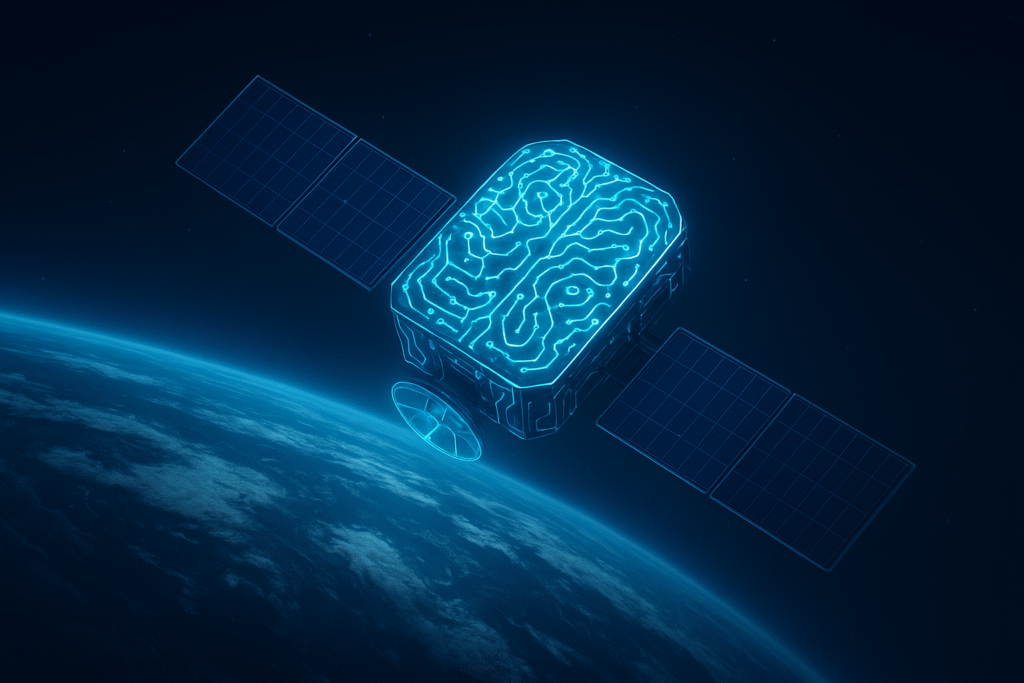
AI-Powered Satellites: How Autonomous Spacecraft Are Changing the Future of Space Missions
Space exploration is undergoing a historic transformation. From Earth observation to interplanetary missions, artificial intelligence (AI) is enabling satellites to think, decide, and act independently.
In 2025, NASA and other global agencies are testing AI-powered satellites that can analyze data in orbit and make real-time decisions — without waiting for human commands. This breakthrough not only reduces mission delays but also sets the stage for fully autonomous space operations in the near future.
🌌 The Evolution: From Manual Control to Machine Autonomy
Traditionally, satellite operations relied heavily on Earth-based control centers. Every command, from capturing an image to adjusting orbit, required a time delay of several seconds to minutes.
AI changes that completely.
Modern satellites are now equipped with onboard neural processors capable of:
Analyzing sensor data in real time
Detecting anomalies automatically
Prioritizing high-value targets for imaging or communication
NASA’s latest Dynamic Targeting satellite experiment proved that AI can independently decide when and what to image — reducing mission latency by up to 70%.
⚙️ How AI-Powered Satellites Make Decisions
At the heart of this revolution lies Edge AI — artificial intelligence embedded directly in spacecraft systems.
Here’s how it works step by step:
Data Collection: Satellite sensors capture images, radiation, and atmospheric readings.
AI Analysis: Onboard AI models identify key patterns (e.g., storm systems, wildfires, volcanic activity).
Autonomous Action: Based on confidence levels, the satellite adjusts its instruments or sends urgent data to Earth.
Learning Loop: With each mission, AI algorithms evolve, improving decision accuracy.
This system significantly reduces reliance on ground control and ensures faster response times for Earth observation and deep-space missions.
🌍 Real-World Applications of AI in Space
AI-powered satellites are already making a global impact.
🌦️ 1. Climate and Disaster Monitoring
AI models detect forest fires, floods, and droughts faster than ever. NASA’s Earth Science division uses AI satellites to automate disaster alerts, improving response times for rescue teams.
🪐 2. Deep Space Navigation
Future missions to Mars and Jupiter’s moons will rely on autonomous navigation. AI enables spacecraft to plot optimal trajectories and avoid obstacles in real time.
🛰️ 3. Space Debris Management
AI systems can identify and track orbital debris, adjusting satellite positioning to prevent collisions — a growing challenge in low Earth orbit.
📡 4. Interplanetary Communication Optimization
AI manages bandwidth, compresses data efficiently, and decides which findings are worth transmitting back to Earth.
🧬 The Technology Behind Autonomous Satellites
AI satellites use specialized radiation-hardened processors capable of deep learning and image recognition in space environments.
Some of the most advanced onboard systems include:
Edge TPU (Tensor Processing Units) for real-time inference
Neuromorphic chips that mimic human brain activity
Reinforcement learning algorithms that adapt based on mission success metrics
In collaboration with Google and NVIDIA, NASA and ESA are experimenting with low-latency deep learning frameworks designed for zero-gravity conditions.
🚀 Leading Projects in 2025
| Mission | Organization | Key Feature | Objective |
|---|---|---|---|
| Dynamic Targeting AI Satellite | NASA | Real-time imaging decisions | Climate observation |
| Lunar AI Rover Coordination | ESA | AI-based navigation | Moon surface mapping |
| Starlink Neural Optimization | SpaceX | Predictive maintenance | Low Earth orbit management |
| Orbital AI Sentinel | Indian Space Research Org. | Automated image analysis | Agricultural monitoring |
🚀 A Square Solutions
We specialise in AI Automation & Workflow Systems — helping businesses scale through AI and intelligent digital systems.
Frequently Asked Questions
What is AI-Powered Satellites?
Space exploration is undergoing a historic transformation.
Why is AI-Powered Satellites important in 2026?
From Earth observation to interplanetary missions, artificial intelligence (AI) is enabling satellites to think, decide, and act independently .
How does AI-Powered Satellites work?
In 2025, NASA and other global agencies are testing AI-powered satellites that can analyze data in orbit and make real-time decisions — without waiting for human commands.
What should you know about AI-Powered Satellites?
This breakthrough not only reduces mission delays but also sets the stage for fully autonomous space operations in the near future.
Sources: Anthropic AI Research | MIT Technology Review
💬 Questions about this topic?
Use the 🤖 Ask Our AI widget (bottom-right) — instant answers, 24/7.