
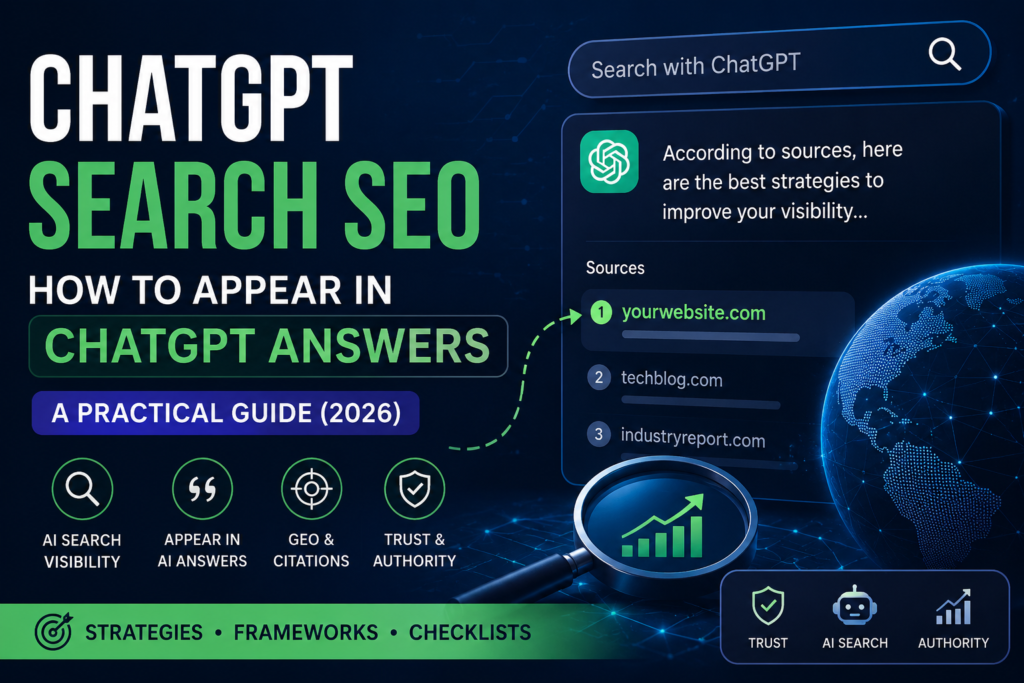
ChatGPT Search is a live-web retrieval system that synthesises answers from real-time content and cites its sources. For the fundamentals, see what GEO actually means. If your website does not appear among those sources, you are invisible to a platform used by hundreds of millions of people — regardless of how well you rank in Google. This guide explains exactly how ChatGPT Search selects sources, what makes content citation-eligible, and what you can do to improve your visibility.
What ChatGPT Search Actually Is
How ChatGPT Search Selects Sources (Direct Answer)
ChatGPT Search uses Bing’s index and its own retrieval system to select cited sources. The primary signals are: (1) the page is indexed by Bing, (2) the content directly and completely answers the query in a short, self-contained passage, (3) the domain has demonstrated authority signals in Bing’s link graph, and (4) the page carries structured data that confirms its topic (Article, FAQPage, HowTo schema).
Pages that appear in ChatGPT Search citations tend to have answer-first writing (lead with the direct answer, then expand), semantic heading structure, and paragraph-level entity density. A 150-word section that fully answers a single question outperforms a 2,000-word article that buries the answer in paragraph 12.
📚 Related Reading
ChatGPT Search is not the same product as standard ChatGPT. Standard ChatGPT generates responses from its training data — a fixed knowledge base with a cutoff date. ChatGPT Search adds a live web retrieval layer: before generating a response, it fetches current content from the web, reads it, and synthesises the retrieved information into an answer. The response then shows visible source citations, linking to the pages it drew from.
OpenAI launched ChatGPT Search in October 2024 and expanded access through 2025. By mid-2026 it is available to all ChatGPT users including the free tier for certain query types, making it one of the largest AI search interfaces in the world by user count. For businesses, this means ChatGPT Search is no longer a niche product used by technical early adopters — it is a mainstream discovery channel with real traffic implications.
The critical operational difference from Google: ChatGPT Search does not produce a list of ranked pages. It produces one synthesised answer with a small set of attributed sources. There is no “position 3” to target. There is either citation or non-citation. That binary outcome is what GEO optimisation for ChatGPT is designed to shift in your favour.
How ChatGPT Search Differs from Google Search
The surface difference — “Google ranks pages, ChatGPT gives answers” — understates how deeply the two systems differ. The differences affect which content gets discovered, which content gets cited, and which optimisation tactics actually work.
| Dimension | Google Search | ChatGPT Search |
|---|---|---|
| Index source | Google's own index (Googlebot) | Bing's web index (primary) + live crawl |
| Output format | Ranked list of pages (SERP) | Single synthesised answer + attributed sources |
| Primary authority signal | PageRank, backlink profile | Passage relevance, entity trust, Bing authority |
| Evaluation unit | Entire page | Specific passages and sections |
| Click outcome | Click-driven — users choose which page to visit | Impression-based — citation may not generate a click |
| Query style | Keyword fragments (“best GEO agency India”) | Conversational questions (“how do I optimise my site for ChatGPT?”) |
| Small site advantage | Low — domain authority gap is hard to close | Higher — specific expertise can beat broad authority |
The index source difference is the most practically important: ChatGPT Search draws from Bing, not Google. A site with strong Google rankings but minimal Bing presence is at a systematic disadvantage for ChatGPT citations. Verifying your site in Bing Webmaster Tools and submitting an updated sitemap is the single highest-leverage technical action you can take for ChatGPT Search visibility.
The Three-Layer Source Selection System
ChatGPT Search selects sources through three layers, applied in sequence. Understanding the layer structure explains why certain optimisations work and others do not.
Layer 1: Bing Web Index (Primary Candidate Pool)
For most queries, ChatGPT Search begins with Bing's web index to identify candidate sources. This means Bing crawl accessibility and Bing authority signals are prerequisites, not optimisations. A page that Bing has not crawled, or that Bing treats as low-quality, will not enter the candidate pool regardless of how well it is written. Verify your Bing indexing status through Bing Webmaster Tools. Check that BingBot is not blocked in your robots.txt. Confirm your sitemap has been submitted and accepted.
Layer 2: Live Web Retrieval (Freshness Layer)
For time-sensitive queries — recent events, current prices, latest research — ChatGPT Search supplements the Bing index with real-time crawl of specific pages. Pages that are regularly updated, have clear publication and modification dates in their schema, and contain content that signals recency are favoured for live retrieval. Keeping dateModified current in your Article schema and updating statistics or tool references quarterly maintains freshness eligibility for this layer.
Layer 3: Training Data (Fallback)
For queries that cannot be answered by current web content — historical questions, well-established factual knowledge — ChatGPT may draw from its training data without live retrieval. This layer is less relevant for content marketing optimisation, since training data cannot be directly influenced. However, brands that have strong representation in authoritative online sources (news publications, Wikipedia, industry databases) benefit from this layer as a secondary trust signal.
What Makes a Website Citation-Eligible
Within the candidate pool identified by Bing, ChatGPT's retrieval system evaluates content for citation eligibility. The evaluation happens at the passage level, not the page level. These are the six factors that determine whether a specific section of your content gets selected:
- Passage direct relevance: Does a specific 2–5 sentence block in your content directly answer the query? Not the page topic in general — a specific extractable passage. ChatGPT's retrieval identifies this passage, not the page. Content that buries its answer in surrounding context is less likely to be cited than content with a standalone answer block.
- Answer completeness: Does the passage give a complete answer without requiring the reader to click through or read more? Passages that say “for the full explanation, see our guide” or hedge everything with “it depends” are penalised relative to passages that commit to a specific answer. ChatGPT prefers sources that take a definitive position based on expertise.
- Specificity and verifiability: Does the passage contain specific, verifiable information — named tools, precise figures, identified entities, dated references? Generic statements (“AI is changing search”) are low-citation content. Specific statements (“ChatGPT Search uses Bing's web index as its primary source pool, with live crawl supplementing for time-sensitive queries”) are high-citation content.
- Entity recognition: Is the publishing organisation a recognisable entity with consistent signals across the web? ChatGPT's systems are more likely to cite sources from entities they have encountered across multiple contexts — in news, directories, social platforms, and other indexed pages. An organisation with proper schema, consistent NAP data, and cross-platform presence has higher entity trust than an anonymous or inconsistently described source.
- Author credibility: Is the content attributed to a named, verifiable author with relevant expertise? Content with a named author who has an associated profile, credentials, and professional history is more citation-eligible than content attributed only to a company or published without attribution.
- Structural parsability: Can the retrieval system cleanly extract the relevant passage? Clean HTML structure, proper heading hierarchy, and well-formed schema significantly improve passage extractability. Content buried inside JavaScript rendering, complex CSS-based layouts, or poorly structured markup is harder to parse and less likely to be cited.
Passage-Level Optimization for ChatGPT Citation
The most important practical shift for ChatGPT Search optimization is moving from page-level thinking to passage-level thinking. Traditional SEO asks: “Is this page well-optimised for this keyword?” ChatGPT Search optimization asks: “Does this specific paragraph answer this specific question in a way that can be extracted and cited standalone?”
The citable passage framework applied to every major section: each H2 section should contain at least one passage that (1) opens with a direct, complete statement not requiring surrounding context, (2) names the topic entity explicitly rather than using pronouns, (3) includes at least one specific fact, figure, or named example, and (4) closes with a complete thought. Test your passages by asking: “If this 3-sentence block appeared in a ChatGPT answer with no other context from my article, would it make sense and be useful?” If yes, it is citation-ready.
Paragraph length matters for ChatGPT citation more than for Google indexing. Paragraphs under 100 words that contain a complete idea are significantly more extractable than 300-word paragraphs that develop an argument over multiple sentences. Break long arguments into sequential, standalone points rather than building to a conclusion over an extended paragraph.
Conversational Query Optimization
ChatGPT Search users phrase queries differently from Google users. Google has trained users to submit keyword fragments. ChatGPT has trained users to ask complete questions in natural language: “How do I make my website show up in ChatGPT answers?” rather than “ChatGPT website visibility.”
Optimise your heading structure and opening paragraphs for conversational query matching. If a user asks ChatGPT “how do I appear in ChatGPT search results,” your content is most likely to be retrieved if it contains a section heading that explicitly answers that question and an opening paragraph that restates the question as a complete answer. Headings like “How to Appear in ChatGPT Search Results” are more aligned to ChatGPT retrieval than headings like “ChatGPT Visibility Strategies.”
The practical exercise: for each major topic your content covers, write out the 3-5 ways a user might phrase that question to ChatGPT in natural language. Then verify that your content contains a direct, passage-level answer to each of those formulations. Gaps in conversational coverage are gaps in citation eligibility.
Structured Data That ChatGPT Actually Uses
Schema markup directly communicates metadata to AI retrieval systems. Not all schema types are equally useful for ChatGPT citation — the relevant types are those that identify the content's nature, date, authorship, and Q&A structure.
| Schema type | ChatGPT relevance | Key fields |
|---|---|---|
| Article | High — establishes recency, authorship, and editorial nature | dateModified (most critical), author, headline |
| FAQPage | High — Q&A format is directly usable as answer content | Conversationally phrased questions, complete answers |
| Organization | Foundation — entity recognition prerequisite | name, url, sameAs (social profiles + directories) |
| SoftwareApplication | High for tool pages — makes tools recognisable in tool-query results | name, applicationCategory, url, description |
The single most important schema field for ChatGPT Search citation is dateModified in Article schema. ChatGPT Search weights content recency heavily for most query types. A post with an outdated dateModified — even if the content was recently reviewed — signals staleness to the retrieval system. Update dateModified every time you make any substantive change to an article's content or data.
Seven Strategies to Improve ChatGPT Search Visibility
These strategies are ordered by impact-to-effort ratio. The first two are technical prerequisites; the remaining five are content and authority optimisations.
ChatGPT Search Visibility — Seven Strategies
1. Bing indexing — the prerequisite
Verify your site in Bing Webmaster Tools. Submit an updated XML sitemap. Check that BingBot is not blocked in robots.txt. Without Bing indexing, no other optimisation has effect on ChatGPT Search visibility.
2. Freshness maintenance
Update dateModified in Article schema every time content changes. Refresh statistics, tool names, and prices quarterly. ChatGPT Search weights recency for most non-historical queries.
3. Passage architecture
Restructure every major article section so that each contains at least one standalone, complete, specific answer block. No section should require context from other sections to be understood.
4. Entity reinforcement
Establish your organisation as a recognisable entity: Organisation schema on your homepage, consistent NAP data across platforms, listings on Crunchbase, LinkedIn, and relevant industry directories. Entity recognition is the trust gate for citation eligibility.
5. Named author authority
Attribute all articles to a named person with a verifiable author profile: full name, professional title, credentials, LinkedIn URL. Anonymous or organisation-attributed content is less citation-eligible than authored content.
6. Source citation within content
Content that cites verifiable external sources signals research quality to AI retrieval systems. Every article targeting ChatGPT citation should reference at least two externally verifiable sources. This is a credibility signal, not a link-building tactic.
7. Conversational heading structure
Rephrase H2 and H3 headings from topic labels to explicit question or answer statements. “How ChatGPT selects sources” is more retrievable than “Source selection overview.” The heading primes the retrieval system for what the section answers.
Common Mistakes Hurting ChatGPT Visibility
- Not being in Bing's index at all. Surprisingly common. Many sites have never submitted a sitemap to Bing Webmaster Tools and have suboptimal Bing crawl rates. Check your Bing indexing status before assuming your content has any chance of ChatGPT citation.
- Content that requires context to make sense. The most common structural mistake. Opening a section with “As discussed above…” or “Building on the previous section…” signals that the content is not passage-independent. ChatGPT cannot cite a passage that only makes sense in the context of surrounding content.
- Hedging instead of answering. Content full of “it depends,” “consult a professional,” and “results may vary” is low-citation content. ChatGPT preferentially cites sources that give specific, authoritative answers. Appropriate caveats are fine — but leading with hedges instead of answers signals low information value.
- Stale
dateModifiedschema. A post last modified in 2023 signals outdated content to ChatGPT Search's recency filters, even if the underlying information is still accurate. Update schema dates when you make any substantive content change. - Missing or organisation-only author attribution. “Published by A Square Solutions” is weaker than “Published by [Name], Head of Digital Strategy at A Square Solutions.” Named authorship signals human expertise rather than automated content generation.
- Dense prose with no structured lists. Long paragraphs that develop arguments across multiple sentences are harder to extract as passage-level citations than structured lists. Convert prose descriptions of multiple items into bulleted or numbered lists.
Measuring ChatGPT Search Visibility
ChatGPT does not currently provide publishers with citation analytics — there is no “ChatGPT referral” channel in standard web analytics. Measurement relies on a combination of direct checks and indirect signals.
- Manual query checks (most direct): Open ChatGPT with the search mode active and submit your top 10 target queries. Check whether your site appears as a cited source. Note which queries cite you and which do not. Run this monthly and track changes over time as you implement optimisations.
- Bing Webmaster Tools: Monitor your Bing crawl stats, indexing coverage, and any crawl errors. Improvements in Bing indexing quality correlate with improved ChatGPT citation eligibility. Bing Webmaster Tools is a direct proxy for the health of your ChatGPT Search foundation.
- Branded search lift in GSC: Users who encounter your brand in a ChatGPT answer often search for your brand directly in Google. A sustained increase in branded query impressions in Google Search Console — without a correlated paid campaign — is a reliable indirect signal of AI citation activity.
- Direct traffic patterns: Similar reasoning applies to direct traffic in GA4. Unexplained direct traffic growth — particularly for landing pages that are not linked from your email or social campaigns — often correlates with AI-driven brand awareness.
- Brand mention monitoring: Tools like Brand24 or Mention track when your site URL or brand name appears in publicly shared AI-generated content. As more users share ChatGPT conversations, this signal becomes increasingly useful.
ChatGPT Search in India — Context and Opportunity
India has one of the largest ChatGPT user bases globally by absolute count, with adoption concentrated among urban professionals, students, and technically sophisticated business users. ChatGPT Search usage in India is growing fastest for English-language queries in categories that have historically been underserved by high-quality local content: business compliance, digital payments, fintech, and professional services.
Fraud and trust queries represent a major opportunity. The growth of UPI payments and digital commerce in India has created a high volume of trust-verification queries: “is this business legitimate,” “how to check if a payment link is safe,” “how to verify a company before paying.” ChatGPT Search answers these queries from sources it trusts. Tools like ScamCheck, which uses AI to detect Indian scam patterns across messages, links, and payment requests, is a directly relevant tool for this query category. Content that positions ScamCheck as a specific answer to specific fraud-detection queries is ChatGPT citation-ready — it answers a concrete conversational question with a named, functional tool.
Business verification is a growing citation category. Indian businesses and consumers increasingly ask AI systems to help verify whether a company is legitimate before transacting. TrustSeal's business trust verification function is a direct answer to “how do I verify an Indian business online” — a high-volume, citation-rich query type. Businesses that deploy TrustSeal also benefit indirectly: a verifiable trust badge strengthens the entity recognition signal that AI citation systems use to assess source credibility.
Language and query format. Indian users increasingly mix English with regional language terms or use transliterated queries. While ChatGPT Search primarily sources from English-language content for English queries, content that reflects Indian business contexts, regulatory environments (GST, FSSAI, SEBI), and social norms consistently outperforms generic international content for India-specific queries in AI search.
The Future of ChatGPT Search Visibility
ChatGPT Search is on a trajectory toward broader access, deeper web integration, and more sophisticated source selection. OpenAI has indicated that real-time browsing capabilities will expand, the quality of source attribution will improve, and the system will increasingly distinguish between high-credibility and low-credibility sources using signals similar to — but distinct from — traditional search authority metrics.
The businesses best positioned for this future are those that treat ChatGPT Search as a primary discovery channel now — building entity authority, passage-optimised content, Bing indexing quality, and measurement infrastructure before the platform matures further. Early-mover citation authority in AI search compounds in the same way that early domain authority compounded in traditional SEO: the businesses that built it first have structural advantages that are difficult to close later.
For the full framework on optimising content across all AI search platforms — not just ChatGPT — see our complete GEO guide.
🚀 A Square Solutions
We specialise in GEO, AI Search Visibility & Digital Growth Systems — helping businesses build authority in AI-era search and get cited where it counts.
Related reading
Frequently Asked Questions
What is ChatGPT Search and how does it differ from standard ChatGPT?
ChatGPT Search is a live web retrieval system distinct from standard ChatGPT. While standard ChatGPT responds from its training data, ChatGPT Search fetches current content from the web — using Bing's web index as its primary source pool — before generating a response. The answer includes visible source citations linking to the pages retrieved. Available to ChatGPT Plus subscribers and increasingly to free users, it has become one of the largest AI search interfaces globally.
Why does Bing matter for ChatGPT Search visibility?
ChatGPT Search uses Microsoft Bing's web index as its primary candidate pool for source selection. Sites not indexed in Bing, or with weak Bing authority signals, are systematically disadvantaged for ChatGPT citations regardless of Google ranking. Verify your site in Bing Webmaster Tools, submit a sitemap, and confirm BingBot is not blocked in your robots.txt. This is the single highest-leverage technical action for ChatGPT Search visibility.
How do I check if my content appears in ChatGPT Search answers?
The most direct method is manual spot-checking: open ChatGPT with the search mode active, submit your top 10 target queries, and check whether your site appears as a cited source. Run this monthly. Indirect signals include: branded search volume growth in Google Search Console (users who see your brand in ChatGPT may search directly), unexplained direct traffic increases, and brand mention monitoring tools tracking AI-generated content that references your site.
What content format is most cited in ChatGPT answers?
ChatGPT Search preferentially cites passages that directly and completely answer a query as a standalone block. The most citable format: a section heading that explicitly states what the section answers, followed by a 2–4 sentence passage opening with a complete standalone statement, including at least one specific fact or named entity, requiring no surrounding context to make sense. Structured lists are more citable than dense prose. Specific claims outperform hedged generalities. Complete answers outperform those that defer to “consult a professional.”
FREE CITATION AUDIT
Not sure which of your pages are citation-eligible for ChatGPT Search? We audit your top-traffic content against ChatGPT’s source-selection signals — passage structure, entity density, answerability — and give you a ChatGPT Citation Readiness Report with exact fixes.
Sources: OpenAI Blog | Bing Webmaster Tools | Google Search Documentation
💬 Questions about this topic?
Use the 🤖 Ask Our AI widget (bottom-right) — instant answers, 24/7.
📡 LIVE AT AI EXECUTION LAB
We document our GEO & ChatGPT ranking strategy as it happens.
A Square Solutions runs a public AI systems journal — real deployments, real failures, real search results. No sanitised case studies. See how we architect GEO signals that get pages cited in ChatGPT answers.
→ GEO Intelligence Architecture at AI Execution Lab | → Operational SEO System
GEO Implementation Service
Generative Engine Optimization Services
End-to-end citation architecture: audit, entity SEO, structured data, content restructuring, and ongoing AI citation monitoring across Google AI Overviews, ChatGPT Search, and Perplexity.