AI for Personalizing Public Services: A Win-Win for Citizens and Government
📚 Further Reading
Governments are increasingly adopting artificial intelligence to move from standardized service delivery to personalized, citizen-centric experiences. By using predictive analytics, automation, and intelligent interfaces, public institutions can deliver faster responses, targeted support, and more accessible services at scale.
From Mass Administration to Intelligent Service Delivery
Traditional public systems were designed for uniform processing, but AI enables dynamic interaction models similar to those used by modern digital businesses. This shift allows governments—and enterprises—to anticipate needs, automate workflows, and improve engagement outcomes.A leading example of this transformation can be seen in Estonia’s AI-enabled digital government platform.
Here are a few examples of how AI can be used to personalize public services:
- AI-powered chatbots: AI-powered chatbots can provide personalized customer service and support to citizens. For example, chatbots can be used to help citizens with tasks such as applying for benefits, finding information about government services, or resolving issues with their accounts.
- AI-powered recommendation systems: AI-powered recommendation systems can help citizens to find the services and resources that they need. For example, recommendation systems can be used to help citizens find the best schools for their children, the most suitable job training programs, or the best healthcare providers.
- AI-powered predictive analytics: AI-powered predictive analytics can be used to identify citizens who are at risk of needing additional support. For example, predictive analytics can be used to identify students who are at risk of dropping out of school, or seniors who are at risk of falling. This information can then be used to provide targeted support to these individuals before they need it.
You can review practical implementations in our case studies.
Administrative automation is another application, demonstrated by AI-driven tax processing systems.
In addition to these specific examples, AI can also be used to personalize public services by:
- Tailoring services to individual needs: AI can be used to tailor public services to the individual needs of citizens. For example, AI can be used to develop personalized learning plans for students, or to create personalized healthcare plans for patients.
These initiatives form part of a broader shift discussed in our analysis of AI-driven social and environmental innovation.
- Making services more accessible: AI can be used to make public services more accessible to citizens. For example, AI can be used to develop machine translation tools that allow citizens to access government services in their preferred language, or to develop voice-activated interfaces that allow citizens to access government services without having to use a keyboard.
- Improving communication: AI can be used to improve communication between citizens and government. For example, AI can be used to develop chatbots that can answer citizen inquiries in real time, or to develop tools that allow citizens to track the progress of their applications and requests.
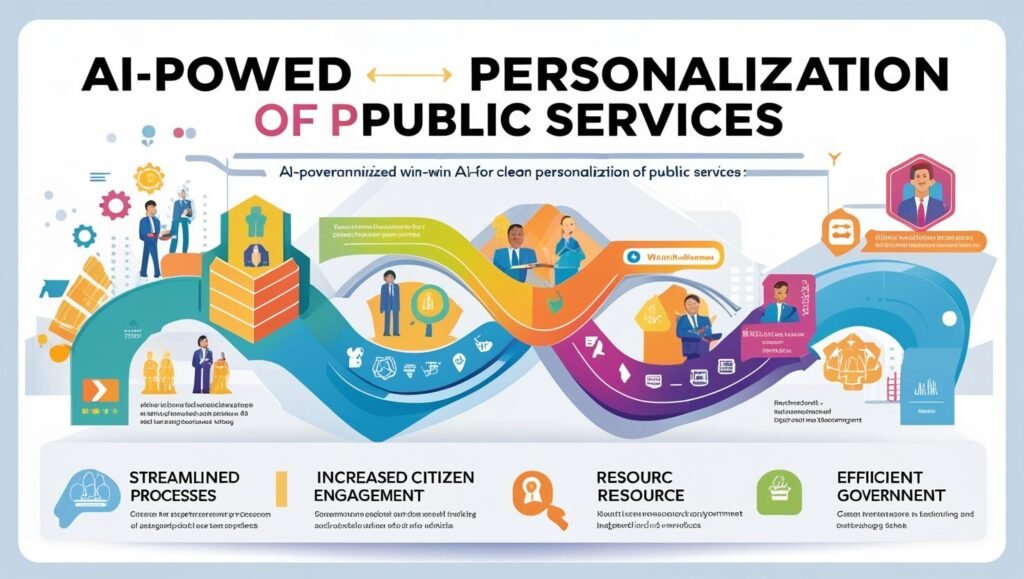
Overall, AI offers a number of potential benefits for personalizing public services. By tailoring services to individual needs, making them more accessible, and improving communication, AI can help to make government more efficient, effective, and responsive to the needs of its citizens.
To see how similar intelligence models are applied in business environments, explore our Digital Marketing and AI pillar guide.
Here are a few additional benefits of using AI to personalize public services:
- Reduced costs: AI can help to reduce the costs of government by automating tasks that would otherwise be performed by human employees.
- Improved accuracy: AI can help to improve the accuracy of government services by reducing the risk of human error.
- Increased satisfaction: AI can help to increase citizen satisfaction with government services by making them more efficient, effective, and accessible.
- Improved equity: AI can help to ensure that all citizens have equal access to government services by tailoring services to individual needs and making them more accessible.
At A Square Solutions, these same personalization and automation frameworks are implemented through our AI-enabled digital services.
Key Takeaways from AI-Powered Public Service Transformation
Personalization improves user satisfaction by delivering relevant services faster.
Predictive analytics allows proactive support rather than reactive administration.
Automation reduces operational costs while increasing scalability.
Data-driven systems enable continuous improvement in service delivery.
The same technologies are now widely adopted across private-sector digital transformation.
As AI continues to develop, it is likely that we will see even more innovative ways to use it to personalize public services. This is a positive development, as it has the potential to make government more efficient, effective, and responsive to the needs of its citizens.