

unlock 2025 advantage —
AI Investment Reality Check 2026: Are Valuations Sustainable or Heading Toward Correction?
📚 Further Reading
The global artificial intelligence sector enters 2026 with unprecedented momentum — and equally unprecedented uncertainty. After years of aggressive funding, massive compute expansion, and soaring startup valuations, investors are now asking a tougher question: is this growth sustainable, or are we approaching a structural correction?
Prefer to have experts handle this? A Square Solutions offers professional AI automation services for growing businesses.
This AI investment reality check 2026 goes beyond hype to examine the real economics of AI, the warning signals emerging across markets, and what the next phase of artificial intelligence investment is likely to look like.
The AI Gold Rush: How We Got Here
Between 2023 and 2025, AI became the most heavily funded technology sector in history. Capital flowed into:
Foundation model developers
Generative AI startups
AI infrastructure and custom silicon
Autonomous agents and enterprise AI platforms
This explosive growth created an assumption that AI adoption automatically equals profitability. However, as discussed earlier in our analysis on
AI redefining Google’s search dominance , technological disruption does not always translate into immediate economic stability.
By 2026, the gap between AI capability and AI commercial viability has become impossible to ignore.
Rising Costs Are Reshaping AI Economics
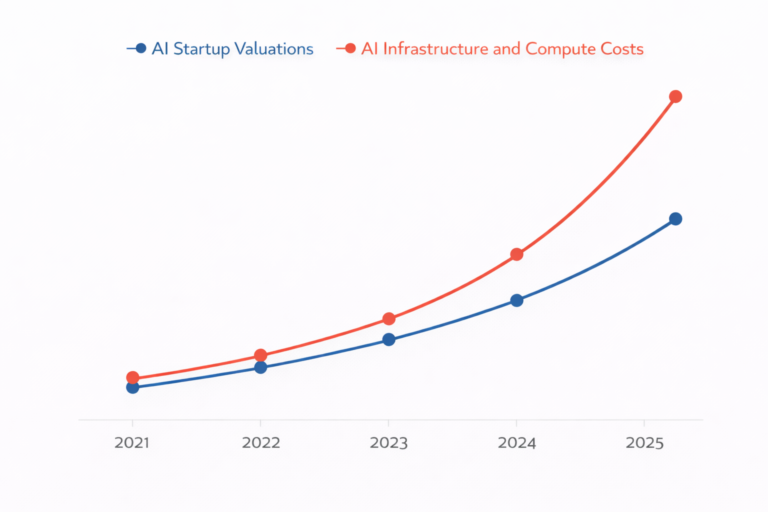
One of the clearest signals in this AI investment reality check 2026 is the rapid escalation of operational costs.
AI companies now face:
Soaring GPU and accelerator prices
Massive energy consumption from data centers
High ongoing model retraining expenses
Increasing compliance and governance costs
While revenues are growing, costs are often growing faster.
This mirrors concerns raised in our earlier breakdown of
AI training data compliance and governance , where regulatory and data constraints were identified as long-term financial pressure points.
For many AI startups, scale is no longer the problem — sustainable margins are.
Valuations vs Fundamentals: A Growing Disconnect
At the heart of the AI investment debate is valuation.
Many AI firms in 2026 are valued on:
User growth instead of cash flow
Future market dominance instead of current defensibility
Narrative leadership rather than unit economics
This pattern closely resembles previous tech cycles. As highlighted in a detailed market analysis by The Guardian, AI is now considered a systemic economic risk rather than a speculative niche, particularly due to its capital-intensive nature.
This external perspective reinforces what many internal indicators already show: AI valuation inflation is real, but unevenly distributed.
Enterprise AI Adoption: ROI Still Uneven
Despite widespread AI deployment, enterprise returns remain mixed.
Organizations report:
Productivity improvements without proportional cost reduction
AI pilots that fail to reach production scale
Talent shortages in AI governance and model oversight
This mismatch aligns with insights from
Agentic AI boom and bust predictions , which warned that nearly 40% of AI initiatives may fail due to execution and integration challenges.
In simple terms: AI works — but not always at a price businesses can justify.
Regulation Is Changing Investor Behavior
2026 also marks a turning point in global AI regulation.
Governments are tightening rules around:
Training data transparency
Model accountability
AI safety and misuse prevention
While regulation improves trust, it also raises compliance costs.
Our previous coverage on
responsible and ethical AI frameworks already noted that regulation disproportionately impacts smaller and mid-stage AI firms, increasing consolidation risk.
Investors are now pricing regulatory exposure into valuations — a classic precursor to market corrections.
The Open-Source Effect: Commoditization Pressure
Another overlooked factor in this AI investment reality check 2026 is open-source acceleration.
Open models and frameworks are:
Reducing entry barriers
Weakening proprietary moats
Forcing AI startups to compete on efficiency, not novelty
As explored in
open-source AI and democratized innovation, commoditization may ultimately benefit users — but it compresses margins for investors.
What Smart Investors Are Watching in 2026
Rather than abandoning AI, experienced investors are shifting focus toward:
Vertical-specific AI with clear ROI
Infrastructure efficiency breakthroughs
AI companies with real cash-flow discipline
Businesses reducing dependency on hyperscale compute
This strategic shift echoes earlier warnings from
AI market correction and spending boom analysis .
The message is not “AI is failing” — it is “AI is maturing.”
Correction vs Collapse: Understanding the Difference
Importantly, the AI investment reality check 2026 does not point toward a collapse.
Instead, evidence suggests:
Valuation compression, not market failure
Startup consolidation, not innovation slowdown
Capital discipline replacing hype
History shows that corrections often strengthen transformative technologies by removing unsustainable players.
Final Assessment: AI’s Future Depends on Economics
AI will remain one of the most important technologies of the 21st century. But in 2026, belief alone is no longer enough.
This AI investment reality check 2026 makes one thing clear:
the next phase of AI growth will reward efficiency, discipline, and real-world value — not hype-driven valuation.
For investors, founders, and businesses alike, the opportunity remains enormous — but only for those who understand the economics behind the intelligence.
❓ FAQ
Q1. Is there an AI investment bubble in 2026?
Yes, certain AI segments show bubble-like characteristics, especially where valuations outpace revenue and profitability.
Q2. Will AI investments crash in 2026?
A full crash is unlikely, but a market correction driven by cost pressures and regulation is probable.
Q3. What are the biggest risks for AI investors in 2026?
Rising compute costs, unclear ROI, regulatory tightening, and commoditization of AI models.
Q4. Is AI still a good long-term investment?
Yes — but only for companies with sustainable business models and real economic value.

💡 Expert Support Available
A Square Solutions delivers AI-Driven Digital Growth Systems for businesses ready to scale with intelligence.
🚀 A Square Solutions
We specialise in Performance Marketing & Growth Architecture — helping businesses scale through AI and intelligent digital systems.
Frequently Asked Questions
What is AI Investment Reality Check 2026?
The global artificial intelligence sector enters 2026 with unprecedented momentum — and equally unprecedented uncertainty.
Why is Unlock 2025 s AI Advantage important in 2026?
The global artificial intelligence sector enters 2026 with unprecedented momentum — and equally unprecedented uncertainty.
How does Unlock 2025 s AI Advantage work?
After years of aggressive funding, massive compute expansion, and soaring startup valuations, investors are now asking a tougher question: is this growth sustainable, or are we approaching a structural correction?.
What should you know about Unlock 2025 s AI Advantage?
This AI investment reality check 2026 goes beyond hype to examine the real economics of AI, the warning signals emerging across markets, and what the next phase of artificial intelligence investment is likely to look lik
Sources: Harvard Business Review | McKinsey Digital
💬 Questions about this topic?
Use the 🤖 Ask Our AI widget (bottom-right) — instant answers, 24/7.
Need help with AI, web, or SEO?
A Square Solutions builds AI products, high-performance websites, and SEO systems. Book a free, no-obligation consultation.
Subscribe to our newsletter
Practical updates on AI, web, and SEO — no spam.