
The Last Russia–US Nuclear Treaty Is About to Expire: What Happens Next?
The US–Russia nuclear treaty expiry marks a critical moment for global arms control, ending decades of structured limits on the world’s largest nuclear arsenals. The final remaining nuclear arms control agreement between the United States and Russia is nearing its expiration—raising serious questions about global security and strategic stability. Signed in a very different geopolitical era, this treaty has acted as a guardrail preventing an unchecked nuclear arms race for more than a decade.
With relations between Washington and Moscow at their lowest point since the Cold War, the treaty’s potential collapse signals more than a diplomatic failure. It could mark the beginning of a world with no formal limits on the two largest nuclear arsenals, at a time when global conflicts and technological risks are accelerating.
Lorem ipsum dolor sit amet, consectetur adipiscing elit. Ut elit tellus, luctus nec ullamcorper mattis, pulvinar dapibus leo.
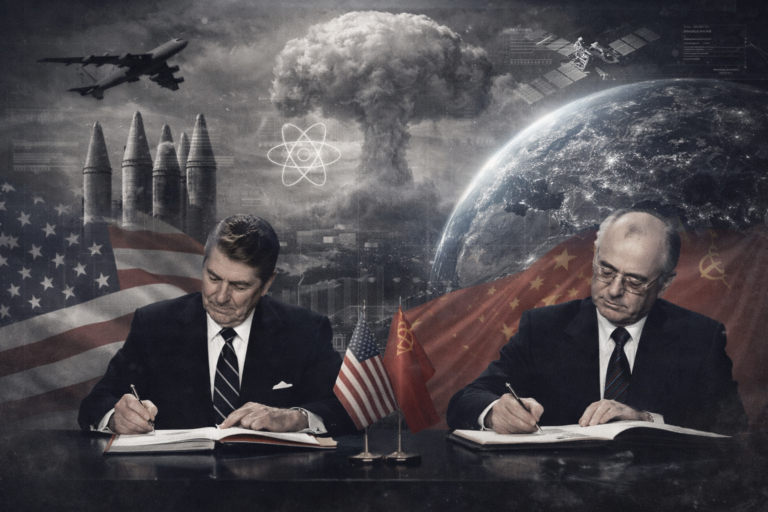
What Is the Last US–Russia Nuclear Treaty?
The agreement at the center of concern is the New START nuclear arms treaty, signed in 2010 and extended once in 2021. It places verifiable limits on deployed nuclear warheads and delivery systems, while allowing on-site inspections that reduce mistrust and miscalculation.
New START evolved from earlier Cold War agreements such as the Strategic Arms Reduction Treaty (START), which helped dismantle thousands of nuclear weapons after the collapse of the Soviet Union. For decades, these frameworks ensured predictability even during periods of political tension.
For broader historical context, the United Nations Office for Disarmament Affairs outlines how bilateral arms control treaties shaped global nuclear stability over the last 50 years.
Lorem ipsum dolor sit amet, consectetur adipiscing elit. Ut elit tellus, luctus nec ullamcorper mattis, pulvinar dapibus leo.
Why This Treaty’s Expiry Matters Now
The world in 2026 is far more unstable than when New START was signed. Ongoing conflicts, rising great-power rivalry, and rapid military innovation have fundamentally changed the risk landscape.
Russia’s suspension of treaty inspections, combined with escalating geopolitical pressure, has already weakened confidence-building mechanisms. Without a replacement agreement, the US and Russia would face no legal constraints on nuclear deployment for the first time since the early 1970s.
This uncertainty compounds broader technology-driven power shifts shaping global affairs, which you can explore further in our analysis on
global affairs and AI-driven power realignments
What Happens If the Treaty Expires?
1. No Legal Caps on Nuclear Arsenals
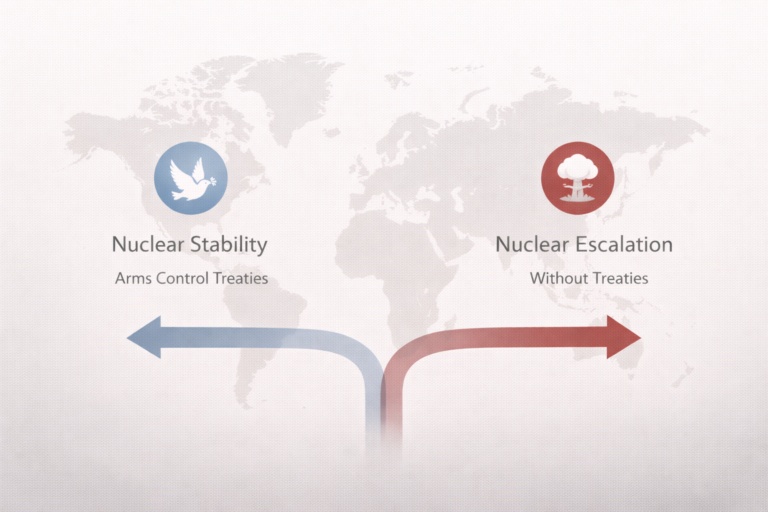
Without New START, both countries can increase deployed warheads without violating international law—reigniting fears of a renewed arms race.
2. End of Transparency and Inspections
The loss of inspections removes crucial visibility into nuclear forces, increasing the risk of misinterpretation and escalation.
3. Global Ripple Effects
Other nuclear states may accelerate weapons development, especially as AI-enhanced military systems reshape strategic planning, a risk we previously analyzed in our coverage of
AGI power struggles and military escalation risks
4. Higher Risk of Miscalculation
With shorter decision windows and no verification, crisis scenarios become far more dangerous.
According to SIPRI’s global nuclear weapons data, the erosion of arms control historically correlates with increased stockpiling and strategic instability.
Is There a Diplomatic Path Forward?
At present, there are no active negotiations for a successor treaty. Political trust is fractured, and future arms control efforts may need to include new nuclear powers—particularly China.
This breakdown mirrors a broader trend of declining international governance frameworks, similar to what we examined in our analysis of
Russia’s push for technological and strategic independence
Without renewed dialogue, the expiration of New START may officially end the Cold War arms control era.
What This Means for the World
The disappearance of treaty-based limits does not guarantee immediate conflict—but it normalizes a more dangerous global baseline. Military planning will increasingly assume worst-case scenarios, while diplomatic guardrails weaken.
In an era where emerging technologies, AI-driven intelligence systems, and geopolitical mistrust intersect, the cost of strategic errors rises dramatically.
Is New START the last nuclear arms control treaty?
Yes. It is the final agreement limiting US and Russian strategic nuclear weapons.
Can the treaty still be extended?
No. Any continuation would require a brand-new agreement.
Does this increase the risk of nuclear war?
Not immediately, but it significantly raises long-term escalation and miscalculation risks.
- January 8, 2026
- asquaresolution
- 10:10 am