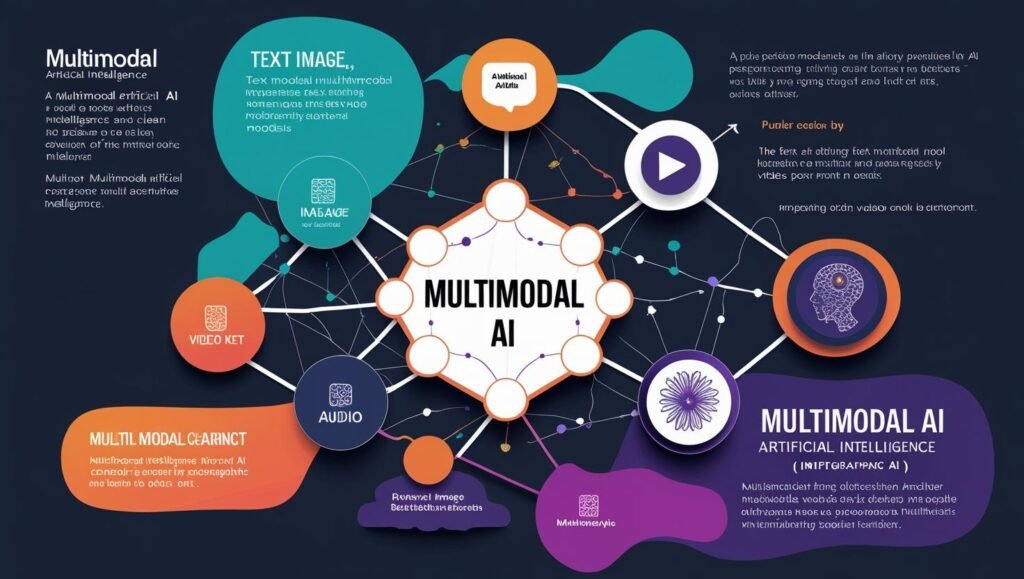
For example, a multimodal AI system could be used to analyze a medical image and patient records to generate a more accurate diagnosis. Or, a multimodal AI system could be used to translate a video from one language to another in real time.

Multimodal AI is important because it can help businesses better understand data and automate workflows through AI-driven digital transformation services. Here are just a few examples of the potential benefits of multimodal AI:
Multimodal AI can be used to develop new medical diagnostic tools that can combine data from multiple sources, such as medical images, patient records, and genetic data. This can help doctors to diagnose diseases more accurately and efficiently.
More realistic and engaging virtual reality experiences:
Multimodal AI can be used to create more realistic and engaging virtual reality experiences by tracking the user’s movements and eye gaze, and generating sound effects based on the user’s environment.
More accurate machine translation:
Multimodal AI can be used to improve the accuracy of machine translation systems by translating images and audio clips in addition to text.
Enhanced natural language processing:
Multimodal AI can be used to improve the performance of natural language processing (NLP) tasks by providing NLP models with access to additional data modalities, such as images and videos.
Multimodal AI can be used to automate the creation of content, such as images, videos, and text. This can help businesses to save time and money, and to create more engaging and informative content for their customers.

Here are some specific examples of multimodal AI in use today:
Google Lens is a mobile app that uses multimodal AI to identify and classify objects in the real world. For example, Google Lens can be used to identify plants, animals, and products, or to scan QR codes and barcodes.
Apple Live Text is a feature that allows users to interact with text in images and videos. For example, Live Text can be used to copy and paste text from images, or to translate text from one language to another.
Microsoft Azure Cognitive Services:
Microsoft Azure Cognitive Services is a set of cloud-based services that provide developers with access to multimodal AI capabilities. For example, Azure Cognitive Services can be used to develop applications that can recognize faces, translate text, and generate speech.
Multimodal AI is being used to develop new medical diagnostic tools that can combine data from multiple sources, such as medical images, patient records, and genetic data. This can help doctors to diagnose diseases more accurately and efficiently.
Multimodal AI is being used to create more realistic and engaging virtual reality experiences. For example, multimodal AI can be used to track the user’s head movements and eye gaze, and to generate realistic sound effects based on the user’s environment.
Multimodal AI is being used to improve the accuracy of machine translation systems. For example, multimodal AI can be used to identify and translate images and audio clips in addition to text
These are just a few examples of the many ways that multimodal AI is being used today.Organizations adopting these technologies are already seeing impact across productivity and decision-making, similar to trends discussed in AI’s transformation of the future workplace. As multimodal AI continues to develop and become more widely adopted, we can expect to see even more innovative and impactful applications for this technology in the future.According to industry research, multimodal systems are becoming a key pillar of next-generation AI platforms, as outlined by Google Cloud’s AI overview.
Overall, multimodal AI is a promising new technology with the potential to revolutionize many different industries. As multimodal AI systems continue to develop and become more sophisticated, we can expect to see even more innovative and impactful applications for this technology in the future.
Conclusion
Multimodal AI is a powerful new technology that has the potential to revolutionize many different industries. By combining information from multiple modalities, multimodal AI systems can gain a more comprehensive understanding of the world and develop more robust and reliable solutions. As multimodal AI systems continue to develop, we can expect to see even more innovative and impactful applications for this technology in the future.