
Low Earth Orbit Disaster: Why Space Could Become Unusable in Just 2.8 Days
Low Earth Orbit (LEO) has quietly become one of humanity’s most critical infrastructures. From GPS navigation and weather forecasting to broadband internet and climate monitoring, thousands of satellites now circle our planet every day.
But according to new research, this invisible network is far more fragile than it appears.
Scientists warn that a Low Earth Orbit disaster could begin in as little as 2.8 days if a powerful solar storm disables satellite control systems — potentially triggering a cascade of collisions that could block access to space for generations.
A Sky Built Like a House of Cards
Researchers led by Sarah Thiele (now at Princeton University) describe today’s satellite mega-constellations as a house of cards. In Low Earth Orbit, satellites pass within one kilometre of each other roughly every 22 seconds. Inside SpaceX’s Starlink network alone, close approaches occur about every 11 minutes.
To stay safe, each Starlink satellite performs an average of 41 avoidance manoeuvres per year.
This constant orbital choreography works — until it doesn’t.
Rare events, not everyday operations, usually trigger large-scale failures. And in space, the most dangerous edge case is a major solar storm.
How Solar Storms Disrupt Satellites
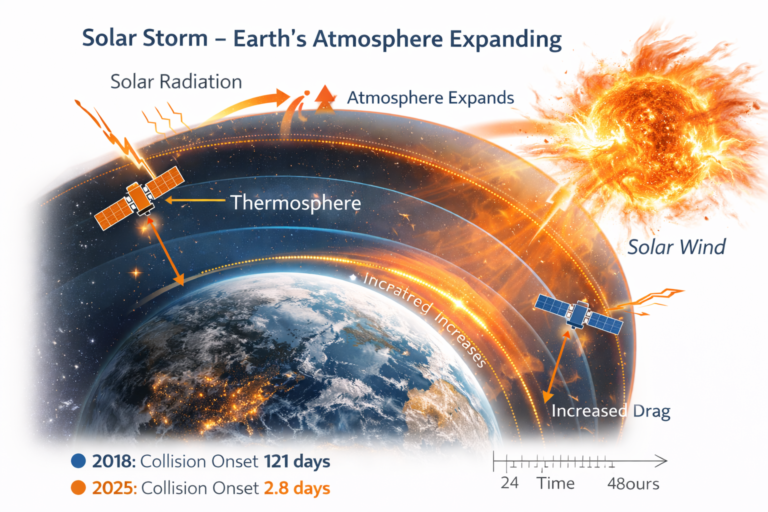
Solar storms strike in two devastating ways.
First, they heat Earth’s upper atmosphere, causing it to expand. This increases drag on satellites, forcing them to burn extra fuel while making their positions harder to predict. During the powerful May 2024 Gannon Storm, more than half of all LEO satellites had to perform emergency adjustments.
Second — and more dangerously — solar storms can knock out satellite navigation and communication systems entirely.
Without real-time control, satellites cannot dodge incoming objects. Combined with increased drag and orbital uncertainty, even a brief outage can turn near-misses into direct impacts.
Measuring the Speed of Disaster
To quantify how fast things could unravel, researchers introduced a new metric: the Collision Realization and Significant Harm (CRASH) Clock.
Their findings are sobering:
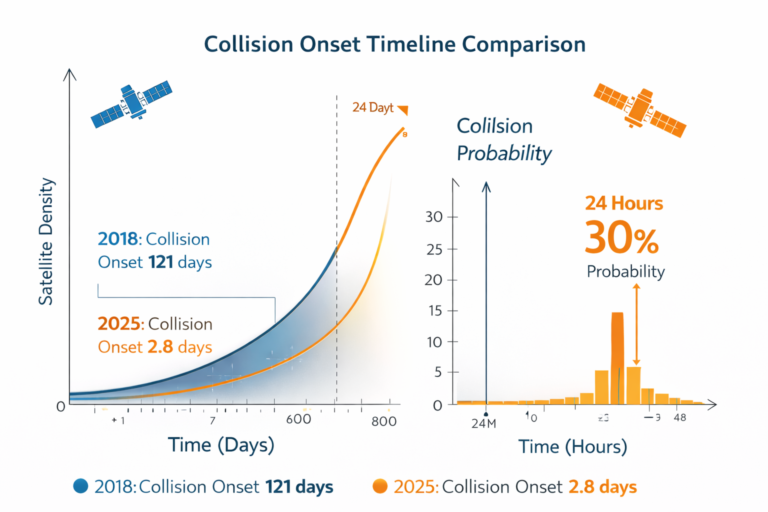
In 2018, before mega-constellations exploded in size, a total loss of satellite control would have taken about 121 days to produce a catastrophic collision.
By mid-2025, that window had collapsed to just 2.8 days.
Losing control for only 24 hours now carries a 30% probability of a major collision event.
Such an accident could ignite Kessler syndrome, a runaway chain reaction where debris generates more debris, eventually making Earth’s orbit unusable.
You can explore how orbital congestion has accelerated this risk in our pillar analysis on artificial intelligence and global power shifts, which explains how emerging technologies are reshaping critical infrastructure worldwide.
Little Warning, Few Recovery Options
What makes solar storms especially frightening is the lack of preparation time. Often, warnings arrive only one or two days in advance.
If satellite operators lose command during such an event, they may have just hours — not weeks — to restore control before collisions begin.
History offers a chilling precedent. The Carrington Event of 1859, the strongest solar storm ever recorded, disrupted telegraph systems across continents. A storm of similar magnitude today could cripple satellite networks far longer than three days.
That single event could isolate humanity from space indefinitely.
A Crowded Orbit Meets Geopolitical Reality
Low Earth Orbit isn’t just a scientific concern — it’s now deeply tied to geopolitics and economics. Satellite networks underpin defence systems, supply chains, and digital economies.
As nations race to dominate orbital infrastructure, the risks multiply. Similar strategic tensions are already visible in terrestrial systems, from cloud outages to global AI competition, as explored in our coverage of how artificial intelligence is reshaping global power.
Yet space lacks enforceable traffic laws, universal safety standards, or coordinated emergency protocols.
Why This Matters for Humanity
The consequences of a Low Earth Orbit disaster would ripple across civilisation:
Loss of GPS and navigation
Breakdown of global communications
Disruption of weather forecasting and disaster response
Long-term shutdown of space launches
Trillions in economic damage
According to Universe Today’s original report, the problem isn’t decades away — it’s already statistically plausible.
For deeper technical context, you can also review the underlying orbital risk research published on arXiv via Princeton University’s collaboration network.
Conclusion: A Connected Sky Comes With Hidden Costs
Satellite mega-constellations have transformed modern life. But they’ve also created a tightly coupled system where one extreme solar storm could trigger irreversible collapse.
A Low Earth Orbit disaster is no longer science fiction. It’s a measurable risk — counted in days.
Preventing it will require global coordination, stricter launch governance, improved space weather forecasting, and sustainable orbital design.
Because once debris fills the sky, there may be no reset button.
If you’re interested in broader space risks, also read our recent analysis on satellite orbit safety and future space sustainability, where we examine how congestion is redefining humanity’s relationship with orbit.
- January 29, 2026
- asquaresolution
- 10:02 am