
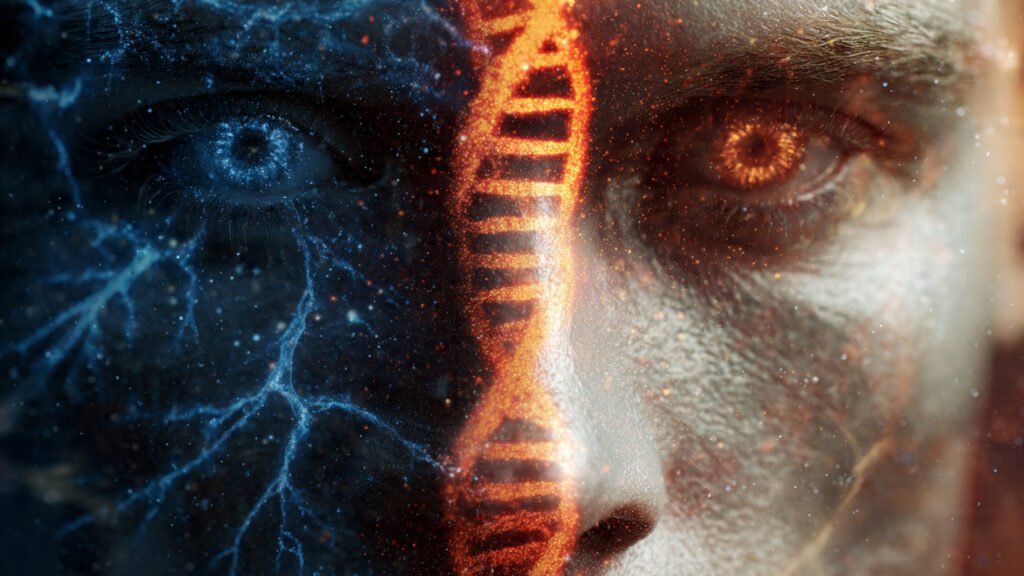
Intelligence did not begin with humans.
It began with survival.
The history of intelligence stretches billions of years back — long before language, long before civilizations, and long before artificial intelligence entered the scene.
Today, as AI systems write code, analyze markets, and assist decision-making, we must ask a deeper question:
How did intelligence evolve in the first place?
This is the complete history of intelligence — from biology to machines.
Intelligence Before Brains: The Biological Foundations
The earliest forms of life had no brains, no nervous systems, and no conscious thought. Yet they adapted.
Single-celled organisms could move toward nutrients and away from danger. This process, known as chemotaxis, represents the earliest form of biological intelligence.
Intelligence at its core is pattern recognition and adaptive response.
As evolution progressed, nervous systems formed. Organisms developed centralized brains capable of processing environmental information more efficiently.
Charles Darwin’s theory of evolution explains that survival favors adaptability. In many ways, evolution itself acts as an intelligence system — testing variations, preserving effective ones, and discarding failures.
The history of intelligence began here: adaptation under pressure.
The Human Cognitive Revolution
The emergence of Homo sapiens marked a turning point in the history of intelligence.
Unlike other species, humans developed symbolic thinking and complex language. This allowed intelligence to become collective.
Knowledge no longer died with individuals. It could be shared, recorded, and preserved.
Writing systems in Mesopotamia and beyond enabled intelligence to exist outside the brain. This shift laid the groundwork for the rise of early civilizations.
If you’ve explored our analysis of the rise of early civilizations, you already understand how writing transformed human coordination and governance.
Language turned intelligence into infrastructure.
The Mathematical Revolution and Computation
The next major leap in the history of intelligence came not from biology — but from mathematics.
In the 20th century, Alan Turing’s foundational work introduced the theoretical model of computation. His ideas laid the foundation for modern computing systems.
You can explore more about Alan Turing’s foundational work here.
Computers separated intelligence from biology.
Logical reasoning could now be encoded in machines.
This was the beginning of artificial intelligence — not yet intelligent in a human sense, but capable of executing complex rule-based tasks.
The history of intelligence had entered the digital phase.
Artificial Intelligence and Machine Learning
Modern artificial intelligence operates through machine learning models trained on massive datasets.
Organizations leading modern artificial intelligence research have built systems that can recognize speech, generate text, create art, and optimize business operations.
Explore developments in modern artificial intelligence research:
https://openai.com
Unlike biological intelligence, machine intelligence does not experience emotion or consciousness. It identifies statistical patterns at scale.
Yet the impact is profound.
AI now supports AI evolution and emerging technologies across industries including healthcare, finance, education, and marketing.
In fact, AI-powered digital transformation is redefining how businesses scale and automate processes.
The history of intelligence is no longer purely biological — it is hybrid.
From Tools to Autonomous Systems
We are now entering the era of agentic AI systems — autonomous programs capable of planning, executing, and adjusting strategies independently.
This marks a shift from tools to actors.
The history of intelligence may soon include non-biological entities making decisions at scale.
This raises philosophical and ethical questions:
Is intelligence equivalent to consciousness?
Or is it simply advanced pattern recognition?
The answer remains uncertain.
Intelligence as Infrastructure
Today, intelligence shapes global systems:
Financial markets
Military strategy
Healthcare diagnostics
Digital ecosystems
Intelligence is no longer confined to individuals. It is distributed across networks.
The history of intelligence has become a story of increasing abstraction:
Biology → Language → Writing → Mathematics → Machines → Autonomous Systems.
Each stage expands capability.
But each stage also increases responsibility.
Watch the Full Documentary
The Future of Intelligence
As artificial systems grow more capable, the question is no longer whether AI will become more intelligent.
The question is whether humanity will apply wisdom alongside intelligence.
Because intelligence without direction can amplify both progress and chaos.
The history of intelligence is still being written.
And we are both its authors — and its subjects.
- February 12, 2026
- A Square Solutions
- 6:50 am