
🏺 Civilizations That Ignored Warning Signs — And Why 2026 Is a Turning Point for Us

Introduction: History Rarely Collapses Overnight
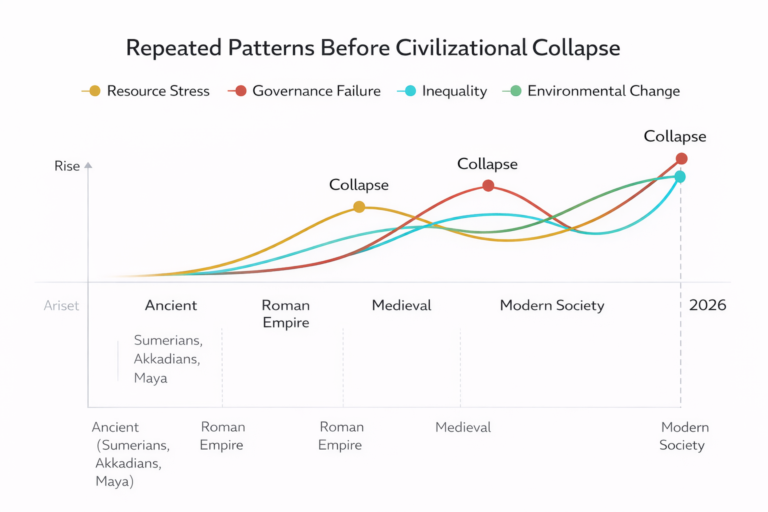
History teaches us one brutal lesson again and again: civilizations do not collapse suddenly. They decay slowly—through ignored warnings, institutional arrogance, and delayed action. From ancient empires to modern societies, the pattern remains consistent. Early signs are visible, documented, and often debated—yet repeatedly dismissed.
In many cases, these failures are recorded in texts, artifacts, and administrative systems that tried to warn future generations. Ancient record-keeping systems such as cuneiform tablets, now being decoded with modern tools, reveal how early societies understood risk long before collapse occurred. Today, we are rediscovering these patterns through technology, as explored in our analysis of AI decoding ancient civilizations and lost historical knowledge. History repeatedly shows that civilizations that ignored warning signs long before their collapse became inevitable.
As we approach 2026, humanity finds itself at a similar inflection point—armed with unprecedented data, yet dangerously confident that collapse is someone else’s problem.
The Roman Empire: When Power Ignored Its Own Decay
The Roman Empire did not fall because of one invasion or one bad ruler. It collapsed because warning signs were normalized.
Currency debasement weakened economic trust
Political institutions lost legitimacy
Military overreach drained resources
Social inequality widened unchecked
Historians studying civilizational collapse note that Rome had centuries to course-correct. Instead, decision-makers relied on short-term stability and symbolic power rather than structural reform. In each case, civilizations that ignored warning signs such as environmental stress, political instability, and widening inequality.
This mirrors modern overconfidence in complex systems—where institutions assume resilience without testing failure scenarios. The same mindset appears today in critical systems where overreliance on automated decision-making replaces human judgment, a risk we’ve examined in depth through modern AI governance failures.
The Indus Valley Civilization: Climate Signals Nobody Acted On
One of history’s most advanced urban societies vanished quietly.
The Indus Valley Civilization had:
Sophisticated city planning
Advanced drainage systems
Standardized trade networks
What it could not control was climate instability.
Recent climate archaeology research published in Nature shows prolonged monsoon failures destabilized agriculture and trade routes. Despite early environmental stress signals, large-scale adaptation never arrived.
Modern societies now face similar climate warnings—only today, the data is clearer, louder, and global. The difference is not awareness. It is response speed.
The Maya Collapse: Data Without Governance
The Maya civilization was mathematically and astronomically advanced. They tracked celestial movements with precision, yet failed to act on long-term environmental degradation.
According to NASA paleoclimate evidence of prolonged droughts, the Maya experienced repeated warning cycles. Each time, leadership doubled down on ritual and hierarchy instead of systemic reform.
This is a recurring theme: information exists, but governance fails.
The same pattern appears today in advanced AI systems that generate insights but lack trustworthy decision-making frameworks, a gap modern research institutions like MIT are actively trying to fix.
Technology as Warning System—or Blindfold?
Ironically, technology has always been part of both survival and collapse.
Ancient civilizations used record-keeping, astronomy, and early mathematics to anticipate risks. Today, AI systems analyze markets, climate, health, and geopolitics in real time.
But technology becomes dangerous when:
Signals are ignored because they are inconvenient
Complexity creates false confidence
Decision-makers outsource responsibility
This is why modern research into trustworthy AI for high-stakes decisions matters—not as innovation hype, but as a safeguard against repeating historical mistakes.
Cuneiform Tablets: The First Risk Reports in Human History
Some of humanity’s earliest warning systems were written in stone—literally.
Cuneiform tablets documented:
Grain shortages
Administrative corruption
Climate disruptions
Political instability
Today, projects decoding these records show how ancient societies understood risk clearly, even if they failed to act. Our deep dive into AI-powered cuneiform translation demonstrates that early civilizations were not ignorant—they were constrained by governance and power dynamics.
The lesson is uncomfortable: collapse is rarely caused by lack of knowledge.
Why 2026 Is Different
For the first time in history, humanity has:
Real-time global risk monitoring
Predictive modeling across systems
Autonomous, agentic technologies that act independently
What makes 2026 a turning point is not danger—it is speed.
Autonomous systems now influence markets, information flows, and infrastructure. As explored in our work on agentic AI systems, small misalignments can scale globally in minutes, not decades.
This compresses the historical timeline of collapse—and recovery.
What History Demands From Us Now
Civilizations that survived did three things early:
Accepted uncomfortable data
Reformed institutions before crisis
Distributed decision-making power
History does not punish ignorance. It punishes denial.
Modern society’s challenge is not technological capability—it is governance maturity. The same patterns appear today, suggesting that modern societies may be repeating how civilizations that ignored warning signs in the past.
As global risk analysts at the World Economic Forum warn, systemic failures rarely announce themselves as disasters. They appear first as “manageable anomalies.”
Conclusion: Learn or Repeat
If history teaches us anything, it is that when civilizations that ignored warning signs, decline followed — and 2026 may test whether we finally learn that lesson.
Civilizations fall when warning signs become background noise.
From Rome to the Maya, from climate collapse to governance failure, history shows that knowledge without action is meaningless. As we move into 2026, the question is no longer whether we can predict risk—but whether we are willing to act on it.
Understanding lessons from human history and technology may determine whether the coming years mark a correction—or another entry in humanity’s long record of avoidable collapse.
- January 1, 2026
- asquaresolution
- 5:53 pm