

AI Is Quietly Changing Human Behavior — And Most People Haven’t Noticed Yet
Introduction: The Change You Didn’t Feel
AI changing human behavior is no longer a distant theory—it is a present-day reality shaping how people think, decide, and interact with technology in subtle but powerful ways. There was no announcement.
No policy debate.
No moment when humanity agreed to hand over small pieces of thinking.
Yet something has changed.
Artificial intelligence is no longer just assisting humans—AI changing human behavior. From how we decide what to read, where we go, what we buy, and even how we cope emotionally, AI is becoming an invisible layer between thought and action.
This transformation isn’t dramatic. That’s what makes it powerful.
The impact of AI changing human behavior is subtle, cumulative, and deeply psychological—and most people haven’t noticed it yet.
How AI Changing Human Behavior Is Reshaping Daily Decisions
Early fears around artificial intelligence focused on job loss and automation. But the more profound shift is happening elsewhere.
AI doesn’t stop humans from thinking.
It changes what humans think about.
When algorithms pre-select options, recommend choices, and predict preferences, humans increasingly operate in reactive mode. Decision-making becomes lighter, faster—and outsourced.
This pattern mirrors concerns raised in our earlier analysis on AI as Emotional Support, where convenience quietly turns into dependency. Researchers now agree that AI changing human behavior operates quietly, influencing attention spans, emotional responses, and trust in automated systems.
The Psychology of Reduced Friction
Human cognition evolved to conserve energy. When AI reduces effort, the brain accepts it willingly.
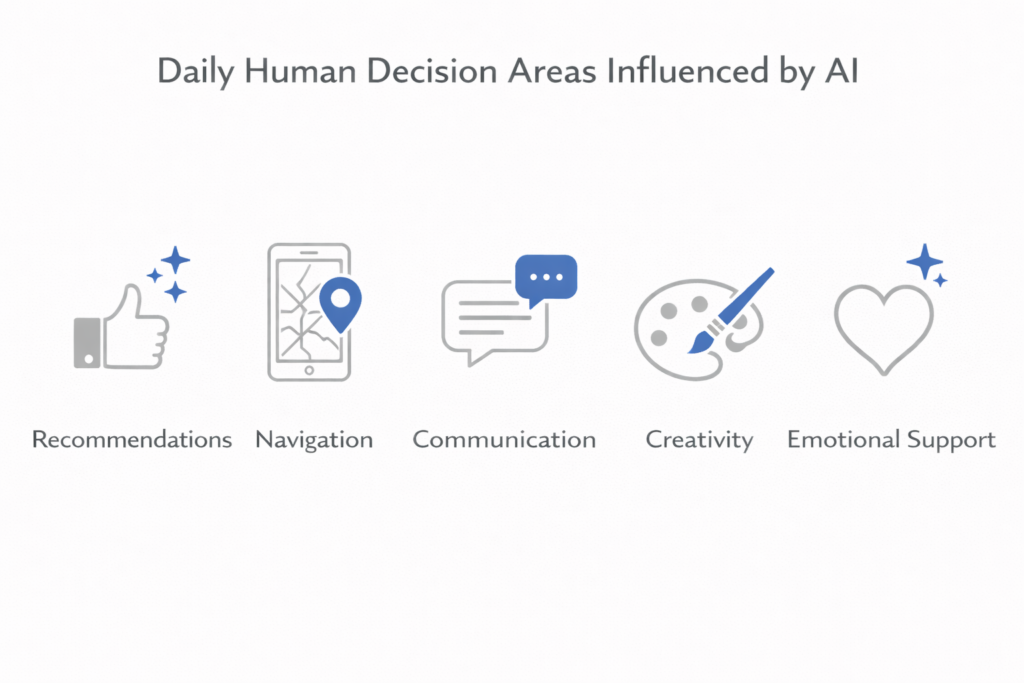
Recommendation engines remove uncertainty.
Navigation apps remove spatial reasoning.
Writing tools remove hesitation.
The result isn’t laziness—it’s adaptation.
Over time, the brain reallocates effort away from tasks AI handles well. This creates efficiency, but also dependency. The skill doesn’t vanish immediately; it atrophies slowly.
This is how AI and human psychology begin to intertwine.
Attention Is Being Rewired, Not Stolen
Much has been written about AI “stealing attention.” The reality is more nuanced.
AI doesn’t just capture attention—it structures it.
Algorithms decide:
What appears first
What feels relevant
What disappears
This subtly shapes worldview. People don’t consume less information—they consume narrower streams of it.
As explored in Why 2025 Will Decide the Future of Artificial Intelligence, the next phase of AI influence is not scale—it’s direction.
Emotional Offloading Is Becoming Normal
One of the most significant behavioral shifts involves emotion.
Millions now use AI tools to:
Vent frustration
Seek reassurance
Organize thoughts
Reduce anxiety
This isn’t inherently harmful. In many cases, it helps.
But emotional offloading changes how humans process feelings internally. Instead of reflection, people increasingly seek external cognitive mirrors.
Trusted outlets like BBC Innovation have noted how AI companionship is reshaping emotional habits—especially among younger users.
Creativity Is Shifting, Not Dying
There is a growing fear that AI will kill creativity. What’s actually happening is more complex.
Humans are moving from creation to curation.
Instead of starting from nothing, people now:
Refine
Select
Guide
Edit
This changes the emotional relationship with creativity. Pride shifts from originality to outcome.
As discussed in AI Winter Explained, every AI cycle forces humans to redefine value—not just productivity.
Trust Is Quietly Migrating
Another overlooked shift is trust.
People increasingly trust:
Algorithmic recommendations
Automated summaries
AI-filtered insights
Often without questioning assumptions.
This raises societal implications. When trust migrates from institutions to systems, accountability becomes opaque. This concern connects directly to the geopolitical risks explored in The Silent AGI War.
A Society That Thinks Faster—but Less Deeply?
Speed is AI’s greatest advantage. But depth requires friction.
When answers arrive instantly, reflection becomes optional. This doesn’t mean humans stop thinking—but thinking becomes shallower by default.
This is not a moral failure. It’s an environmental change.
Just as cities reshape movement and smartphones reshape memory, AI is reshaping cognition.
The Point of No Alarm—But Awareness
This is not a warning against artificial intelligence.
AI has delivered real benefits: accessibility, efficiency, inclusion, and insight. The issue is not adoption—it’s unexamined adaptation.
Societies that understand how AI changes behavior can design better education, healthier digital habits, and more resilient thinking frameworks.
Those that don’t may wake up to changes they never consciously chose.
Conclusion: The Quietest Revolutions Matter Most
Revolutions don’t always arrive loudly.
Some slip in gently—through convenience, assistance, and efficiency—until they become invisible.
Artificial intelligence is quietly changing human behavior. Not by force. Not by control. But by becoming the path of least resistance.
The future of AI will not be decided by technology alone.
It will be decided by how consciously humans adapt to it. The long-term impact of AI changing human behavior will depend on how consciously societies choose to guide and regulate these systems.
And that conversation is only just beginning.
- December 27, 2025
- asquaresolution
- 5:30 pm

Trump Orders Release of UFO & Alien Files in 2026 — Political Showdown with Obama Sparks Transparency Debate
21 February 2026 | by A Square Solutions
Read More → 
Prince Andrew Arrest 2026: Epstein Fallout and the Monarchy’s Accountability Crisis
20 February 2026 | by A Square Solutions
Read More → 
How to Convert Image to PDF Online for Free (Step-by-Step Guide)
19 February 2026 | by A Square Solutions
Read More → 
US Plans Online Portal to Bypass European Content Bans — A New Digital Sovereignty Battle Begins
19 February 2026 | by A Square Solutions
Read More → 
AI in FMCG Industry (2026): 9 Real Use Cases Driving Revenue, Automation & ROI
18 February 2026 | by A Square Solutions
Read More →