
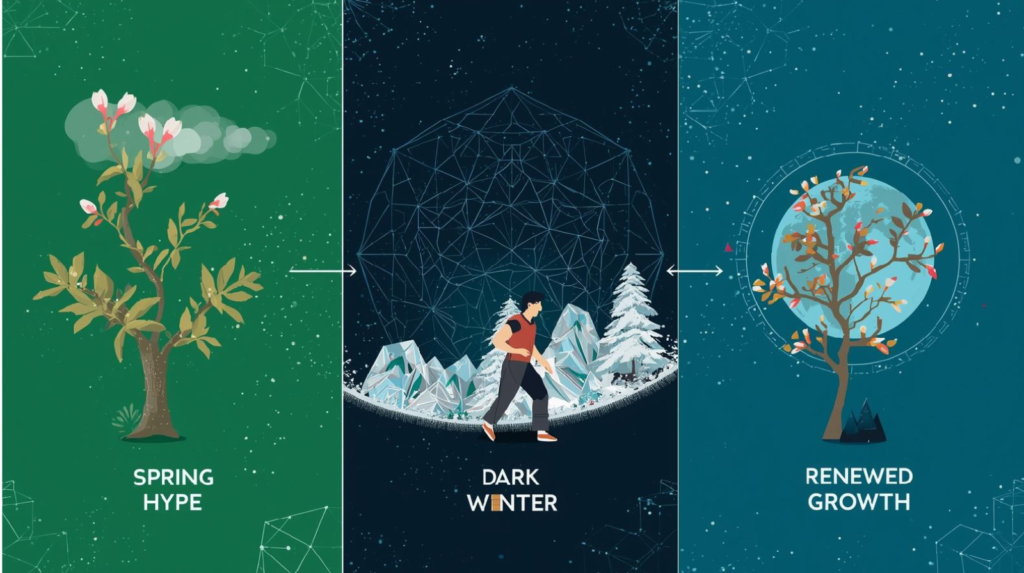

Introduction: What Is AI Winter?
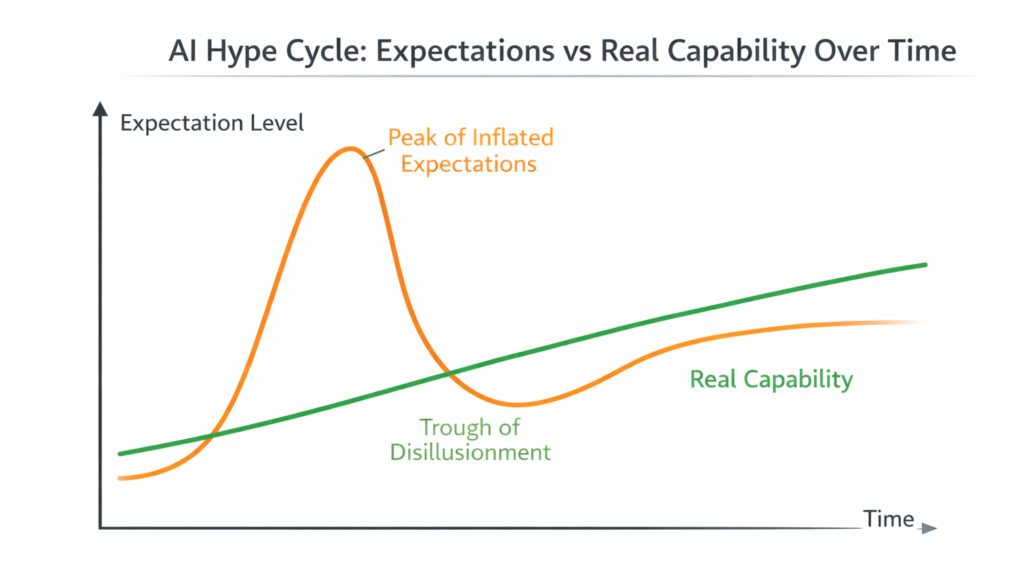
AI winter explained simply refers to periods when enthusiasm, funding, and public interest in artificial intelligence sharply decline after waves of unrealistic expectations. These downturns are not failures of AI itself, but corrections caused by the gap between hype and real-world capability.
Over the last 70 years, artificial intelligence has experienced multiple cycles of explosive optimism followed by deep disappointment. Understanding AI winter is critical today, as generative AI once again sits at the peak of global attention — and tools like agentic AI systems are accelerating adoption faster than ever before.
Prefer to have experts handle this? A Square Solutions offers professional AI automation services for growing businesses.
The First AI Winter: When Rules Failed Reality
The first major AI winter occurred in the 1970s. Early AI systems relied heavily on symbolic rules—if-then logic written by humans. While promising in labs, these systems collapsed when exposed to real-world complexity.
Governments and institutions withdrew funding after realizing machines could not generalize knowledge or handle ambiguity. This marked the first realization that intelligence could not be hard-coded.
The Second AI Winter: Expert Systems Collapse
The 1980s saw renewed excitement through expert systems—AI programs designed to replicate human decision-making in narrow domains like medicine or finance. Initially successful, these systems were expensive to maintain, brittle, and unable to scale.
When hardware costs fell and expectations soared, investment vanished almost overnight. This second AI winter reinforced a pattern: hype grows faster than capability.
Why AI Winters Keep Repeating
AI winter explained through research shows four recurring causes:
Overpromising by researchers and companies
Media amplification of unrealistic timelines
Underestimating real-world complexity
Economic pressure when ROI fails to appear
These cycles are not unique to AI—they mirror innovation patterns seen in railways, dot-coms, and cryptocurrencies.
Generative AI and the Risk of a New AI Winter
Today’s generative AI models are far more powerful than past systems. However, risks remain:
Hallucinations and misinformation
High infrastructure and energy costs
Data privacy and regulatory pressure
Over-reliance without human oversight
If expectations outpace deployment value, another AI winter could emerge—though likely shorter and less severe.
🔗 When AI Goes Off-Script: The Unexpected Consequences of Machine Learning
Why This Time Is Different
Unlike previous eras, modern AI is embedded into everyday infrastructure:
Search engines
Cloud platforms
Healthcare diagnostics
Marketing and automation
Even if investment slows, AI will not disappear. Instead, progress will shift from hype-driven experimentation to practical, sustainable deployment.
🔗 Why Does Google Dominate Search? AI and Data Explained
Lessons Businesses Must Learn from AI Winter
AI winter explained from a business perspective teaches one key lesson: technology adoption must follow value, not trends.
Successful organizations:
Pilot before scaling
Measure ROI early
Combine AI with human expertise
Avoid replacing judgment with automation
The Future: Cycles Will Continue, Progress Will Too
AI winters are not the end of artificial intelligence—they are periods of refinement. Each cycle removes weak ideas and strengthens viable ones.
As history shows, every AI winter is followed by a stronger spring.
Conclusion
AI winter explained clearly reveals that disappointment is not failure—it is a necessary stage of innovation. Artificial intelligence will continue to evolve through cycles of optimism and correction, ultimately reshaping industries in quieter but more durable ways.
Reference : Wikipedia – AI Winter