

The Silent AGI War: How Artificial Intelligence Is Reshaping Global Power in 2025
📚 Further Reading
The most consequential war heading into 2025 is not being fought with missiles, soldiers, or tanks. It is unfolding silently—inside data centers, research labs, and government policy rooms. This is the silent AGI war, a global struggle to control artificial intelligence powerful enough to reshape economies, security, and political influence.
Unlike past technological rivalries, this conflict lacks visible flashpoints. There are no declarations, no treaties, and no headlines announcing escalation. Yet its consequences may be deeper and longer-lasting than any traditional arms race.
Why This Is an AGI War, Not a Tech Race
Artificial intelligence competitions of the past focused on products: better algorithms, faster software, smarter consumer tools. The silent AGI war is different.
This race is about general intelligence—systems capable of reasoning, adapting, and making decisions across domains. Control over AGI means influence over logistics, finance, military planning, scientific discovery, and governance itself.
As discussed in our earlier analysis on Why 2025 Will Decide the Future of Artificial Intelligence, the next phase of AI development is no longer optional infrastructure—it is national strategy.
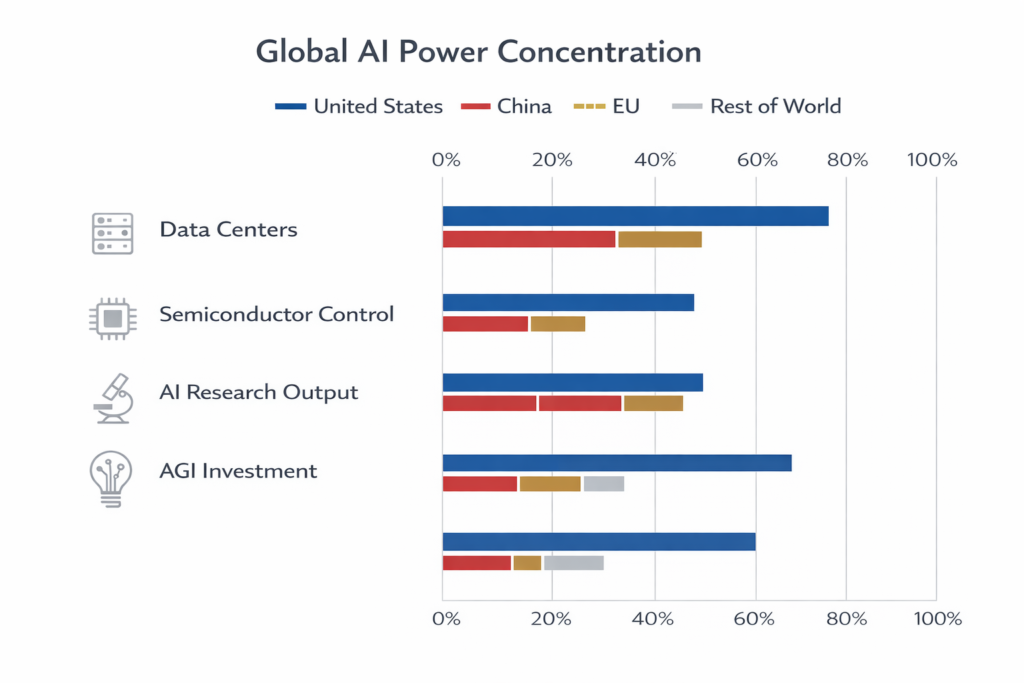
Compute Is the New Oil
In the silent AGI war, compute power has replaced oil as the world’s most strategic resource.
Massive AI models require unprecedented access to GPUs, energy, and cooling infrastructure. Nations capable of building and sustaining these systems gain asymmetric advantages. Those without access risk dependency.
According to reporting from BBC Innovation, global competition over AI data centers and semiconductor supply chains has intensified quietly but rapidly.
This mirrors concerns raised by MIT Technology Review, which that AI power is consolidating faster than regulatory frameworks can adapt.
Data Sovereignty Is Becoming National Security
Data is the fuel of artificial intelligence—and in the AGI era, it becomes a matter of sovereignty.
Countries are increasingly restricting cross-border data flows, citing privacy and security. But beneath the surface lies a deeper motive: retaining training data for strategic AI advantage.
This trend aligns with themes explored in our article on AI Governance and Global Regulation, where fragmented rules risk creating AI blocs rather than a shared ecosystem.
The Military Implications No One Wants to Admit
While public conversations focus on consumer AI, defense agencies are quietly integrating AI into surveillance, logistics, simulation, and strategic modeling.
AGI-adjacent systems promise faster decision cycles—but also raise unprecedented risks. Automated escalation, misaligned objectives, and opaque reasoning could destabilize deterrence itself.
This is why many experts warn that the silent AGI war may be more dangerous than nuclear competition—not because of immediate destruction, but because of loss of control.
A Fragmented AI World Is Emerging
One of the most overlooked outcomes of the AI arms race in 2025 is fragmentation.
Instead of a unified global AI ecosystem, we are moving toward:
Western AI stacks
Chinese AI infrastructure
Region-specific regulatory models
As previously analyzed in AI and Global Power Dynamics, this fragmentation could reduce collaboration while amplifying mistrust.
Public Awareness Lags Behind Reality
Despite its significance, the silent AGI war remains largely invisible to the public.
There are no consumer-facing signals, no dramatic announcements. Most developments occur behind closed doors, shielded by corporate secrecy and national security classifications.
This gap between reality and perception is dangerous. Societies cannot debate or govern what they do not understand.
What Happens If the Silent AGI War Escalates?
If mishandled, the AI arms race could produce:
Concentrated power among a few actors
Increased global instability
Accelerated ethical erosion
Reduced democratic oversight
Yet escalation is not inevitable. Transparency, international coordination, and shared safety research could redirect the trajectory.
Conclusion: The War That Will Shape the Decade
The silent AGI war will not be remembered for a single breakthrough or headline. It will be remembered for reshaping how power itself is distributed.
As artificial intelligence moves closer to general reasoning, the question is no longer whether nations will compete—but whether humanity can manage that competition responsibly.
The silent AGI war has already begun.
What happens next depends on choices made now.
A Square Solutions specialises in AI Intelligence & Business Strategy — AI, automation, and intelligent digital systems that deliver real ROI.

🚀 A Square Solutions
We specialise in AI Intelligence & Business Strategy — helping businesses scale through AI and intelligent digital systems.
Frequently Asked Questions
What is The Silent AGI War?
The most consequential war heading into 2025 is not being fought with missiles, soldiers, or tanks.
Why is The Silent AGI War important in 2026?
It is unfolding silently—inside data centers, research labs, and government policy rooms.
How does The Silent AGI War work?
This is the silent AGI war , a global struggle to control artificial intelligence powerful enough to reshape economies, security, and political influence.
What should you know about The Silent AGI War?
Unlike past technological rivalries, this conflict lacks visible flashpoints.
Sources: Reuters Technology | BBC Technology
💬 Questions about this topic?
Use the 🤖 Ask Our AI widget (bottom-right) — instant answers, 24/7.