
🔍 Why Does Google Dominate Search Engines?
AI, Data Monopoly & Network Effects Explained (2025 Research)
Why does Google dominate search engines even after two decades of competition from Bing, DuckDuckGo, and now AI chatbots like ChatGPT?
The answer is not just “better algorithms” — it is a powerful mix of AI intelligence, massive data advantage, behavioral science, and network effects that competitors struggle to replicate.
This article breaks down the real research-backed reasons behind Google’s search dominance in 2025 — and whether AI will finally disrupt it.
Google’s AI Advantage: From RankBrain to Gemini
Google’s dominance in search is deeply rooted in its early adoption of artificial intelligence.
RankBrain (2015) allowed Google to understand search intent, not just keywords
BERT & MUM improved context, language, and semantic understanding
Gemini AI (2024–2025) integrates reasoning, multimodal search, and predictive intent
Unlike traditional search engines, Google doesn’t just index pages — it predicts what users actually want.
AI Redefining Google Search Dominance – Why It Matters
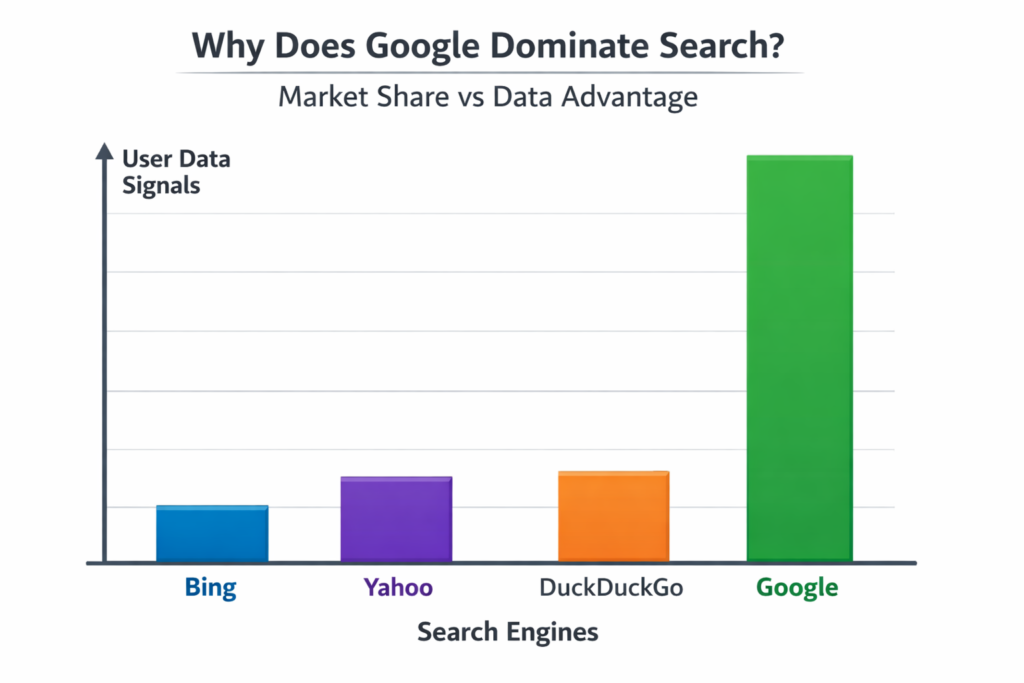
The Data Flywheel: Why More Users Make Google Stronger
Google processes over 8.5 billion searches per day.
Every click, bounce, reformulation, and dwell time feeds back into its AI models.
This creates a data flywheel effect:
More users → better results → more trust → more users
Competitors like Bing or DuckDuckGo simply do not have access to this scale of behavioral data — even with similar technology.
Behavioral Science: Google Understands Humans, Not Just Queries
Google’s algorithms are trained on human behavior patterns, not just text.
It tracks:
Click satisfaction
Search refinement loops
Short vs long dwell time
Implicit trust signals
This allows Google to self-correct results in real time, something AI chatbots still struggle with.
How AI Understands Human Intent Better Than Keywords
Why Bing, DuckDuckGo & Others Still Lag Behind
Despite heavy investment, alternatives face structural disadvantages:
| Engine | Limitation |
|---|---|
| Bing | Lower user data diversity |
| DuckDuckGo | Privacy-first but weaker personalization |
| AI Chatbots | Hallucinations + lack of citation trust |
Even when results are “technically good,” users default to Google out of habit and trust.
This is called default bias, a well-documented cognitive phenomenon.
Will AI Chatbots Replace Google Search?
Short answer: Not yet.
AI chatbots are excellent for:
Exploratory research
Summarization
Ideation
But Google still wins in:
Real-time information
Source diversity
Local intent
Transactional queries
In fact, Google is absorbing AI features into search, not competing against them.
🔗 Google AI Search Impact on Digital Marketing in 2025
Regulatory Pressure vs User Reality
Governments may challenge Google’s dominance legally, but users decide dominance behaviorally.
As long as Google:
Feels faster
Feels more accurate
Feels more familiar
…it will remain the default search engine — regardless of regulation.
🔮 Conclusion: The Real Reason Google Dominates Search
Google’s dominance is not accidental.
It is the result of AI leadership, data scale, behavioral intelligence, and deep ecosystem integration.
Until another platform can match all four simultaneously, Google’s search dominance in 2025 remains largely unchallenged.