
Venezuela Political Crisis 2026: What Maduro’s US Detention Means for Power, Oil & the Global Order
Venezuela has entered one of the most volatile political moments in its modern history. According to Reuters, U.S. forces detained President Nicolás Maduro in an overnight operation in Caracas, transferring him to a detention facility in New York to face long-standing drug-related charges.
While Washington frames the move as a law-enforcement action, events unfolding inside Venezuela suggest that power has not changed hands — at least not yet.
This developing crisis has implications far beyond Latin America, touching energy markets, international law, and the future of U.S. interventionism.
What Happened in Venezuela?
As reported by Reuters, U.S. President Donald Trump ordered Maduro’s removal, stating that the United States would temporarily “oversee” Venezuela until a political transition occurs. Images of Maduro blindfolded and handcuffed stunned both supporters and critics.
However, inside Caracas:
Vice President Delcy Rodríguez has assumed interim authority
The military and security apparatus remains loyal to Maduro’s inner circle
Streets remain tense but largely calm, according to local accounts
This contradiction — a detained president but an intact ruling structure — defines the Venezuela political crisis of 2026.
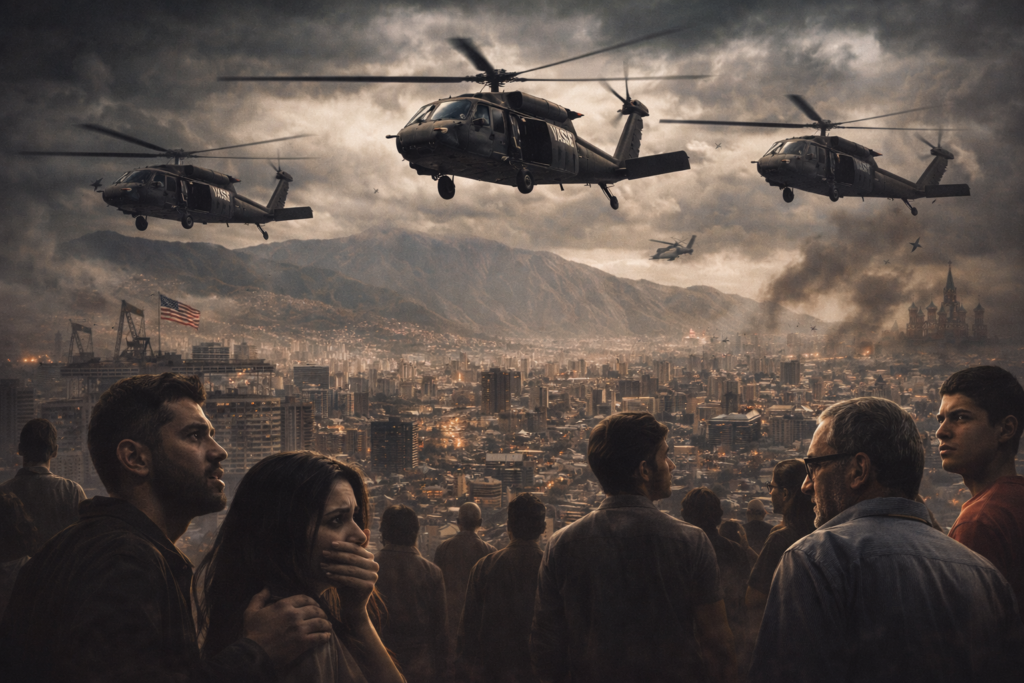
Who Really Controls Venezuela Right Now?
BBC analysis confirms that despite Trump’s rhetoric, Maduro’s allies still control state institutions. The military, judiciary, and oil ministry continue to operate under the same leadership.
Delcy Rodríguez, who also oversees oil policy, has rejected claims that she is cooperating with Washington. Her position is critical because Venezuela’s oil sector remains the country’s primary economic lever.
This mirrors patterns seen in other regime-change attempts, where removing a leader does not automatically dismantle entrenched power networks.
Oil, Sanctions, and the Real Battle
At the heart of this crisis lies oil.
Reuters reports that Venezuela’s state oil company PDVSA has begun shutting down production sites as U.S. sanctions and tanker blockades disrupt exports. Trump has openly stated that major U.S. oil companies could move into Venezuela — a claim Caracas officials say confirms long-held suspicions.
This aligns with broader global trends explored in our analysis of global power shifts driven by technology and resources, where energy access increasingly shapes geopolitical decisions.
International Law and Global Reaction
The legality of detaining a sitting head of state has drawn widespread criticism.
The United Nations Secretary-General warned the move sets a “dangerous precedent”
Russia and China, both key Maduro allies, condemned the action
U.S. lawmakers from both parties have demanded clarity on next steps
According to BBC World Service, many Venezuelans fear that even if Maduro is gone, the country could slide into deeper instability without a clear transition plan.
Why This Crisis Matters Beyond Venezuela
This is not just a regional story.
The Venezuela political crisis 2026 raises urgent questions:
Can powerful nations detain foreign leaders without global consensus?
Does military-backed “law enforcement” redefine sovereignty?
Will resource-driven interventions become normalized?
As we’ve explored previously in our Global Affairs & News coverage, technology, sanctions, and economic pressure now function as modern instruments of power — often replacing traditional diplomacy.
Why This Crisis Matters Beyond Venezuela
Several scenarios remain possible:
Stalemate – Maduro’s allies retain control while negotiations stall
Escalation – Further U.S. pressure or military action
Negotiated Transition – International mediation involving the UN
For ordinary Venezuelans, uncertainty dominates daily life. As one Caracas resident told the BBC, “It feels like waiting for something that could either free us — or destroy us.”
Final Thoughts
The Venezuela political crisis 2026 is a defining moment for international order. Whether this becomes a turning point for democracy or a cautionary tale of interventionism depends on what happens next — not just in Caracas, but in Washington, Beijing, Moscow, and beyond.
At A Square Solutions, we track these developments not as isolated headlines, but as part of a larger system where power, technology, and economics intersect.
- January 4, 2026
- asquaresolution
- 6:51 pm