Starlink Satellite Orbit Safety: Why SpaceX Is Lowering Orbits in 2026
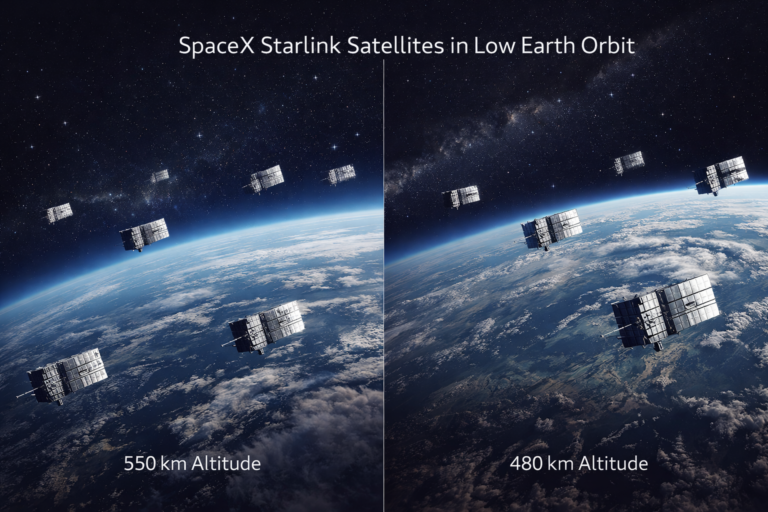
Starlink satellite orbit safety has become one of the most urgent challenges in modern space operations. In response, SpaceX has announced a major reconfiguration of its Starlink constellation—lowering satellites from around 550 km to 480 km throughout 2026.
The decision follows a rare in-orbit anomaly that created debris and reignited global concerns about congestion in low Earth orbit (LEO). As satellite constellations multiply, even small adjustments can significantly impact long-term space sustainability.
SpaceX plans to lower Starlink satellites to improve orbital safety and reduce space debris.
What Exactly Is Starlink Changing in 2026?
Starlink currently operates nearly 10,000 satellites, making it the largest satellite network in history. According to SpaceX, all satellites operating around 550 km altitude will gradually be shifted downward to 480 km.
Why this matters for starlink satellite orbit safety:
Lower orbits contain fewer debris objects
Atmospheric drag naturally pulls failed satellites down faster
Collision probability drops significantly below 500 km
This move is not cosmetic—it’s structural.
Why Lower Orbits Improve Satellite Orbit Safety
The physics of orbital altitude plays a major role in long-term space safety.
At higher altitudes, debris can remain in orbit for decades or centuries. At lower altitudes, atmospheric drag causes objects to burn up in years—or even months.
By lowering Starlink satellites:
Defunct satellites deorbit faster
Chain-reaction collisions (Kessler Syndrome) become less likely
Space traffic becomes easier to manage
This approach aligns with international best practices promoted by organizations like NASA’s Orbital Debris Program Office, which emphasizes faster post-mission disposal.
The Incident That Triggered the Shift
In late 2025, Starlink confirmed that one satellite experienced a kinetic anomaly, creating a small amount of debris and losing communications. The spacecraft dropped several kilometers in altitude unexpectedly—suggesting an internal failure.
While rare, this incident highlighted a key reality:
Even well-engineered systems fail at scale.
With thousands of satellites in orbit, starlink satellite orbit safety must assume failure—not just success.
The Bigger Problem: Crowded Low Earth Orbit
The number of active spacecraft in Earth’s orbit has surged due to:
Satellite internet constellations
Earth observation networks
Military and research payloads
Companies and governments are racing to deploy tens of thousands of satellites. Without proactive measures, collision risk rises exponentially.
Prioritize orbital responsibility over maximum coverage
This mirrors how earlier technologies—from aviation to nuclear power—had to mature rapidly once risks became unavoidable.
Is Lower Orbit a Trade-Off?
Yes—but a calculated one.
Lower orbits mean:
Slightly higher atmospheric drag
More frequent station-keeping maneuvers
Potentially shorter satellite lifespans
However, SpaceX appears willing to trade longevity for safety, a shift that signals maturity rather than limitation.
From a systems perspective, this reflects a broader principle seen across advanced engineering:
Safer systems often sacrifice peak efficiency for resilience.
Why This Matters Beyond Starlink
Starlink satellite orbit safety isn’t just a SpaceX issue—it’s a global commons issue.
Navigation systems, weather forecasting, climate monitoring, and emergency communications all rely on safe orbital environments. A single cascade failure could cripple essential infrastructure worldwide.
As we enter 2026, space is no longer “empty.” It’s critical infrastructure.
Final Thoughts: A Quiet but Crucial Decision
Lowering satellite orbits may not sound dramatic—but it’s one of the most responsible moves any space company can make right now.
Starlink’s 2026 plan signals an important shift: space safety is no longer optional—it’s foundational.
As satellite networks expand, decisions like this will determine whether Earth’s orbit remains usable for generations—or becomes a cautionary tale.
Understanding Starlink Satellite Orbit Changes The Starlink satellite constellation, developed by SpaceX, is a rapidly expanding network designed to provide...
In today’s digital workflow, sharing documents in a structured and professional format is essential. Whether you’re submitting assignments, sending business...
We use cookies to ensure that we give you the best experience on our website. If you continue to use this site we will assume that you are happy with it.