

Ramanujan Pi Formula: How a 100-Year-Old Insight Is Still Explaining the Universe
In the early 20th century, Srinivasa Ramanujan worked alone, without computers, formal training, or modern physics. He filled notebooks with formulas that appeared beautiful but impractical—mathematical expressions that many believed belonged only to abstract theory.
More than a hundred years later, scientists are discovering something remarkable: the Ramanujan pi formula is quietly describing real phenomena in the physical universe. From turbulent fluids to the structure of black holes, equations once thought disconnected from reality are now appearing at the heart of modern physics.
This is not just a story about mathematics. It is a story about how the universe may be written in patterns that human intuition can glimpse long before science fully understands them.
Who Was Srinivasa Ramanujan?
Srinivasa Ramanujan was not a traditional mathematician. Born in India in 1887, he developed extraordinary mathematical intuition with little access to formal education or research resources. His notebooks contained thousands of formulas—many without proofs—that stunned mathematicians across Europe.
What made Ramanujan unique was not calculation speed, but pattern recognition. He seemed to see mathematical relationships instinctively, producing results that would take others decades to verify.
At the time, many of his discoveries—including his formulas for π (pi)—were admired for elegance, not utility. No one imagined they would one day help explain turbulence or black holes.
What Is the Ramanujan Pi Formula?
Pi (π) represents the ratio of a circle’s circumference to its diameter. Calculating it accurately has challenged mathematicians for centuries.
Ramanujan discovered rapidly converging infinite series for π—formulas that calculate its value with extraordinary efficiency. These expressions were far ahead of their time, outperforming known methods by orders of magnitude.
For decades, the Ramanujan pi formula was treated as pure mathematics—beautiful, but detached from physical meaning.
That assumption is now changing.
The IISc Discovery: Math Meets Reality
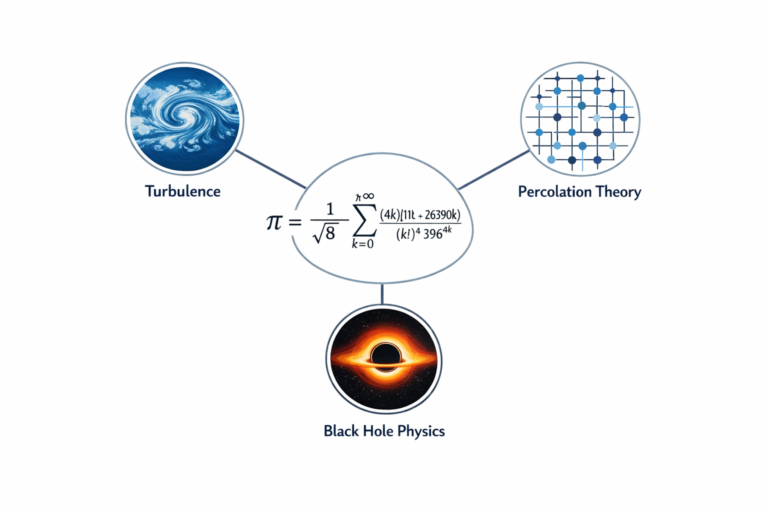
Researchers at the Indian Institute of Science (IISc) recently discovered that the same mathematical structures underlying Ramanujan’s pi formulas also describe real-world physical systems.
These structures appear in:
Turbulent fluid flows
Percolation processes (how substances spread through materials)
Statistical models used in black hole physics
This connection suggests that Ramanujan unknowingly captured universal mathematical patterns that govern both abstract numbers and physical reality.
Why Does the Same Math Appear Everywhere?
Nature favors efficiency. Systems that minimize energy, maximize stability, or follow probabilistic balance often converge toward the same mathematical patterns.
This is why:
Fluid turbulence resembles galaxy formation
Percolation models resemble neural networks
Black hole entropy shares similarities with statistical mechanics
Ramanujan’s work appears to capture these deep structural symmetries.
This idea echoes themes explored in our analysis of large-scale scientific systems, including ecosystem breakdown discussed in Zombie Worms Have Vanished From the Deep Ocean — And Scientists Are Alarmed.
From Equations to Black Holes
One of the most surprising connections is to black hole physics.
Modern theoretical models rely heavily on statistical mechanics—precisely the domain where Ramanujan’s formulas naturally arise. Researchers are finding that the same infinite series structures can describe entropy distributions and quantum boundary behavior near black holes.
This reinforces a profound idea: the universe may follow mathematical rules discovered long before we knew where to look.
India’s Scientific Legacy Revisited
Ramanujan’s rediscovery arrives at a time when Indian science is regaining global attention. From breakthroughs in biotechnology—such as India’s First Gene-Edited Sheep Turns One—to foundational mathematical insights, India’s contribution to global knowledge is increasingly visible.
Ramanujan’s legacy is not symbolic pride. It is functional science.
Why This Discovery Matters Today
This revelation impacts multiple fields:
Physics: Better models of chaos and entropy
Mathematics: Validation of intuition-driven discovery
Cosmology: Insights into universal order
Education: Reframing how mathematical creativity is valued
At a time when artificial intelligence dominates technological discussion—as seen in 2025 Will Decide the Future of AI—Ramanujan reminds us that human insight remains irreplaceable.
Mathematics as the Language of the Universe
Physicists often say the universe is written in the language of mathematics. Ramanujan may have been fluent in that language long before we understood its grammar.
He did not solve physical problems. He uncovered patterns that reality later revealed as fundamental
Conclusion: When the Universe Catches Up to Genius
Ramanujan died at just 32 years old. He never saw computers, quantum theory, or modern cosmology.
Yet today, his formulas help scientists understand turbulence, black holes, and the structure of reality itself.
The Ramanujan pi formula is not a historical artifact.
It is living mathematics—still unfolding its meaning.
- December 29, 2025
- asquaresolution
- 9:43 pm

Trump Orders Release of UFO & Alien Files in 2026 — Political Showdown with Obama Sparks Transparency Debate
21 February 2026 | by A Square Solutions
Read More → 
Prince Andrew Arrest 2026: Epstein Fallout and the Monarchy’s Accountability Crisis
20 February 2026 | by A Square Solutions
Read More →