
NASA Confirms Its 6,000th Alien World — And the Universe Has Never Looked Stranger
From lava planets and gemstone clouds to a promising super-Earth just 20 light-years away, recent discoveries are rewriting our cosmic expectations.
🚀 Introduction: A Milestone in Humanity’s Search for Life
NASA has officially confirmed 6,000 exoplanets, each one a new world orbiting a distant star. It’s a moment that marks how far our technology — and curiosity — have come. But the diversity of these planets is what has stunned scientists the most:
Lava oceans stretching across entire worlds
Planets lighter than Styrofoam
Gemstone clouds raining sapphires and rubies
Star-hugging gas giants that complete an orbit in hours
At the same time, new research suggests that intelligent life may be incredibly rare, with the nearest possible alien civilization perhaps 33,000 light-years away. Yet another discovery — a newly confirmed super-Earth just 20 light-years away — may be our best chance yet to detect life.
And while this is unfolding, NASA also released stunning new images of comet 3I/ATLAS, shutting down viral rumors claiming it might be an alien spacecraft.
This is the story of all these breakthroughs — connected, explained, and made to truly blow your mind.
🪐 1. NASA’s 6,000 Exoplanets: A Universe of Strange Worlds
Source: NASA Jet Propulsion Laboratory (Sept 21, 2025)
NASA’s exoplanet catalog hitting 6,000 confirmed worlds isn’t just a number — it’s a new era of discovery.
The strangest planets we’ve found so far
🔥 Lava Worlds
Some exoplanets are so close to their stars that their surfaces are literal magma oceans. Winds can blow molten rock sideways at thousands of km/h.
🪶 “Styrofoam” Worlds
A handful of planets have densities lower than Styrofoam — meaning you could theoretically scoop them with a giant spoon.
💎 Gemstone Clouds
A few ultra-hot Jupiters appear to host clouds made of corundum — the mineral behind rubies and sapphires.
These alien worlds echo the cosmic strangeness seen in posts like “Cosmic Arcs & Silicon Dreams”
What allowed these discoveries?
Kepler
TESS (still scanning)
Ground-based spectrographs
AI-enhanced signal extraction
Improved transit timing variations
These tools are why we now confirm new planets almost weekly.
What allowed these discoveries?
Source: Europlanet (Oct 12, 2025)
A new statistical model proposes that intelligent, technological civilizations are probably far rarer than optimistic estimates suggested.
Key finding:
The nearest intelligent civilization may be 33,000 light-years away.
Not impossible — but unimaginably far.
This echoes themes we explored earlier in our internal article on the Fermi Paradox & AI models distinguishing noise from dark matter:
Why this matters
Intelligent life might be a fluke.
Biospheres could be common… but brains might not be.
SETI must scan much deeper than before.
Yet scientists emphasize the search must continue — either answer transforms our understanding of life.
🌍 3. A New Hope: A Super-Earth Just 20 Light-Years Away
Source: Penn State (Nov 13, 2025)
While intelligent life might be rare, habitable planets may not be.
Researchers just confirmed a super-Earth in the habitable zone of a nearby star — only 20 light-years away.
Why this one matters:
Right temperature for liquid water
Stable star with a long lifespan
Rocky surface (unlike gas giants)
Detectors capable of analyzing its atmosphere soon
Penn State’s advanced spectrographs made the detection possible after decades of observations.
This discovery aligns with earlier internal articles about exoplanet atmospheres and alien biosignatures:
If any nearby planet has a shot at harboring life — it might be this one.
☄️ 4. NASA Releases New Images of Comet 3I/ATLAS — And No, It’s Not an Alien Ship
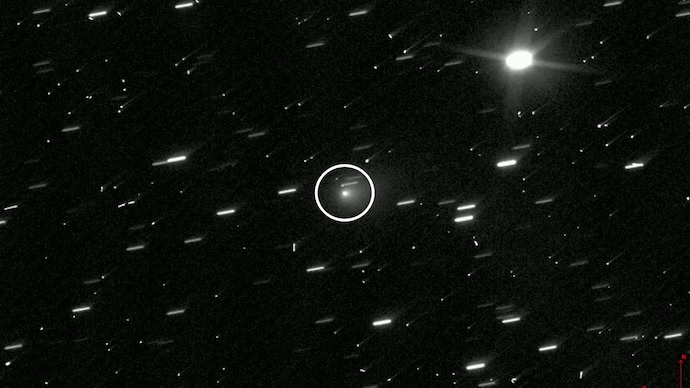
In a separate development, NASA unveiled crystal-clear images of comet 3I/ATLAS, a rare interstellar visitor.
Some corners of the internet spun up rumors claiming ATLAS was an alien spacecraft because of its trajectory.
NASA has now officially shut that down:
“There is absolutely no evidence that 3I/ATLAS is artificial.”
The comet is simply:
icy
natural
tumbling
extremely old
and on a hyperbolic path
But the images themselves? Breathtaking — and the best look yet at an object from beyond our solar system.
🛰️ 5. What Comes Next: The Space Missions That Will Make This Even Bigger
🚀 Roman Space Telescope (Launch: 2027)
Will image exoplanets directly with unprecedented precision.
🛰️ Habitable Worlds Observatory (2030s)
Humanity’s first telescope designed specifically to detect life.
🧬 AI-enhanced analysis
Modern AI techniques can extract details from light curves that human astronomers miss — something we explored in:
👉 Read here
Together, they will answer:
How many planets actually resemble Earth?
Which atmospheres contain oxygen, methane, or industrial pollutants?
How common are oceans?
Could any host biology?
The next decade may finally tell us whether life is rare… or universal.
🌌 Conclusion: Three Discoveries, One Message — The Universe Is Alive With Possibilities
NASA’s 6,000 exoplanets show that worlds are everywhere.
The Europlanet study shows that intelligence may be incredibly rare.
The super-Earth discovery shows that habitable worlds may be right next door.
And comet 3I/ATLAS reminds us that not every mystery is an alien ship — but some mysteries are still worth chasing.
Together, these breakthroughs reshape our understanding of life, intelligence, and our place in a vast and wild universe.
- November 23, 2025
- asquaresolution
- 2:08 pm