
Light-Driven Cockroach Cyborgs: Bio-Hybrid Robotics Breakthrough 2025
Bio-hybrid technology has entered a new era with the creation of light-driven cockroach cyborgs — living insects enhanced with robotic components and guided by ultraviolet (UV) light. This approach unlocks a future where nature’s agility merges with human engineering to achieve tasks regular robots struggle with.
Researchers from the University of Osaka have introduced a non-invasive cyborg design that leverages biological behavior instead of surgical manipulation. This breakthrough shows how robotics can evolve ethically, sustainably, and more efficiently than ever before.
🧬 What Are Bio-Hybrid Systems & Why Cockroaches?
Bio-hybrid systems combine living biological organisms with mechanical control systems to create adaptive, efficient, and durable robotic solutions.
Cockroaches were chosen because:
They survive tough environments
They navigate through narrow spaces
They require minimum energy to move
Their nervous systems respond well to UV light
This makes them ideal candidates for search-and-rescue, environmental monitoring, and micro-robotic field operations.
💡 How Light-Driven Cockroach Cyborgs Work
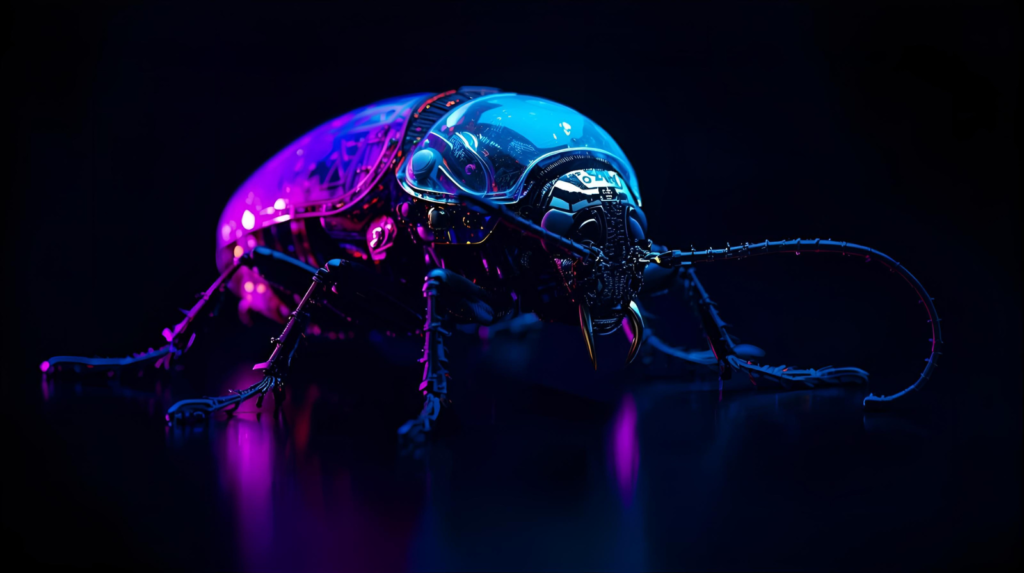
Instead of using electrodes and painful implants, researchers place a micro UV-helmet on the insect.
🔹 When UV light shines on the cockroach →
its neural reflex makes it move away from the light direction
That means:
Light on left side → moves right
Light on right side → moves left
Strong continuous light → moves forward
No surgery. No harm. Full mobility.
This innovative design turns insects into responsive micro-robots, without altering their biology.
Learn more about bio-hybrid cyborg control: NIST AI & Robotics Research
🧠 Benefits of Non-Invasive Bio-Cybernetic Control
Using light instead of implants creates major advantages:
🔹 Ethical advantage
No physical harm to the organism
Minimal stress during operation
Animal-friendly research approach
🔹 Technical advantage
No electrode failure
Fully mobile — not restricted by wires
Works in complex environments
🔹 Sustainability advantage
No surgery → no medical waste
Low-cost maintenance
Long-term reliable operations
This step is not only smarter science, it is more humane science.
Lorem ipsum dolor sit amet, consectetur adipiscing elit. Ut elit tellus, luctus nec ullamcorper mattis, pulvinar dapibus leo.
📊 Comparison: Light-Driven vs. Traditional Cockroach Cyborgs
| Feature | Traditional Cyborgs | Light-Driven Cyborgs |
|---|---|---|
| Method | Electrodes & surgery | UV-guided light control |
| Welfare | Painful & stressful | Non-invasive & humane |
| Mobility | Limited by wires | Free movement |
| Reliability | Short-term | Long-term stable |
| Precision | Moderate | High directional control |
This shift shows how light-driven cockroach cyborgs solve old limitations.
🚁 Applications in Real-World Industries
These cyborgs can reach places humans and machines cannot.
Top use-cases:
✔ Disaster Search Operations
Locate survivors under collapsed buildings
✔ Environmental Monitoring
Test soil, detect toxins, track wildlife
✔ Cyber-physical Robotics
Bio-inspired micro-robots for manufacturing
✔ Agricultural Operations
Pollination assistance + pest control
✔ Urban Infrastructure Scanning
Navigate tiny pipelines & wiring ducts
They deliver precise mobility, energy efficiency, and survival ability unmatched by silicon-based robots.
🔍 Ethical Implications & Responsible Deployment
As with all bio-hybrid inventions, we must consider:
Respecting biological life
Ensuring humane research standards
Reducing ecological disruption
Creating proper regulatory guidelines
A cockroach cannot give consent — so researchers must be cautious and compassionate when designing cyborg solutions.
🔍 Ethical Implications & Responsible Deployment
In the coming years, expect:
On-board AI microchips for autonomous decisions
Swarm coordination to explore spaces collectively
Improved UV-sensors for accuracy in harsh terrain
Disaster robots that can replace risky human missions
This research paves the way for ethical, efficient bio-robotics that expand what machines can do — without sacrificing nature.
🏁 Conclusion
Light-driven cockroach cyborgs prove that combining the strengths of biology with precise robotic control unlocks a powerful innovation path.
They are:
✔ Humane
✔ Sustainable
✔ Highly mobile
✔ Mission-ready for real-world use
This breakthrough stands as a milestone toward a future where robots are not built against nature… but built with nature.