
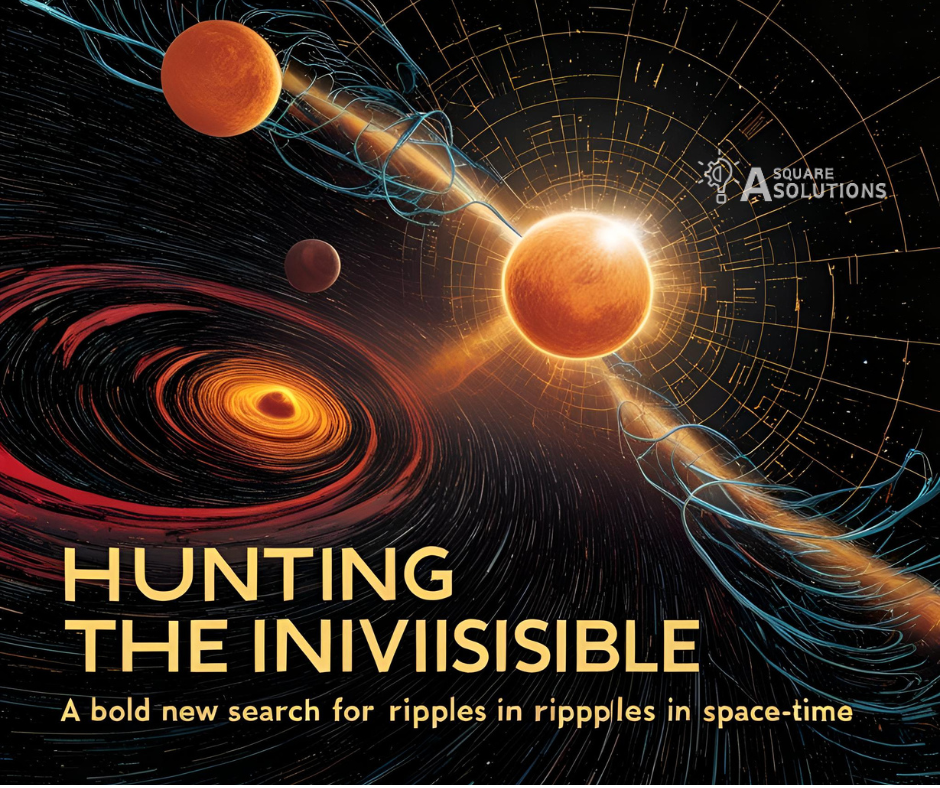
hunting invisible —
Introduction: The Cosmic Sea of Gravitational Waves
📚 Further Reading
Gravitational waves are ripples in the fabric of spacetime that carry information about their origins and about the nature of gravity itself. Predicted by Albert Einstein in 1916 as part of his General Theory of Relativity, these waves are generated by some of the most violent and energetic processes in the universe, including the collision of black holes, neutron stars, and even the explosive aftermath of the Big Bang. This revolutionary theory reshaped our understanding of gravity, suggesting it is not merely a force between masses but rather a curvature of spacetime affected by mass and energy.
The significance of detecting gravitational waves lies in their ability to provide unprecedented insight into cosmic events that were previously hidden from our observational capabilities. In 2015, the LIGO observatory made history with the first successful direct detection of gravitational waves, confirming Einstein’s predictions and opening a new era of astrophysics known as gravitational wave astronomy. This landmark achievement not only validated a century-old theory but also demonstrated the potential of gravitational waves as tools for probing the universe’s most extreme phenomena.
Scientists believe that studying gravitational waves will enhance our understanding of fundamental aspects of the universe, such as dark matter and the elusive nature of quantum gravity. The ability to detect these waves allows researchers to observe events that occurred billions of years ago, offering a unique window into the evolution of astronomical bodies and cosmic structures. As we delve deeper into the cosmic sea of gravitational waves, the methodologies for detection continue to evolve, propelling research into innovative approaches that may unveil secrets of the universe yet unknown. This search for the invisible is critical, as it holds the keys to answering profound questions about the nature of existence and our place within the cosmos.
In this deep-dive, we explore how gravitational waves act as invisible messengers, carrying information from black hole mergers, neutron stars, and the early universe.
The Challenge: Why We Need New Ways to Listen
The quest to understand the universe has come a long way since the advent of gravitational wave astronomy with detectors like LIGO (Laser Interferometer Gravitational-Wave Observatory). While LIGO has successfully identified events such as stellar-mass black hole mergers and neutron star collisions, it is essential to recognize its limitations. The existing technology primarily functions in the frequency range of about 10 Hz to 10 kHz, effectively capturing only a subset of gravitational waves and leaving a vast spectrum largely unexplored.
Among the critical gravitational wave signals that remain undetected are super-low-frequency waves produced by supermassive black hole mergers and primordial waves stemming from cosmic inflation. These waves, although potentially rich in information about the early universe and the formation of large-scale structures, lie outside the sensitivity range of current detectors. The inability to detect these elusive signals hinders our understanding of fundamental processes and phenomena in astrophysics.
To illustrate this challenge, Dr. [researcher] provides an insightful analogy: imagine trying to hear a whisper in a bustling, crowded room. While some conversations may reach your ears, many subtle and significant exchanges are easily drowned out. Similarly, the existing gravitational wave detectors face the overwhelming challenge of “noise,” which prevents them from picking up the faint signals from supermassive black holes and early cosmological events.
This scenario underscores the urgent need for more advanced detection methods, capable of expanding the frequency range and sensitivity beyond the limitations of current technologies. Through innovative approaches to gravitational wave detection, scientists hope to unveil the hidden stories of the universe, providing greater insight into the fundamental workings of space and time, and addressing critical questions about our cosmic origins and the nature of gravitational waves themselves.
The Hidden Signals We’re Missing
Gravitational waves, which are ripples in space-time caused by some of the universe’s most cataclysmic events, can be classified into various types based on their origins and frequencies. Primarily, we categorize them into stellar, intermediate, and supermassive gravitational waves. Each type offers a unique insight into cosmic phenomena but presents detection challenges with current technologies.
The hum produced by merging supermassive black holes, for instance, exhibits a frequency that is particularly low. Current detectors like LIGO and Virgo are optimized for higher frequency waves, rendering them less effective at capturing these lower-frequency signals. As a consequence, substantial portions of the cosmic background remain silent, limiting our understanding of the interactions among such colossal entities. Despite this limitation, the cosmic resonance from mergers of supermassive black holes could carry profound implications for our understanding of galaxy formation and the evolution of the universe.
Moreover, echoes from cosmic inflation also represent a critical category of gravitational waves that have eluded detection. These primordial waves are theorized to be remnants from the period of rapid expansion shortly after the Big Bang. They could potentially reveal the conditions of the universe at its nascent stages, offering clues about the fundamental physics that governs cosmic evolution. However, current observational frameworks lack the sensitivity needed to capture this kind of faint signal, leaving a significant gap in our cosmic knowledge.
Improving detection systems holds the promise of unlocking these hidden signals. Advanced technologies such as space-based detectors or more sensitive terrestrial observatories could enhance our ability to capture these elusive waves. By addressing existing gaps in detection capabilities, we can pave the way for groundbreaking discoveries, broadening our comprehension of the universe and its complex workings.
The CU Boulder Breakthrough: Quantum Meets Astronomy
A Square Solutions specialises in AI-Powered Analytics & Research — AI, automation, and intelligent digital systems that deliver real ROI.
A Square Solutions
AI-Powered Analytics & Research
🚀 A Square Solutions
We specialise in AI-Powered Research & Analytics — helping businesses scale through AI and intelligent digital systems.
Frequently Asked Questions
What is Introduction?
Gravitational waves are ripples in the fabric of spacetime that carry information about their origins and about the nature of gravity itself.
What is The Challenge?
The quest to understand the universe has come a long way since the advent of gravitational wave astronomy with detectors like LIGO (Laser Interferometer Gravitational-Wave Observatory).
What is The Hidden Signals We’re Missing?
Gravitational waves, which are ripples in space-time caused by some of the universe’s most cataclysmic events, can be classified into various types based on their origins and frequencies.
What is The CU Boulder Breakthrough?
2026 Strategic Resources: How To Solve Common WordPress Login Issues Unveiling Cosmic Wonders The James Webb Space Telescopes Insights Into Galactic Collisions And Galaxy Arp 107 Unveiling The Carousel Lens A Breakthroug.
Sources: NASA Official | European Space Agency
💬 Questions about this topic?
Use the 🤖 Ask Our AI widget (bottom-right) — instant answers, 24/7.