
THE FUTURE OF HUMAN INTELLIGENCE: 2 BREAKTHROUGHS IN BRAIN IMPLANTS REDEFINE PERCEPTION AND AWARENESS
Two landmark scientific achievements—one from Northwestern University and one from Columbia University—signal the beginning of a new cognitive era. These two breakthrough brain implants in 2025 do not merely restore lost function; they introduce entirely new modes of perception and communication. The first uses micro-LED–driven artificial sensations, teaching the brain to “feel” light-based patterns as meaningful signals. The second, an ultra-thin silicon implant known as BISC, establishes a high-bandwidth brain-to-AI communication channel, enabling the wireless streaming of thoughts, intentions, and neural states in real time.
Together, these discoveries redefine what human intelligence can become. They suggest that cognitive enhancement will expand beyond memory or speed—toward synthetic senses, augmented awareness, and direct thought integration with AI systems. Their implications reach neuroscience, disability technology, mental health, AI governance, national security, and even the philosophy of consciousness.
This article synthesizes emerging data, evaluates scientific foundations, explores socio-ethical consequences, and outlines how these breakthrough brain implants in 2025 signal a fundamental shift in the human cognitive horizon.
THE ARRIVAL OF SYNTHETIC AWARENESS
For most of human history, the boundaries of perception were fixed: vision, sound, touch, smell, taste. Even technological augmentation—eyeglasses, cochlear implants, prosthetic limbs—has stayed within the domain of restoring what biology already designed.
But 2025 marks an irreversible break from biological limits. To explore how these developments fit into broader AI innovation and industry transformation, visit our latest AI and digital transformation insights.
Recent research demonstrates that the brain is not merely adaptable—it is programmable. New neural implants can now:
- Write artificial sensory messages directly into neural circuits
- Interpret thoughts, movement intent, and perception signals in real time
- Communicate wirelessly with external AI models
- Mimic complex neuronal firing patterns that resemble natural sensory experience
The implications go beyond medical therapy. They suggest an entirely new category of intelligence—engineered cognition—where synthetic sensations, enhanced perception, and AI-mediated reasoning reshape what it means to be human.
These are the two most critical breakthroughs:
ARTIFICIAL SENSATION THROUGH LIGHT-BASED NEURAL MESSAGING
Source: Northwestern University (Dec 8, 2025)
The first breakthrough brain implant of 2025 is a soft, fully implantable device that teaches the brain to interpret light-based signals as meaningful sensory input—without any traditional sensory organs involved.
What the Implant Actually Does
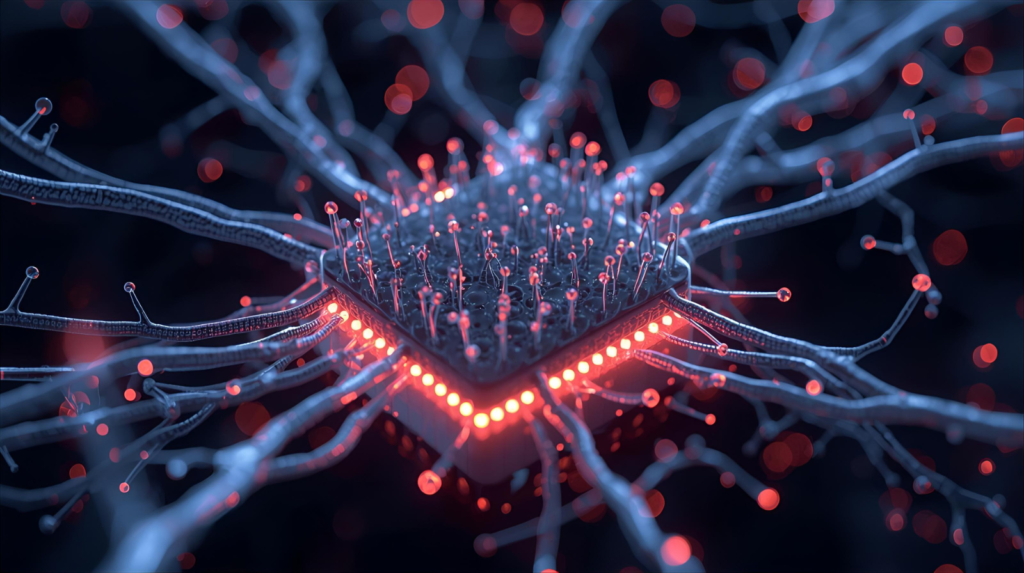
The system embeds up to 64 micro-LEDs inside a soft neural interface. Each micro-LED targets specific neurons and generates precise spatiotemporal patterns—akin to writing a message using the language of neural activity.
Instead of stimulating the skin or the eyes, the implant bypasses sensory organs entirely and activates neural circuits directly.
Why It Matters
This discovery confirms that the brain can:
• Learn new types of signals that evolution never designed for
• Interpret abstract light pulses as sensory meaning
• Form stable internal models of synthetic input channels
• Merge artificial sensations with natural perception
This opens the door to synthetic senses—perception modules that humans do not naturally possess.
Applications (Short-term & Long-term)
Medical Uses:
• Restoring sensation in prosthetics
• Providing artificial feedback loops to paralysis patients
• Enhancing rehabilitation for stroke survivors
Cognitive Expansion:
• New “sense” for electromagnetic fields
• Infrared/ultraviolet perception
• Augmented spatial navigation
• Real-time environmental scanning
Military/Security:
• Silent communication between units
• Enhanced threat detection
AI Integration:
• Direct sensory-sharing between humans and AI agents
Why Researchers Used Light Instead of Electricity
Electrical stimulation lacks precision—neurons fire in chaotic clusters.
Light stimulation allows:
✔ Tight spatial resolution
✔ Targeted neuron selection
✔ Information-rich patterns
✔ Lower noise interference
This is a fundamental step toward programmable neural input channels.
REAL-TIME THOUGHT STREAMING WITH ULTRA-THIN BISC CHIP

Source: Columbia University School of Engineering (Dec 9, 2025)
If Northwestern’s device writes messages into the brain, Columbia’s device reads messages out of it.
What BISC Is
The Brain-Integrated Silicon Circuit (BISC) is a paper-thin implant containing:
• Tens of thousands of electrodes
• Ultra-thin flexible substrate
• High-bandwidth wireless communication
• On-chip AI inference modules
The implant is slid through a small opening in the skull, spreads across the cortical surface, and forms a stable, long-term brain-to-AI interface.
What It Can Do Right Now
Early demonstrations show BISC can:
• Decode movement intent
• Interpret perception-related neural activity
• Track emotional states
• Reconstruct motor commands
• Recognize patterns associated with memory retrieval
The most disruptive feature is its ability to stream neural data wirelessly in real time, creating a high-bandwidth communication pathway between the brain and AI systems.
Technological Leap: Why This Is Not “Just Another BCI”
Previous BCIs required:
• Wired connectors
• Bulky external processors
• Limited electrode density
• Low signal stability
• Slow decoding speeds
BISC overcomes all of these:
✔ Fully wireless
✔ High-density electrode array
✔ Flexible material reduces immune response
✔ Integrated machine-learning accelerators
✔ Real-time intent decoding
This transforms BCIs from research tools into general-purpose neural operating systems.
ARTIFICIAL INPUT + REAL-TIME OUTPUT = A PROGRAMMABLE HUMAN MIND
The first implant writes, the second reads.
Together, they form the first closed-loop architecture for programmable cognition.
This pairing forms the core insight of the breakthrough brain implants 2025 revolution:
Artificial sensations (input) + thought streaming (output) = a bidirectional digital mind.
This is not simply a medical breakthrough. It is the foundation of:
✔ Synthetic awareness
✔ Enhanced cognition
✔ Closed-loop AI copilots for the mind
✔ Human-AI symbiosis frameworks
✔ Cognitive reinforcement systems
✔ Sensory superintelligence
Why These Two Technologies Complete Each Other
Northwestern’s Implant
• Adds new sensory channels
• Augments perception
• Creates non-biological input streams
Columbia’s BISC Chip
• Extracts rich neural signals
• Decodes thoughts
• Streams perception, emotion & intent
When combined, they form a neural read-write interface, the missing piece of next-generation neurotechnology.
This enables:
Future Capabilities Enabled by Their Convergence
A) Synthetic Sensory Intelligence Systems
AI agents could feed synthetic cues directly into the brain:
• Navigational overlays
• Hazard warnings
• Spatial mapping
• Physiological monitoring
• Advanced prosthetic feedback
B) Thought-Level Interaction with AI Agents
Users could issue commands without speech or movement:
• “Zoom the image.”
• “Open the document.”
• “Call mom.”
All executed through real-time neural intent decoding.
C) Closed-Loop Cognitive Augmentation
The brain receives real-time corrective feedback, enabling:
• Faster learning
• Error correction
• Motor skill refinement
• Cognitive troubleshooting
Think of it as intelligence assisted by feedback loops, similar to how self-driving cars refine their driving models.
D) Neural Co-Processing With AI
The brain offloads heavy reasoning to AI models and receives processed insights back through artificial sensation channels.
This is the earliest conceptual form of thought-level co-processing — humans thinking with AI the way a GPU accelerates a CPU. A similar acceleration in progress toward AGI and reasoning AI can be seen in models like Google’s Gemini 3 Ultra, which pushes the boundary of cognitive-like behavior.
WHY THE BRAIN CAN ACCEPT SYNTHETIC REALITY
The breakthroughs depend on one key biological truth:
The brain is indifferent to the source of a signal — only its structure matters.
This is why a blind person can “see” through tongue electrodes or a cochlear implant can convert sound into electrical pulses.
Feature: Cortical Plasticity as a Computational Engine
Neuroscience shows:
• Neurons reorganize
• Cortical maps reassign
• Synapses strengthen or weaken
• New codes emerge through repetition
This plasticity allows:
Synthetic sensory channels → to be treated as real ones
AI-assisted patterns → to be internalized as meaningful
Temporal Coding and Meaning Formation
The micro-LED system works because:
• Neurons do not encode “light” or “touch,”
• They encode patterns, sequences, and timing.
The artificial implant creates information-rich spatiotemporal codes.
The brain learns:
• This pattern means “reward.”
• This means “left movement.”
• This means “object detected.”
Awareness as a Construct, Not a Sensory Constraint
If awareness is created by neural patterns…
…then artificial patterns can, in principle, create new forms of awareness.
This is the theoretical foundation of synthetic consciousness modules:
• Electromagnetic sense
• Chemical signature detection
• Urban environmental scanning
• Real-time atmospheric sensing
• Physiological rhythm monitoring
In essence, the brain becomes an expandable platform — more like an operating system than a fixed biological machine.
AI INTEGRATION MODELS: HOW THOUGHTS, SENSES & AI WILL VENTURE INTO ONE COGNITIVE LOOP
Breakthrough brain implants in 2025 introduce the first plausible blueprint for neural-AI architectures.
Here are the five clearest integration paths:
Model A — Neural Input Augmentation (NIA)
AI generates sensory overlays delivered through artificial micro-LED channels:
• Spatial data
• Obstacle mapping
• Cognitive reminders
• Emotional regulation cues (calming patterns)
Equivalent to an internal heads-up display (HUD).
Model B — Neural Output Interpretation (NOI)
BISC interprets:
• Motor intent
• Emotional states
• Cognitive load
• Decision hesitation
• Memory recall attempts
AI becomes a thought interpreter, not just an assistant.
Model C — Closed-Loop Reinforcement Systems (CLRS)
This is the future of education and training.
AI monitors neural patterns during learning and delivers micro-stimuli to:
• Accelerate skill acquisition
• Enhance memory consolidation
• Reduce cognitive load
• Guide attention focus
• Detect early fatigue
Humans essentially get a learning autopilot.
Model D — Shared Sensory Ecosystems
Two humans equipped with these implants could:
• Share sensations
• Exchange spatial awareness
• Transmit emotional cues
• Sync cognitive states
This is the earliest conceptual form of mind-to-mind networks.
Model E — Neural Copilot Systems (NCS)
The most ambitious model.
AI does not replace human intelligence — it co-processes with it.
When the brain begins a complex cognitive task:
• AI predicts the next neural stages
• Suggests optimal pathways
• Reduces cognitive friction
• Enhances decision speed
This is analogous to flying with an “intelligence copilot.” A similar AGI capability progression is visible in systems like DeepMind’s Alpha Agent, which demonstrates early signs of multi-step reasoning and adaptive intelligence.
RISKS, ETHICS & GOVERNANCE OF NEXT-GEN BRAIN IMPLANTS
The arrival of breakthrough brain implants in 2025 makes one thing clear:
Neural technology is no longer a hypothetical future — it is entering human society now.
But society is not yet prepared for technologies that:
• Read thoughts
• Write artificial sensations
• Communicate wirelessly with cloud-based AI
• Operate continuously inside the skull
• Record emotional and perceptual states
To understand the implications, we must evaluate risk across five domains:
Neuroprivacy and Cognitive Theft
Traditional cybersecurity protects:
• Devices
• Databases
• Networks
Neural interfaces demand something entirely new:
protection of thought itself.
Real risks include:
Unauthorized neural data extraction
Emotion or intent inference without consent
AI models training on neural signals
Remote access to implants
Profiling of neural behavior patterns
Without strong governance, BISC-like implants could become:
• Advertising tools that read subconscious preferences
• Surveillance devices
• Behavior-modification instruments
This is why researchers emphasize:
Neural data is the most sensitive data humanity will ever generate. These risks echo global safety concerns around advanced AI, where the pace of innovation often outstrips governance.
Emotional Manipulation and Cognitive Drift
If implants can deliver synthetic sensations, they can theoretically:
• Reinforce certain emotional states
• Suppress others
• Guide decision-making
• Influence risk-taking or social behavior
The micro-LED sensory implant is powerful — but like all sensory systems, it can also:
Change how people feel, react, and interpret reality.
This is a dual-use capability:
• Therapeutic: reducing anxiety, modulating chronic pain
• Dangerous: manipulation of perception, political persuasion, dependency
Dependency and the Loss of Cognitive Autonomy
AI-enhanced implants may become:
• Cognitive shortcuts
• Emotional stabilizers
• Sensory guides
Over time, users may rely on them for:
• Direction
• Decision-making
• Memory cues
• Social interpretation
This raises a cognitive risk similar to smartphone overdependence — but deeper:
When does the brain stop being fully “human-initiated” and become AI-mediated?
Inequality: A New Cognitive Divide
Neural implants could create:
• Enhanced classes
• Non-enhanced classes
Similar to the arrival of literacy or computing power — but more severe.
Enhanced individuals may gain:
• Faster learning
• Better emotional regulation
• Stronger memory
• Synthetic sensory abilities
• Cognitive collaboration with AI
This forms a neurocognitive elite, accelerating inequality unless regulated.
Military and State Control Risks
Defense agencies will not ignore technologies that:
• Enable silent squad communication
• Enhance awareness
• Reduce fear or pain
• Improve reaction times
• Provide battlefield mapping overlays
But with great power comes systemic danger:
Militarized neural implants could force ethical conflicts unseen in modern warfare.
Risks include:
• Hacking of soldier implants
• Unauthorized command overrides
• Cognitive conditioning
The battlefield of 2040 may include neurodigital soldiers, raising profound legal and moral questions.
GLOBAL GOVERNANCE: WHO CONTROLS THE FUTURE OF THE HUMAN BRAIN?
No country currently has a full regulatory framework for:
• Artificial sensations
• Real-time thought streaming
• AI-driven perception models
• Neural data storage
• Implant-to-AI communication
These gaps mirror challenges seen in AI regulation and compliance frameworks, where legal and ethical guidelines consistently lag technological capabilities.
Different global actors will approach regulation differently:
United States
Likely to allow rapid private-sector innovation with minimal early restrictions, followed by late-stage federal oversight.
European Union
Expected to regulate earliest, emphasizing:
• Data protection
• Informed consent
• Safety monitoring
• Ethical boundaries
China
Likely to accelerate defense-driven and state-backed applications, potentially pushing the fastest mass deployment.
India
Will face the challenge of balancing innovation with ethical risk management in a population of 1.4B.
Australia, Japan, South Korea
Likely to become early adopters in clinical research and elderly-care augmentation.
THE PHILOSOPHY OF SYNTHETIC AWARENESS: WHAT DOES IT MEAN TO “FEEL” SOMETHING ARTIFICIAL?
The Northwestern implant reveals something extraordinary:
Awareness itself is flexible.
The brain does not distinguish between:
• Natural sensation
• Artificial sensation
• AI-generated sensory codes
It interprets all of them as experience.
This challenges centuries of philosophy:
• What counts as “perception”?
• What counts as “intention”?
• What counts as “thought”?
• Where is the boundary between self and technology?
If AI begins to supply sensory data directly to human awareness, then:
Perception becomes a shared computational experience.
This is the foundation of post-biological cognition.
THE EVOLUTION OF HUMAN IDENTITY
When thought can be streamed
and sensation can be written
and AI can integrate into perception…
Human identity shifts from being:
Biological → Hybrid → Networked → Expanded
This is the roadmap neuroscientists quietly acknowledge.
Biological Identity (Past)
Perception and cognition limited by sensory organs and brain structure.
Hybrid Identity (2025–2035)
Augmented perception
AI-integrated decision systems
Sensory overlays
Networked Identity (2035–2050)
Brain-to-brain communication
Shared perception
Collective cognitive systems
Expanded Identity (2050+)
Synthetic global senses
On-demand cognitive enhancement
AI co-processing
Programmable emotions
Artificial awareness modules
The breakthrough brain implants in 2025 are the tipping point from hybrid to networked identity.
APPLICATIONS, INDUSTRY TRANSFORMATION & FUTURE SCENARIOS

Breakthrough brain implants in 2025 are not isolated scientific achievements; they are catalysts for an entire industrial reconfiguration.
The combination of:
Artificial sensory implants (micro-LED neural signaling)
Ultra-thin thought-streaming implants (BISC)
creates the foundation for new sectors, new professions, and new human capabilities.
APPLICATIONS: WHERE THESE TECHNOLOGIES WILL TRANSFORM HUMAN LIFE
We categorize the applications into seven core industries.
Healthcare & Neurorehabilitation
This is the earliest and most ethical deployment arena. Such capabilities reflect the rapid evolution of next-generation neural interface technologies now emerging in clinical and engineering research.
Restoring Lost Functions
• Artificial touch for prosthetic users
• Sensory feedback for paralysis patients
• Gait correction systems
• Stroke rehabilitation acceleration
Neuroadaptive Prosthetics
Prosthetics become not just functional, but felt.
Applications include:
• Finger-level feedback
• Temperature perception
• Pressure gradients
Epilepsy, Parkinson’s, and Depression
Thought-streaming enables:
• Continuous monitoring
• AI-driven prediction
• Closed-loop stimulation to abort episodes
This becomes the first personalized brain-health ecosystem.
Education & Skill Acceleration
Closed-loop learning systems will be revolutionary.
AI-Assisted Skill Formation
Imagine learning:
• Piano
• Coding
• Foreign languages
• Surgery
…with implants that:
• Detect cognitive overload
• Deliver micro-signals to guide learning
• Reinforce correct neural pathways
• Reduce learning time by 40–60%
Education becomes physiological, not just intellectual.
Productivity & Enterprise Intelligence
Enterprise AI copilots will integrate directly with cognitive processes.
Cognitive Workflow Augmentation
Implants will:
• Analyze decision fatigue
• Suggest optimal action paths
• Accelerate reasoning tasks
• Deliver focus-enhancing neural patterns
The workplace becomes:
brain + AI = dual-processor cognition
Sensory Expansion & Human Augmentation
The most transformative future applications.
Synthetic Senses
Humans could gain:
• Infrared perception
• Electromagnetic field awareness
• 360-degree spatial mapping
• Atmospheric pattern sensing
• Subsurface material detection (for engineers)
These are not science fiction — they are direct extensions of the micro-LED input system.
Disability Technology & Independence Systems
This is a moral and societal priority.
For the Blind
BISC + micro-LED implants enable:
• AI-interpreted visual scenes → translated into neural light patterns
• “Seeing” through patterns that represent shape, depth, and motion
For the Deaf
AI interprets sound → patterns delivered as artificial sensations.
For Motor Disabilities
Real-time intent → robotic assistance systems.
Mental Health & Emotional Regulation
AI-assisted emotional models will change psychiatry.
Real-time monitoring
Implants detect:
• Anxiety buildup
• Emotional dysregulation
• Stress spikes
• Cognitive overload
Stabilization loops
Micro-LED implants deliver:
• Calm sequences
• Neural rhythm reinforcement
• Sleep modulation patterns
This is the future of precision mental health.
Defense, Intelligence & Security
The most ethically contested domain.
Silent Communication
Soldiers communicate via thought signals.
Battlefield Sensory Overlays
AI sends:
• Threat maps
• Heat signatures
• Drone perspectives
• Navigation cues
directly to the artificial sensory channel.
Enhanced Fear Modulation
Ethical concerns arise if implants dampen fear without consent.
INDUSTRY TRANSFORMATION: WINNERS, LOSERS & NEW MARKETS
Industries That Will Explode
Neurotechnology Manufacturing
Demand for:
• micro-LED neural arrays
• Flexible electrode systems
• Implant-grade silicon
• Neural adhesives
will skyrocket.
AI-Neural Software
This becomes the most profitable new market category.
Includes:
• Neural decoding models
• Sensory encoding software
• Cognitive reinforcement engines
• Neural privacy frameworks
Neuro-compatible Medical Devices
Hospitals will need:
• Neural imaging units
• Implant calibration centers
• Cognitive performance labs
Industries That Will Face Disruption
Education
Traditional teaching models collapse when neural learning systems outperform human instruction.
Workplace Productivity Tools
If “thought-to-action” bypasses screens, keyboard-centric workflows decline.
Therapy & Psychiatry
AI-driven neurofeedback replaces many traditional interventions.
Entirely New Professions
Neural Experience Designers (NEDs)
Craft artificial sensory experiences.Cognitive Architecture Engineers
Build AI-human co-processing models.Neuroethics Regulators
Write laws for permissible brain-AI interactions.Memory Forensics Analysts
Investigate neural data breaches.Synthetic Awareness Researchers
Design and test non-biological senses.
Lorem ipsum dolor sit amet, consectetur adipiscing elit. Ut elit tellus, luctus nec ullamcorper mattis, pulvinar dapibus leo.
FUTURE SCENARIOS (2030–2050)
We outline the four most plausible macro-scenarios.
Scenario A — Cognitive Renaissance
Implants become:
• Safe
• Affordable
• Widely available
Humans gain:
• Faster learning
• Enhanced perception
• AI-assisted focus
• Advanced emotional stability
The world experiences a massive productivity boom.
Scenario B — Cognitive Divide
Only wealthy nations and elite groups get augmented.
Results:
• A two-class civilization
• Unequal cognitive economies
• Neuro-political tension
Scenario C — Neurosecurity Collapse
If implants are widely deployed without strong security:
• Neural hacking emerges
• Cognitive manipulation scams
• Emotional ransomware
• Intent hijacking
Governments enforce emergency bans.
Society enters an era of bio-digital distrust.
Scenario D — Symbiotic Intelligence
The most optimistic scenario.
Humans and AI co-evolve in:
• Thought processing
• Sensory integration
• Cognitive reinforcement
AI becomes:
a cognitive partner, not a digital tool.
This is the beginning of post-biological intelligence.

Author
A Square Solutions Editorial team