
What Digital Marketing Got Wrong in 2025 — And What Will Actually Work in 2026
Introduction: 2025 Looked Successful — But Something Was Broken
Digital marketing mistakes 2025 revealed a hard truth: most brands did more work, but achieved less real growth.
Traffic numbers went up. AI tools exploded. Automation became mainstream. Dashboards were full.
But beneath the surface, something quietly failed.
Brands published more content than ever — yet trust declined.
Ad budgets increased — yet conversion quality dropped.
Automation scaled — yet brand differentiation disappeared.
These were not small tactical errors. They were systemic digital marketing mistakes of 2025, and they matter because they set the rules for what will — and will not — work in 2026.
Mistake #1:Digital Marketing Mistakes 2025: Confusing Activity With Real Impact
In 2025, marketing teams optimized for outputs instead of outcomes.
More blog posts, fewer readers
More impressions, less recall
More leads, lower intent
This is why many businesses saw traffic but no meaningful growth.
These digital marketing mistakes 2025 were not tactical errors, but strategic blind spots that weakened long-term growth.
SEO suffered especially when content was produced at scale without topical authority. We see this clearly when auditing sites that publish dozens of disconnected posts instead of building structured clusters — something we addressed earlier in our guide on how SEO strategy needs to evolve beyond keywords.
2026 correction:
Impact-first marketing — fewer assets, stronger positioning, deeper authority.
Mistake #2: Over-Automation Without Oversight
AI didn’t “ruin” digital marketing in 2025 — uncontrolled automation did.
Brands automated:
Content writing
Email sequences
Ad creatives
Chat responses
But forgot to automate review, intent checking, and human judgment.
As discussed in our analysis of AI-driven marketing risks, over-automation reduces brand voice consistency and trust — especially in sensitive decision funnels.
External research from Harvard Business Review confirms this trend: automation increases efficiency, but unchecked automation reduces perceived credibility when audiences sense synthetic messaging.
2026 correction:
Human-in-the-loop marketing systems — AI assists, humans decide.
Mistake #3: Treating SEO, Ads, and Content as Separate Silos
In 2025, many teams still ran:
SEO as a traffic channel
Ads as a conversion channel
Content as “branding”
This separation no longer matches how users behave.
Google Discover, zero-click search, and AI summaries have blurred these boundaries. A piece of content might never rank #1 — yet still drive brand authority and conversions.
This is exactly why Discover-optimized formats now outperform keyword-stuffed posts, as we’ve seen across our Digital Marketing category audits.
Understanding digital marketing mistakes 2025 is essential for building strategies that will actually work in 2026.
2026 correction:
Unified growth loops — content fuels SEO, SEO informs ads, ads validate content.
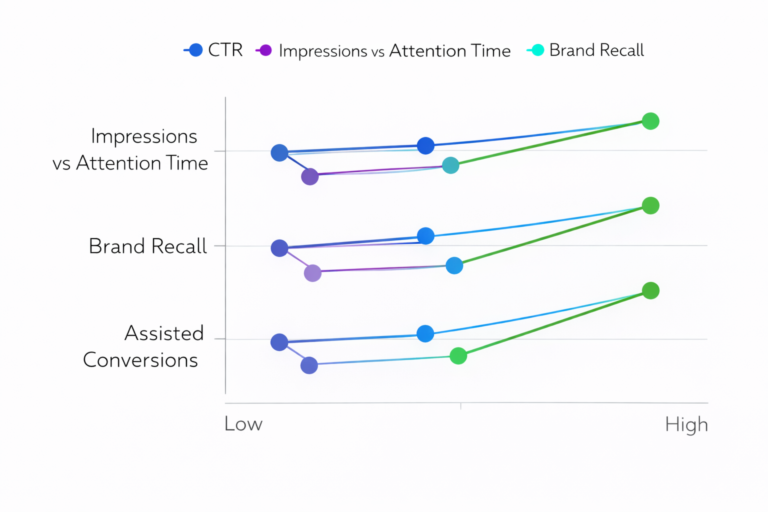
Mistake #4: Chasing Metrics That No Longer Represent Reality
In 2025, marketers still celebrated:
CTR
Bounce rate
Session duration
But ignored:
Attention depth
Brand recall
Assisted conversions
Platforms themselves moved away from clicks. Google Discover and social feeds prioritize engagement signals, not just relevance.
According to Google Search Central documentation, content performance is increasingly evaluated holistically — not by single metrics.
2026 correction:
Shift from click metrics to trust and retention indicators.
Mistake #5: Ignoring Digital Fatigue
Audiences are exhausted.
In 2025, users:
Scrolled more
Trusted less
Skipped faster
Over-optimized funnels, aggressive remarketing, and repetitive messaging created resistance.
This aligns with what we discussed earlier in our post on content saturation and declining engagement patterns, where we highlighted how frequency without differentiation kills performance.
2026 correction:
Less noise, more signal. Fewer messages, clearer value.
What Will Actually Work in 2026 (And Beyond)
1. Authority-Led Content, Not Volume-Led Content
One well-researched, opinionated article will outperform ten generic posts.
2. Discover-First Visual Storytelling
Featured images, contextual graphs, and narrative headlines will matter more than keyword placement.
3. Trust-Based Funnels
People don’t convert because of CTAs anymore.
They convert because they trust the source.
This is why brands investing in long-term SEO foundations, as outlined in our digital growth frameworks, consistently outperform short-term hacks.
How A SQUARE SOLUTIONS Helps Brands Fix These Mistakes
At A SQUARE SOLUTIONS, we don’t sell traffic.
We build systems that convert attention into growth.
Our services include:
SEO built for Discover & topical authority
AI-assisted content with human editorial control
Conversion-focused digital strategy
Sustainable PPC & performance optimization
Brand-led growth frameworks
👉 If your marketing “looks active” but doesn’t drive results, it’s time to rethink the system.
You can contact us here to discuss how your 2026 strategy should actually be built.
Conclusion: 2025 Was the Warning Year
2025 exposed what doesn’t work anymore.
More content ≠ more growth
More automation ≠ better marketing
More data ≠ better decisions
The brands that win in 2026 will not be louder —
they will be clearer, calmer, and more trusted.
- December 31, 2025
- asquaresolution
- 1:30 pm