
The Most Dangerous Space Discoveries of 2025 — And Why Scientists Are Concerned
Introduction: 2025 Was Not Just a Year of Discovery — It Was a Year of Warnings
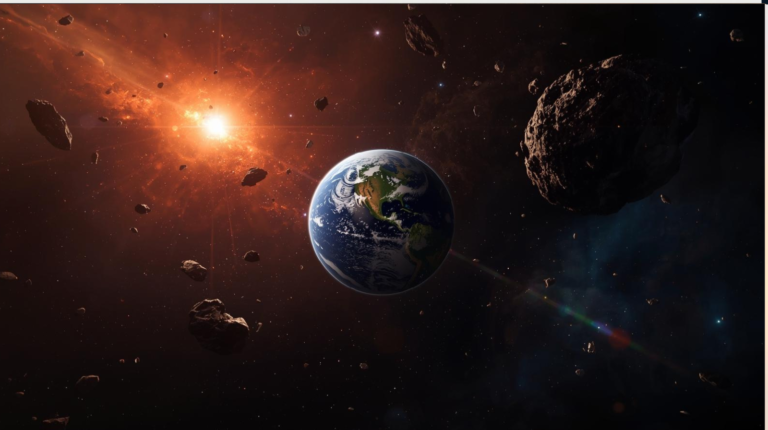
Dangerous space discoveries 2025 revealed something unsettling:
the universe is not just fascinating — it is increasingly threatening to our technology, infrastructure, and even long-term survival.
From near-miss asteroids and violent solar storms to unexpected cosmic radiation patterns and worsening space debris risks, scientists spent much of 2025 issuing quiet warnings rather than celebrating breakthroughs.
These discoveries didn’t dominate headlines.
But they changed how astronomers, space agencies, and governments think about risk beyond Earth.
As we move into 2026, understanding these findings is no longer optional — it is necessary.
1. Near-Earth Asteroids: 2025’s Close Calls Were Too Close for Comfort
One of the most alarming dangerous space discoveries of 2025 involved a series of near-Earth objects (NEOs) that passed closer to Earth than previously predicted.
Thanks to improved detection systems and AI-assisted orbital modeling, astronomers identified multiple asteroids weeks — not years — before closest approach.
According to updated data from NASA’s Center for Near-Earth Object Studies, some objects passed within distances smaller than the Moon’s orbit — a reminder that detection does not equal protection.
Scientists are concerned because:
Most planetary defense systems are still theoretical
Deflection missions take years of preparation
Late detection dramatically reduces response options
This reinforces why space risk is no longer “science fiction,” but a real planning issue.
2. Solar Storms in 2025 Revealed How Fragile Earth’s Technology Really Is
In 2025, the Sun entered a volatile phase of its solar cycle, producing stronger-than-expected solar flares and coronal mass ejections (CMEs).
Several of these events caused:
Temporary satellite communication disruptions
GPS accuracy degradation
Increased radiation exposure for astronauts
ESA and NASA both warned that a Carrington-level solar storm, if repeated today, could cripple power grids, aviation systems, and global internet infrastructure.
External research from NOAA’s Space Weather Prediction Center shows that our dependence on satellites has outpaced our protection strategies.
This makes space weather one of the most underestimated dangerous space discoveries of 2025.
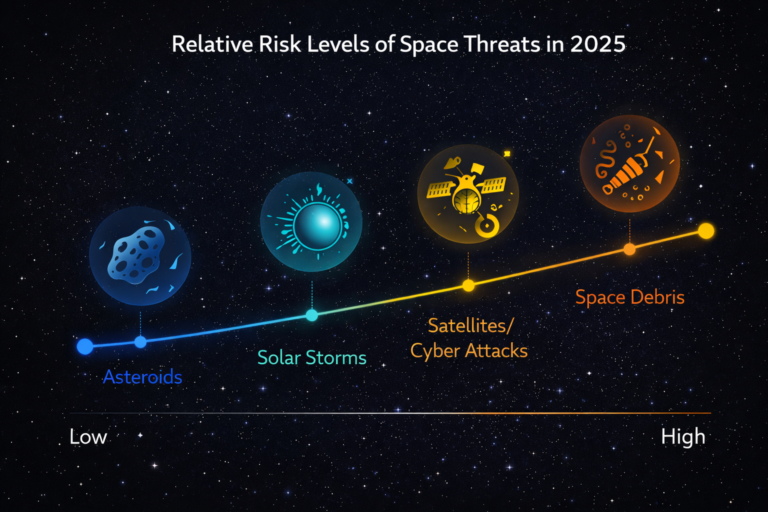
3. Space Debris Reached a Critical Threshold in Earth Orbit
2025 confirmed what many astronomers feared:
Earth’s orbit is becoming dangerously crowded.
With tens of thousands of active and inactive objects circling the planet, even a small collision can trigger cascading failures — known as the Kessler Syndrome.
Several near-miss satellite collisions in 2025 forced emergency orbital adjustments, highlighting:
Limited international coordination
Weak enforcement of debris mitigation rules
Growing private satellite deployments
This problem directly impacts astronomy itself, as discussed earlier in our analysis of how modern space activity affects scientific observation.
According to the European Space Agency, orbital debris is now one of the top threats to long-term space operations.
4. Unexpected Cosmic Radiation Patterns Raised New Health Concerns
One of the quieter but more troubling dangerous space discoveries of 2025 involved unexpected variations in cosmic radiation detected by deep-space probes.
These fluctuations challenge existing models of:
Galactic cosmic rays
Solar shielding behavior
Long-term astronaut exposure risks
For future missions to the Moon, Mars, and beyond, radiation remains the single biggest health obstacle.
NASA scientists noted that shielding assumptions based on older data may be insufficient for prolonged human missions, forcing a rethink of deep-space habitation plans.
5. James Webb Data Revealed Violent Early-Universe Activity
While the James Webb Space Telescope delivered breathtaking images in 2025, it also revealed something unsettling:
the early universe was far more violent and energetic than predicted.
Observations showed:
Rapid galaxy formation
Massive black holes appearing earlier than models allow
Extreme energy outputs from young cosmic structures
These findings suggest that cosmic instability may be more common than previously believed, reshaping how scientists think about universal evolution and long-term cosmic safety.
You can explore similar paradigm shifts in our broader Science & Innovation coverage, where emerging data continues to rewrite established theories.
6. Why Scientists Are Increasingly Vocal About Space Risk
Historically, astronomers focused on discovery.
In 2025, the tone changed to risk communication.
Scientists are concerned because:
Detection is improving faster than mitigation
Global coordination lags behind private space expansion
Earth’s technological dependency increases vulnerability
As highlighted by multiple studies published through Nature Astronomy, space threats are no longer rare anomalies — they are systemic risks.
What These Discoveries Mean for 2026 and Beyond
The takeaway from dangerous space discoveries 2025 is clear:
Space is not empty or passive
Risk is increasing as exploration accelerates
Preparation has not kept pace with discovery
In 2026, we can expect:
Stronger planetary defense discussions
More regulation of orbital activity
Increased investment in space weather monitoring
A shift from exploration-only narratives to resilience-focused space strategy
FAQs: Dangerous Space Discoveries 2025
❓ What was the most dangerous space discovery in 2025?
Near-Earth asteroid close passes combined with late detection timelines posed the most immediate potential risk.
❓ Are solar storms really dangerous for Earth?
Yes. Strong solar storms can disrupt satellites, GPS, power grids, and aviation systems.
❓ Is space debris a real long-term threat?
Absolutely. Without intervention, orbital debris could make certain orbits unusable for decades.
Conclusion: Discovery Without Preparation Is a Risk
The most important lesson from dangerous space discoveries 2025 is not fear — it is urgency.
Humanity is expanding into space faster than it is learning how to protect itself from it.
As 2026 approaches, the question is no longer what will we discover next?
It is are we ready for what we’ve already found?
- December 31, 2025
- asquaresolution
- 5:37 pm