
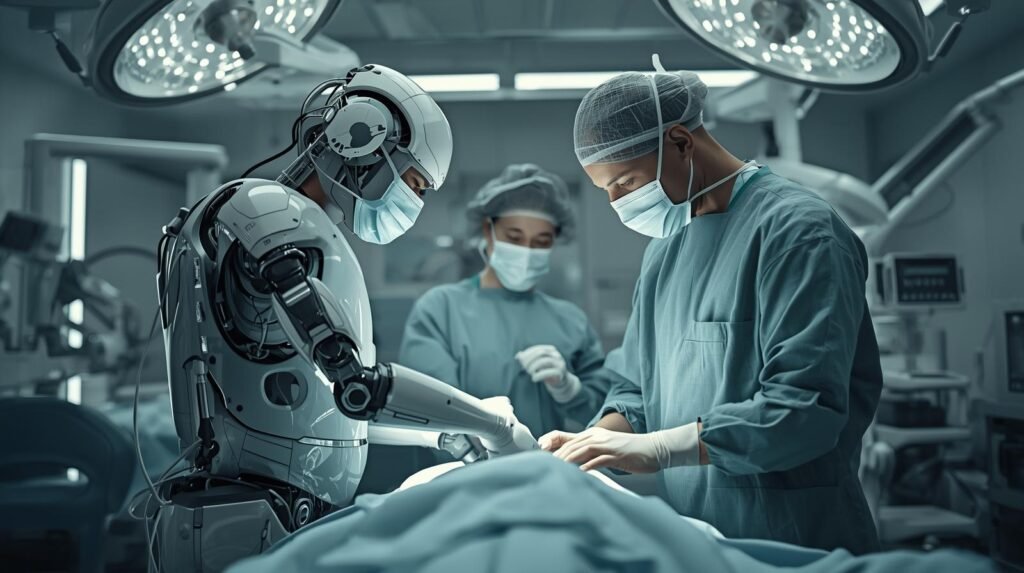
Artificial intelligence was supposed to make surgery safer, faster, and more precise. Instead, as AI rapidly enters operating rooms worldwide, regulators and hospitals are reporting a growing number of injuries, misidentifications, and near-misses linked to AI-assisted medical tools.
From robotic surgery systems to AI-powered imaging and decision-support software, medical device makers have raced to embed AI into critical procedures — often faster than regulators, doctors, and hospitals can adapt.
This article explains what went wrong, where AI in surgery is failing, and what this means for the future of healthcare.
🚨 What Is AI Doing Inside Operating Rooms?
AI is currently used in surgery to:
Assist robotic surgical arms
Identify organs, blood vessels, and tumors in real time
Provide decision support during complex procedures
Analyze medical imaging before and during operations
In theory, AI should reduce human error. In practice, over-reliance on automated systems has created new risks.
⚠️ Reported AI-Related Surgical Failures
Recent investigations and regulatory filings highlight troubling patterns:
❌ Misidentified Body Parts
Some AI imaging systems have incorrectly labeled organs or tissues, forcing surgeons to pause procedures — or worse, operate on the wrong area.
❌ Delayed Human Intervention
When surgeons rely heavily on AI prompts, critical seconds can be lost before overriding faulty recommendations.
❌ Software Blind Spots
AI models trained on limited or biased datasets can fail in edge cases, such as unusual anatomy, rare diseases, or emergency conditions.
These incidents are not science fiction — they are already appearing in official adverse-event databases.
🏥 Why Doctors Are Raising Red Flags
Many surgeons and medical associations now warn that:
AI tools are often marketed as “assistive” but behave like decision-makers
Training for doctors lags behind deployment
Hospitals feel pressure to adopt AI for efficiency and cost savings
A recurring concern is that AI confidence can mask uncertainty, making errors harder to detect in real time.
🧩 The Regulatory Gap
Medical AI evolves faster than healthcare regulation.
Key challenges:
AI software updates can change behavior without new approvals
Black-box models make accountability difficult
Existing medical device laws were not designed for adaptive algorithms
Regulators are now facing a critical question:
If an AI system causes harm, who is responsible — the doctor, the hospital, or the software maker?
🧠 AI Is a Tool — Not a Surgeon
Despite the risks, experts agree on one thing: AI itself is not the villain.
When used correctly, AI can:
Improve surgical precision
Reduce fatigue-related human error
Enhance pre-operative planning
The problem arises when automation replaces judgment, rather than supporting it.
This echoes a broader pattern seen across industries, including search and content systems, where AI must remain human-guided, not autonomous — a theme also discussed in our analysis of how AI is reshaping decision-making across sectors.
🔮 What Happens Next?
Expect three major shifts:
Stricter oversight of AI medical devices
Mandatory human-in-the-loop safeguards
Greater transparency into AI training data and limitations
Hospitals adopting AI without robust governance may face legal, ethical, and reputational fallout.
📌 Final Takeaway
AI will transform surgery — but not safely without restraint.
The future of medicine depends on collaboration between humans and machines, not blind trust in algorithms.
As AI moves deeper into life-and-death decisions, the lesson is clear:
Innovation without accountability is risk, not progress.
- February 9, 2026
- A Square Solutions
- 11:01 pm