
The Quiet AI Arms Race Heading Into 2025 — And Why the World Is Unprepared
Introduction: A New Arms Race, Without Weapons
When people think of an arms race, they imagine missiles, fighter jets, and nuclear stockpiles.
But the most consequential arms race of the modern era doesn’t involve visible weapons at all.
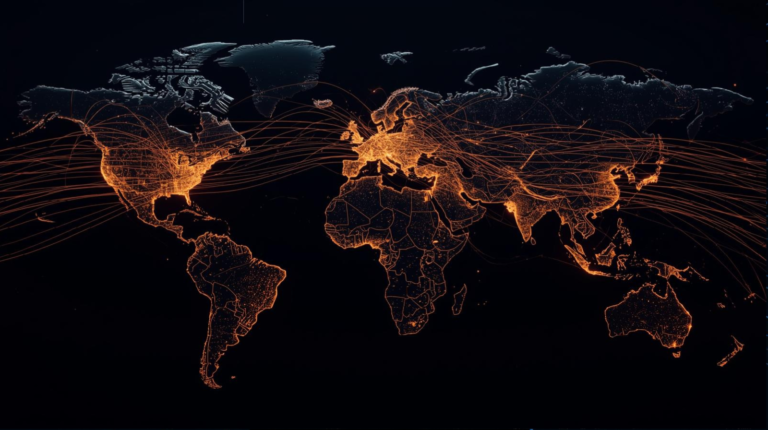
The AI arms race 2025 is unfolding quietly — through data centers, semiconductor supply chains, research labs, and national policy decisions. There are no parades, no public declarations of war, and no clear finish line. Yet its consequences may outweigh every previous technological competition combined.
This race isn’t about who builds the smartest chatbot. It’s about who controls intelligence itself — and how that control reshapes global power.
Why the AI Arms Race 2025 Is Different From Everything Before
Previous technological races were loud. Space programs were televised. Nuclear tests were announced. Military expansions were visible.
The AI arms race is silent by design.
Artificial intelligence scales invisibly. A breakthrough in model architecture or compute efficiency doesn’t require public disclosure. Entire strategic advantages can emerge behind closed doors.
In 2025, three unprecedented forces converge:
AI systems are approaching generalized reasoning capabilities
Governments are integrating AI directly into national security and infrastructure
Economic competitiveness increasingly depends on AI dominance
This makes the AI arms race 2025 uniquely dangerous — and uniquely underestimated.
AGI Has Turned Competition Into Strategy
Artificial General Intelligence (AGI) is no longer treated as science fiction.
Major research institutions now acknowledge that modern AI systems demonstrate early forms of reasoning, planning, and abstraction. While true AGI remains undefined, its trajectory has changed how nations think about risk.
In geopolitical terms, AGI represents a strategic asymmetry.
A country that reaches functional AGI first gains leverage across:
Cybersecurity
Military logistics
Economic forecasting
Scientific research
Information control
This is why the AI arms race is no longer driven by private innovation alone. It has become a state-level priority.
AI as the New Geopolitical Currency
In the 20th century, power was measured by oil, territory, and military force.
In the 21st century, it is measured by compute, data, and talent.
Countries leading the AI arms race are investing heavily in:
Semiconductor independence
Domestic AI research ecosystems
Sovereign data infrastructure
As covered previously in our analysis of the future of AI governance, regulation is now being used as both a safety mechanism and a competitive barrier.
AI is not just technology anymore. It is leverage.
The United States, China, and the Fragmentation of AI Power
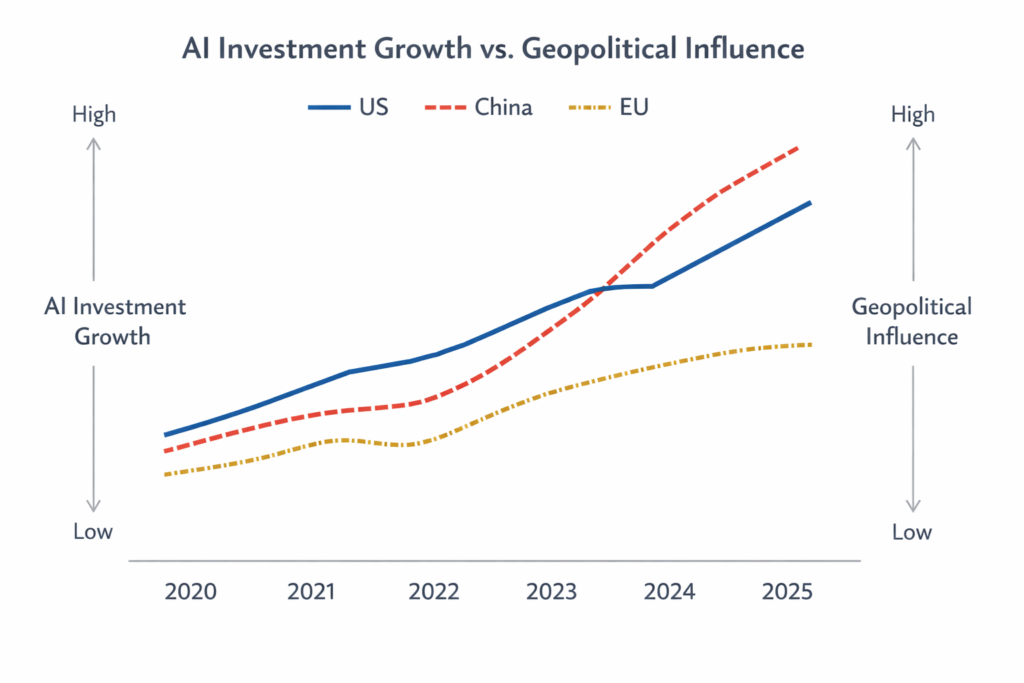
The AI arms race 2025 is not evenly distributed.
The United States dominates foundational models, private capital, and global platforms
China leads in scale, state coordination, and applied AI deployment
Europe focuses on regulation, safety, and ethical constraints
Rather than a single global AI ecosystem, we are moving toward fragmented intelligence blocs.
This fragmentation increases friction, reduces collaboration, and accelerates mistrust — classic ingredients of an arms race.
Why No One Is Talking About the Real Risks
Public AI discussions focus on productivity, creativity, and consumer tools. These narratives are comforting — and incomplete.
The real risks of the AI arms race include:
Escalation without accountability
Automated decision systems influencing conflict
Strategic misalignment between AI capability and human control
As highlighted by reporting from BBC Innovation, many of the most powerful AI deployments occur outside public visibility, particularly in defense and intelligence contexts.
Silence is not accidental. It is strategic.
The Economic Battlefield Beneath the Technology
The AI arms race 2025 is also an economic war.
Nations unable to compete in AI infrastructure risk long-term dependency. Entire industries — from manufacturing to finance — are being reorganized around AI-driven optimization.
This mirrors trends already observed in AI-powered industry transformation, where even small AI advantages cascade into outsized economic outcomes.
In this race, second place may not exist.
Public Trust: The Weakest Link in the AI Arms Race
Technology does not operate in isolation.
As AI systems become more autonomous, public trust becomes a strategic constraint. Societies that lose confidence in AI governance may slow deployment — voluntarily surrendering advantage.
This tension between speed and legitimacy is one of the defining challenges of the AI arms race 2025.
What Happens If the World Gets This Wrong?
History shows that arms races rarely end quietly.
Without coordination, the AI arms race risks:
Uncontrolled escalation
Reduced transparency
Systemic instability
Unlike traditional weapons, AI systems adapt and evolve. Mistakes propagate faster than regulation can respond.
The danger is not intentional misuse — but misalignment at scale.
Conclusion: The Arms Race You Won’t See Coming
The AI arms race 2025 will not announce itself with sirens or speeches. It will unfold quietly, through policy papers, research breakthroughs, and infrastructure investments.
By the time its outcomes become visible, the balance of power may already be locked in.
The world is not unprepared because it lacks technology.
It is unprepared because it refuses to treat artificial intelligence as the geopolitical force it has already become.
- December 27, 2025
- asquaresolution
- 3:11 pm