
nasa toi 715 —
🌍 NASA’s “Super Earth” Discovery: TOI-715 b — The Most Promising Habitable-Zone Planet Yet
📚 Further Reading
Every few years, a discovery comes along that forces humanity to ask the big question again:
“Are we alone?”
NASA’s latest rising star — TOI-715 b, a warm, rocky “super-Earth” orbiting inside its star’s habitable zone — has triggered that question worldwide.
Even though the original confirmation occurred months earlier, this exoplanet has gone viral again across Google Discover, Reddit, X, YouTube, and global space media because:
It’s one of the most Earth-like planets ever found
It orbits a small, quiet, long-lived red dwarf star
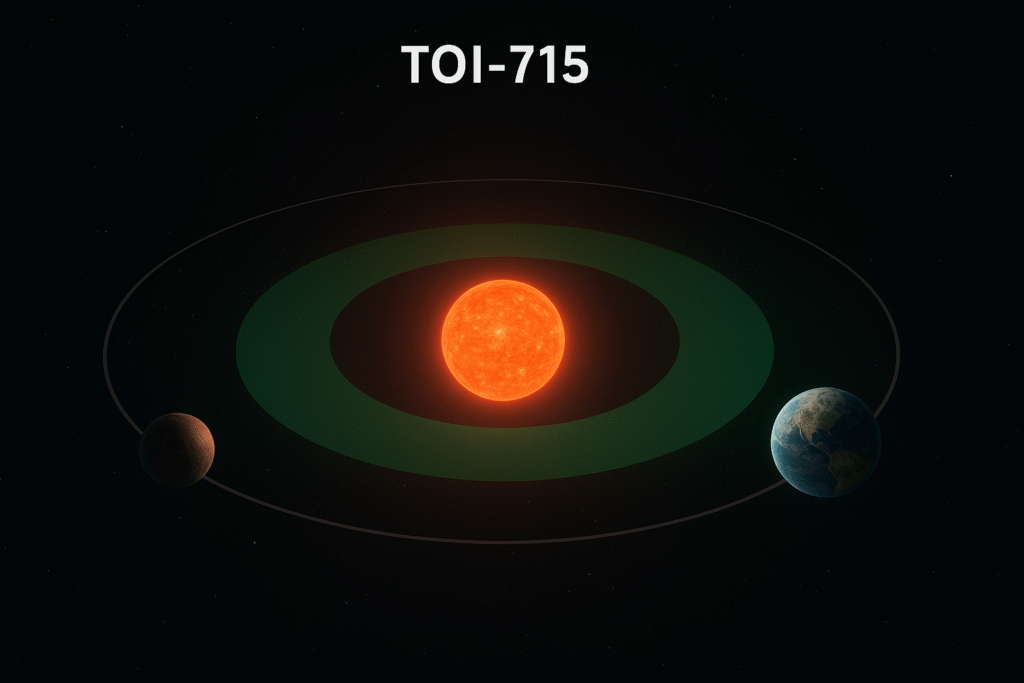
It sits comfortably in the Goldilocks Zone (where liquid water can exist)
It is a top target for the James Webb Space Telescope (JWST)
And… it may have a neighboring second habitable-zone planet
This combination is extremely rare — and that’s why TOI-715 b is exploding online again in 2025.
Let’s dive into the full, viral-ready breakdown.
🌎 What Exactly Is TOI-715 b?
TOI-715 b is a super-Earth — a rocky world larger than our planet but smaller than Neptune.
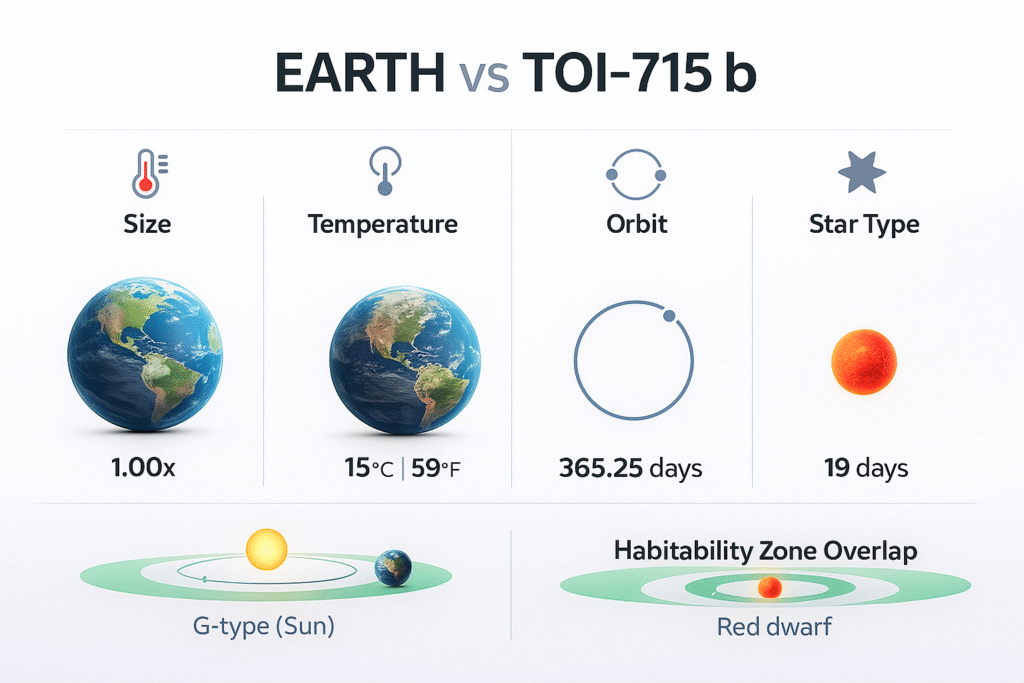
Quick Specs
Distance from Earth: ~137 light-years
Size: ~1.55× Earth
Type: Rocky super-Earth
Star: A cool, stable red dwarf (TOI-715)
Orbital Period: Just 19 Earth days
Location: Constellation Dorado
Despite the short year, the star is cool, meaning the planet sits at the ideal temperature range for liquid water.
This alone puts TOI-715 b in the elite category of potentially life-supporting planets.
🧪 Why Scientists Are Calling This “One of the Most Promising” Habitable Planets
This alone puts TOI-715 b in the elite category of potentially life-supporting planets — a growing list confirmed by new research revealing Earth-like planets across the galaxy.
1️⃣ It Orbits in the Star’s Habitable Zone
That precious “Goldilocks region” where temperatures allow liquid water.
Most exoplanets we discover sit:
❌ too close → scorched
❌ too far → frozen
But TOI-715 b sits just right — a huge deal.
2️⃣ Its Star Is Quiet and Long-Lived
Most red dwarfs flare violently, destroying atmospheres.
But this star?
✨ Calm
✨ Stable
✨ Perfect for life to develop
This stability increases the chances of the planet retaining water and an atmosphere.
3️⃣ It May Not Be Alone
There’s evidence for a second, smaller planet in the same system — possibly also in the habitable zone.
If confirmed, TOI-715 could become one of the most exciting life-hunting systems ever studied.

🔍 How NASA Found It — The TESS Telescope
TOI-715 b was discovered using NASA’s TESS spacecraft, which spots planets by detecting tiny dips in starlight.
TESS watched the star TOI-715 repeatedly dim at perfect, predictable intervals — the signature of a planet passing in front. NASA increasingly pairs such methods with precision AI-driven systems that validate and analyze exoplanet signals.
This consistency allowed scientists to confirm:
Planet size
Orbit
Star type
Temperature potential
Next step?
The James Webb Space Telescope will analyze its atmosphere — a historic moment.
🌬️ What JWST Will Search for (This Is the Big Moment)
JWST may attempt to detect:
Water vapor
Carbon dioxide
Methane
Ozone
Organic molecules
If even one of these appears in the right ratios…
🛑 …we’ll have our strongest evidence of habitability outside our solar system.
🔥 Potential for Life — The Most Emotional Part
Scientists believe TOI-715 b may have:
A thick, protective atmosphere
Warm surface temperatures
Stable climate cycles
Rocky terrain
Potential oceans
These are the exact same criteria that made Earth thrive. Modern discoveries in how biology explores life systems show that even small environmental stability can support complex life.
Unlike many exoplanets, TOI-715 b is:
not too hot
not too cold
not gas-based
not irradiated
not tidally scorched
Instead, it sits in a “sweet spot” that astrobiologists dream about.
This is why the planet is trending again: hope.
🌟 Why This Discovery Matters for Humanity
TOI-715 b is important because it shifts the conversation from:
“Where might life exist?”
to
“Where should we search first?”
— especially as we understand more about planetary climate conditions and their role in sustaining life.
Humanity is closer than ever to detecting another Earth — not fantasy, but science.
🧭 Final Thoughts: Humanity’s Most Hopeful Window
Some discoveries are scientific.
Others are emotional.
TOI-715 b is both.
It reminds us that Earth — our home — may not be the only place where life found a way. And for the first time in human history, we have the tools to look.
The next chapter depends on JWST.
And the world is watching.
🚀 Need expertise in AI-Powered Analytics?
A Square Solutions delivers measurable results — from strategy to deployment.
A Square Solutions specialises in AI-Powered Analytics & Research. Explore our work or get in touch.
🚀 A Square Solutions
We specialise in AI-Powered Research & Analytics — helping businesses scale through AI and intelligent digital systems.
Frequently Asked Questions
What is 🌍 NASA’s “Super Earth” Discovery?
Every few years, a discovery comes along that forces humanity to ask the big question again: “Are we alone?” NASA’s latest rising star — TOI-715 b , a warm, rocky “super-Earth” orbiting inside its star’s habitable zone —.
Why is NASA s TOI-715 b important in 2026?
Even though the original confirmation occurred months earlier, this exoplanet has gone viral again across Google Discover, Reddit, X, YouTube, and global space media because: It’s one of the most Earth-like planets ever
How does NASA s TOI-715 b work?
TOI-715 b is a super-Earth — a rocky world larger than our planet but smaller than Neptune.
What should you know about NASA s TOI-715 b?
Quick Specs Distance from Earth: ~137 light-years Size: ~1.55× Earth Type: Rocky super-Earth Star: A cool, stable red dwarf (TOI-715) Orbital Period: Just 19 Earth days Location: Constellation Dorado Despite the short ye
Sources: NASA Official | European Space Agency
💬 Questions about this topic?
Use the 🤖 Ask Our AI widget (bottom-right) — instant answers, 24/7.