
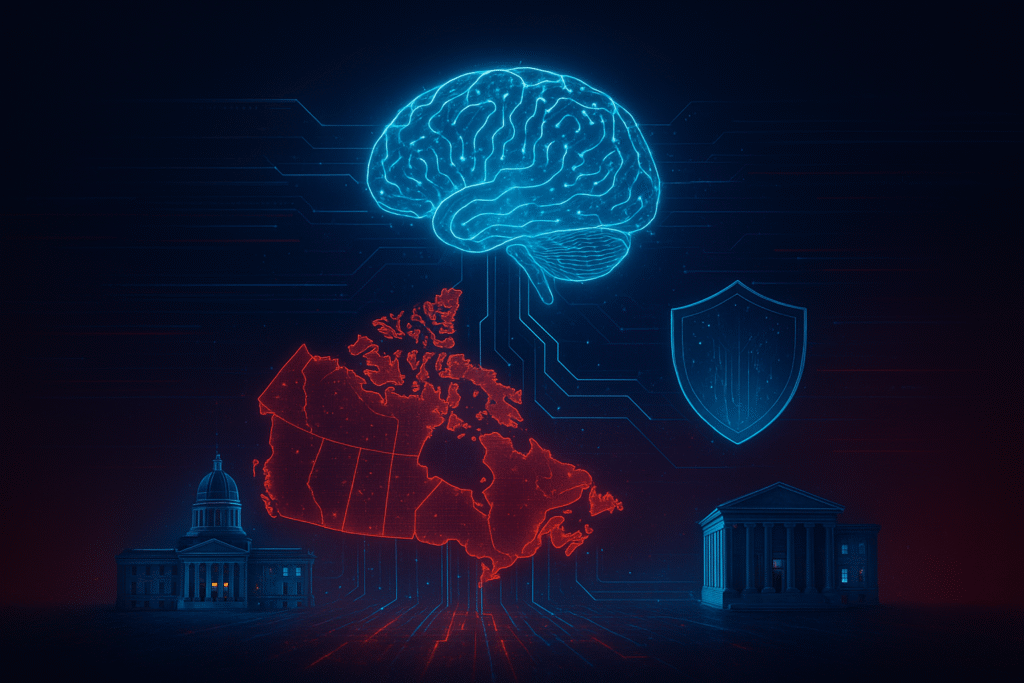
canada new safety blueprint —
How Canada Is Redefining the Future of AI Safety
📚 Further Reading
📺 Are AI Systems Acting Beyond Human Control?
📺 Are AI Systems Acting Beyond Human Control?
Canada AI safety is becoming the world’s new benchmark for governing powerful AI systems — and here’s why.
Canada AI safety is already influencing regulation debates across the EU and OECD.
Canada is no stranger to artificial intelligence.
This is the country that gave the world pioneers like Yoshua Bengio, some of the earliest deep learning breakthroughs, and research labs that have shaped AI for two decades.
But in 2025, something changed.
Canada shifted from being merely a research hub to becoming an AI safety powerhouse—a nation trying to influence how the world handles the most powerful technology ever created.
While the U.S. and China battle for AI dominance, Canada is putting its weight behind something far more urgent:
How do we keep AI safe, aligned, and accountable before it becomes uncontrollable?
Its latest frameworks, laws, and international alliances have made Canada one of the most influential voices in global AI governance—and possibly the blueprint the rest of the world will follow.
❄️ Canada: The Unexpected Leader in AI Safety
Canada’s rise in AI safety didn’t happen overnight.
It grew from three major forces:
1. A strong academic foundation (Bengio, Montreal Institute, etc.)
Canada’s AI safety framework is now influencing global AGI governance discussions.
Canada houses some of the world’s deepest AI research roots.
Bengio’s recent warnings about AGI risk—covered in our post “Why Bengio Is Breaking from Big Tech”—have pushed Canada to rethink its relationship with tech giants.
2. The AI & Data Act (AIDA)
As other countries struggled to regulate AI, Canada introduced AIDA, one of the first national-level frameworks specifically targeting high-impact AI systems, such as:
surveillance
biometric systems
autonomous decision-making
high-risk AI models
early AGI-like architectures
AIDA shifts responsibility upstream—forcing companies to test, document, and disclose risk before deploying AI.
3. A push for global cooperation
Canada is aggressively collaborating with:
the EU
OECD
G7
frontier lab alliances
safety research institutions
Instead of competing in the AI arms race, Canada is building the AI safety table others are now joining.
🧩 A New Blueprint: Safe AI Before Powerful AI
Most countries regulate AI after it’s deployed.
Canada is flipping that script.
Here’s what Canada’s new AI safety strategy prioritizes:
🔹 1. Mandatory Safety Evaluation for High-Risk AI
Before powerful models go public, they must pass:
robustness tests
bias and fairness audits
misuse stress tests
alignment evaluation
interpretability checks
This mirrors the approach discussed in our earlier article on “Can LawZero Make AI Tell the Truth?”.
🔹 2. Red Lines for Frontier Models
Experts say Canada AI safety standards could become the world’s default blueprint.
Through the Canada AI safety framework, policy-makers hope to make model testing and transparency mandatory.
Canada is building global consensus around what AI systems should never be allowed to do—regardless of who builds them.
These include:
autonomous cyber-attacks
self-replicating agents
AI-controlled weapons
disinformation models at scale
deceptive AGI behavior
This aligns with global concerns raised in our analysis “Humanity Has 10 Years to Tame AI — Or Be Replaced.”
Companies must report:
AI failures
model collapses
hallucination cascades
unexpected agentic behavior
hidden prompt channels
rogue decision loops
This is a first in global AI policy.
🔹 4. Canada’s Global AI Safety Taskforce
Canada is assembling:
ethicists
AGI researchers
cognitive scientists
policymakers
quantum computing experts
public safety officers
The goal:
Build a global AI safety coalition before rogue-state AGI emerges.
🌐 Why Canada’s Approach Is Turning Heads Worldwide
1. Neutral but influential
Canada isn’t at war with Big Tech—unlike parts of the EU—yet it isn’t controlled by Big Tech either.
This neutrality gives Canada a unique role as a trusted global mediator.
2. Focus on alignment and transparency
U.S. regulations focus on competition.
EU regulations focus on privacy.
China’s focus is infrastructure and control.
Canada’s regulations focus on:
long-term alignment, transparency, and AGI safety.
3. Canada embraces AGI risk discussions openly
While other nations downplay AGI due to political pressure, Canada openly acknowledges:
AGI could emerge faster than expected
It may not align with human values
Early governance is crucial
Bengio’s influence is visible everywhere in these policies.
4. Early collaboration with frontier labs
Canada is actively working with:
OpenAI
Anthropic
DeepMind
Cohere
Mila
Stanford AI Safety
EU AI Office
Together, they’re designing global safety baselines.
🛰️ The Tech Behind Canada’s AI Safety Vision
While policy grabs headlines, Canada is also investing in technical safety research, including:
1. Mechanistic interpretability
Understanding how neural networks “think.”
2. Agent behavior evaluation
Testing how AI agents make decisions when unsupervised.
3. Alignment tuning
Training models to stay aligned with human goals over time.
4. Quantum-safe AI
Preparing for the world where quantum computing can break AI security systems.
5. Autonomous monitoring systems
AI models supervising other AI models—Canada’s version of “AI watchdogs.”
🚀 A Square Solutions
We specialise in AI Intelligence & Business Strategy — helping businesses scale through AI and intelligent digital systems.
Frequently Asked Questions
How Canada Is Redefining the Future of AI Safety?
Canada AI safety is becoming the world’s new benchmark for governing powerful AI systems — and here’s why.
Why is Canada s New AI Safety Blueprint important in 2026?
Canada AI safety is becoming the world’s new benchmark for governing powerful AI systems — and here’s why.
How does Canada s New AI Safety Blueprint work?
Canada AI safety is already influencing regulation debates across the EU and OECD.
What should you know about Canada s New AI Safety Blueprint?
This is the country that gave the world pioneers like Yoshua Bengio , some of the earliest deep learning breakthroughs, and research labs that have shaped AI for two decades.
Sources: Reuters Technology | BBC Technology
💬 Questions about this topic?
Use the 🤖 Ask Our AI widget (bottom-right) — instant answers, 24/7.