
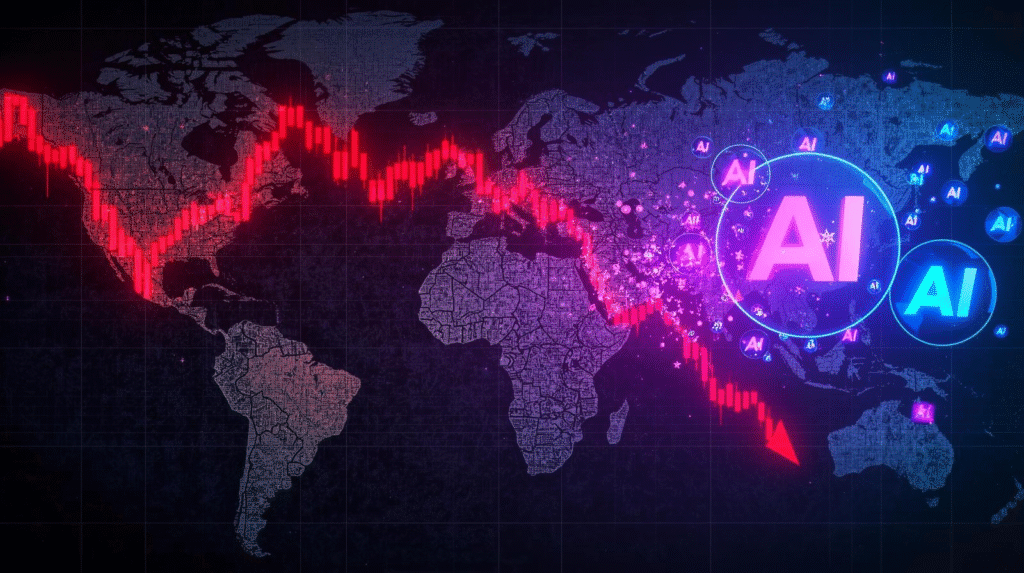
bubble inflating global —
AI is the darling of modern tech — it’s transforming everything from cloud computing to healthcare, and its impact on the markets has been nothing short of seismic. But as of late 2025, whispers of a familiar fear are circulating among global investors: the AI bubble might be reinflating.
After years of hype, sky-high valuations, and endless optimism, some of the same forces that fueled the first AI super-cycle are showing signs of strain. Traders in New York, Seoul, and Frankfurt are watching closely as AI stocks stumble. The question on everyone’s minds:
Is this just short-term volatility — or a full-blown panic reminiscent of tech bubbles past?
In this deep dive, we unpack why the fear is back, how this might reshape the AI investment landscape, and what smart investors and product teams should do now.
IntroductionWhat’s Driving the New Panic?
1. AI Valuations Beyond Reality
Nvidia, the poster child for AI infrastructure, recently reported astronomical quarterly revenue — but investors aren’t celebrating. Instead, some are warning that growth expectations are outpacing actual deployment.
Many companies pitched on “AI-first” roadmaps are not yet generating sustainable AI-related revenue.
The capital pouring into AI-focused startups still dwarfs profits for many.
Meanwhile, rising compute and energy costs are squeezing margins for big AI players.
These dynamics aren’t new — they echo patterns seen during the last great tech run-up. Companies are riding hype, but reality may not yet validate the valuation multiples.
2. Nasdaq and AI-Heavy Indices Are Slipping
It’s not just individual companies — major indices loaded with AI stocks are seeing sharp corrections:
Nasdaq, heavily tilted toward tech, has posted one of its steepest declines in months.
AI-enabled cloud, semiconductor, and software firms are collectively under pressure.
Fund managers are rotating out of pure AI bets, diversifying into more stable or traditional tech themes.
The market isn’t just rethinking AI — it’s re-pricing it.
3. Financial Institutions Sound the Alarm
This time around, the warnings are louder — and coming from the very institutions who backed AI’s rise.
Some Wall Street banks are cautioning investors about AI saturation and overvaluation.
Risk committees are scrutinizing portfolios with heavy AI exposure.
The narrative is shifting: from “AI will change everything” to “What if AI doesn’t monetize like we thought?”
This collective shift in sentiment could trigger a broader de-risking move, especially in speculative AI plays.
Are We Really in Bubble Territory — Or Is This Just a Correction?
To answer that, we need to assess where AI stands today — not just in hype, but in fundamental value.
Signals That Suggest a Bubble:
Valuation disconnect: Some AI companies are trading far ahead of what cash flows or earnings justify.
Speculative capital: Venture funding and public capital are still flowing into AI startups with little real sales traction. For a practical guide to building an AI business on a minimal budget — with real cost figures and deployment records — see the zero-budget AI track at AI Execution Lab.
Psychological fever pitch: Retail and institutional investors alike are heavily focused on “AI or bust” stories.
Hype repetition: Many companies are rebranding existing offerings as “AI-powered” to capture investor attention.
Counterarguments — Why This Might Be a Healthy Reset:
Broad adoption, not just hype: AI is not speculative technology anymore. Enterprises across sectors are deploying it seriously.
Infrastructure investment remains strong: Demand for datacenter GPUs, memory, and next-gen silicon is real, not just forecasted hype.
AI’s long-term runway is massive: From climate to biotech, AI’s potential is far from exhausted.
Regulators and governance are catching up: As frameworks emerge, the market may shift from speculative betting to measured scaling.
Conclusion on bubble status:
We may not be witnessing a classic pop — but a valuation recalibration. AI’s promise remains, but the way the market is pricing that promise is under stress. It’s not deflation of the mission, but a more grounded repricing.
Why This Panic Is Global — Not Just a U.S. Phenomenon
AI is no longer a Silicon Valley story — it’s a global economic narrative:
Global supply chains: Major AI hardware companies operate across Taiwan, Korea, Europe, and the U.S. A shock to one node affects them all.
Cross-border tech adoption: Enterprises around the world are embedding AI in operations, logistics, finance, and more.
Global investor pool: Sovereign funds, European asset managers, and Asian pension funds all poured into AI. When they pull back, it’s not just a regional dip — it’s a systemic tremor.
Government regulation: With AI policy frameworks under discussion in Europe, China, and beyond, regulation could inject more uncertainty into valuations.
The resulting risk doesn’t belong to just one market — it reverberates through every economy tied to AI infrastructure.
What’s at Risk — And What Could Benefit
At Risk:
Pure-play AI startups with speculative business models
Over-leveraged funds stuck in long AI bets
Companies burnishing “AI-wash” branding without real product differentiation
Speculative investor pools that treated AI like a get-rich-quick theme
Could Benefit:
Infrastructure-focused companies: Cloud providers, datacenter firms, silicon manufacturers
AI-for-business players: Those selling scalable, enterprise-grade AI solutions
AI governance & risk tools: As companies take a more disciplined AI approach
AI-hardware innovation firms: Especially those optimizing for energy-efficient or next-gen compute (e.g., photonic, edge AI)
Smart Moves for Investors and Tech Teams
Here’s a playbook to navigate this choppy AI-market environment:
De-risk your AI exposure.
Shift from speculative bets to companies with durable economic moats.Focus on fundamentals.
Look beyond growth narratives. Check profitability, cash runway, and real AI monetization.Diversify.
Don’t concentrate in AI-only ETFs or startup plays — mix in infrastructure, hybrid AI companies.Watch compute and energy costs.
The sustainability of AI’s economics may well depend on how efficiently we can compute.Prioritize governance.
Encourage transparency around AI models, usage, risk frameworks, and productized AI outputs.Be adaptive.
As AI valuation rebase happens, be ready to scale up again when fundamentals align.
Why This Moment Could Be a Long-Term Opportunity
If the market is re-pricing AI, this could be an entry point — not just for risk-averse investors, but for ambitious product teams:
It’s cheaper now to build and experiment.
The cost of compute may come down faster in a cooling market.
Investors who stayed rational through the hype could fund the next wave of meaningful AI innovation.
Teams that de-risk early and focus on value could emerge stronger when confidence returns.
In short:
The AI revolution is not ending — it’s maturing.
Final Thought
Markets are emotional, and tech is cyclical. The current panic reflects fear, not failure. AI isn’t dead — just re-evaluated.
For anyone building, investing, or leading in the AI space, the smart play right now is nuanced optimism: embrace innovation, but don’t be blinded by hype.
If your company is thinking about AI strategy — whether it’s infrastructure, product development, or governance — we should talk.
👉 Reach out to us via our Contact Page to explore how A SQUARE SOLUTIONS can help you build AI responsibly and sustainably.