
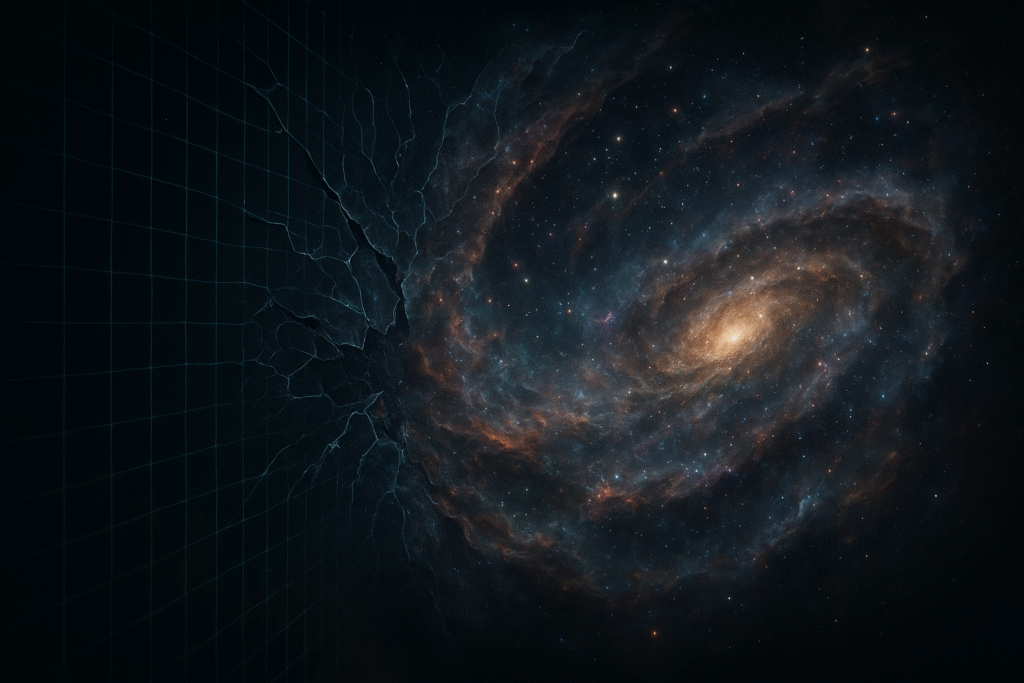
physicists prove universe isn —
Physicists Prove the Universe Isn’t a Simulation After All — New Mathematical Breakthrough
📚 Further Reading
For decades, the idea that we might be living inside a computer simulation has fascinated scientists, philosophers, and tech visionaries. From Elon Musk’s claims to Hollywood blockbusters like The Matrix, the “simulation hypothesis” became one of the most popular modern cosmology theories.
Prefer to have experts handle this? A Square Solutions offers professional our services for growing businesses.
The simulation hypothesis has long captivated philosophers and technologists, but new mathematical work now challenges whether a fully algorithmic universe is possible.
But now, a groundbreaking study from researchers at the University of British Columbia Okanagan has mathematically demonstrated something astonishing:
👉 The universe cannot be a simulation.
👉 Its foundations require non-algorithmic understanding that no computation can replicate.
Using the powerful framework of Gödel’s incompleteness theorem, the team showed that physical reality contains truths that no algorithm, simulation, or supercomputer — no matter how advanced — can fully compute.
This discovery doesn’t just challenge the simulation hypothesis.
It rewrites our understanding of what reality fundamentally is.
But now, a groundbreaking study from researchers at the University of British Columbia Okanagan has mathematically demonstrated something astonishing:
🌌 Why People Thought the Universe Could Be a Simulation
Before discussing why the hypothesis fails, we must understand why it became popular.
1. The Rise of Superintelligent AI
If future civilizations create computers powerful enough, they could simulate entire universes.
If that’s possible, some argued that:
Simulated universes would vastly outnumber “real” ones.
Therefore, statistically, we should be inside one.
This was Nicholas Bostrom’s famous philosophical argument.
2. Quantum Physics Looks… Digital?
Some physicists observed that the universe appears quantized:
energy comes in discrete packets
Planck length is the smallest possible dimension
space-time behaves like it has a limited “resolution”
This looks suspiciously like computer processing limits.
3. Computational Models of Physics
Many modern theories — from quantum gravity to string theory — rely on algorithmic or simulated mathematical frameworks.
So the leap to “the universe is a simulation” wasn’t huge.
But the new study UBC Okanagan press release says otherwise.
Why the Simulation Hypothesis Fails Mathematical Tests
🧠 Gödel’s Incompleteness Theorem: The Proof Against a Simulated Universe
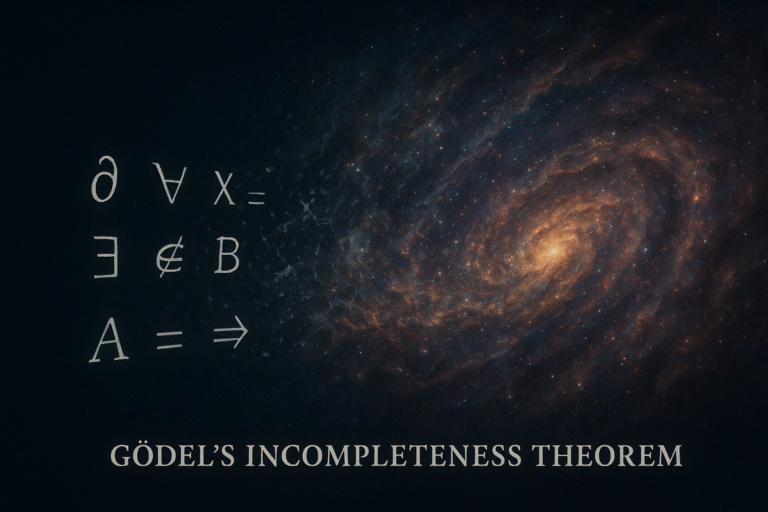
Gödel’s theorem (1931) states:
Any algorithmic system (like a computer) is incomplete.
There will always be truths it cannot compute, predict, or express.
If the universe were a simulation, it would function as an algorithmic system.
But reality contains non-algorithmic truths — things no machine can encode.
🧩 Key Insight from the UBC Okanagan Researchers
The researchers mathematically showed:
Physical laws require logical completeness
But simulations are algorithmically incomplete
Therefore, the universe cannot be generated by an algorithm
This destroys the possibility of a purely computational universe.
🌌 The Universe Behaves in Non-Computable Ways
Here are real examples in physics that break computability:
1. Quantum Randomness
Quantum outcomes are fundamentally unpredictable.
Not “complex,” but truly algorithmically unknowable.
2. Continuum of space-time
Many physical values are not discrete numbers.
They exist on an infinite continuum, which a computer cannot simulate without losing precision.
3. Gödelian Truths in Physics
Certain theorems in cosmology — especially involving infinity, singularities, and topology — fall into the category of true but unprovable within any finite system.
A simulation cannot contain truths that its own code cannot express.
But our universe does.
🎮 Why This Breaks the Simulation Hypothesis Completely
If the universe is a simulation:
it must be computable
it must follow algorithmic rules
it must be representable inside finite hardware
But Gödel + physics proves:
✔ The universe contains non-computable phenomena
✔ Physical laws require unrestricted mathematical truth
✔ No finite or infinite computer can simulate this entirely
Thus:
A simulated universe is logically impossible.
This is not speculation.
It’s mathematical proof.
🧩 Does This Mean There Is No “Creator”?
No — it simply means:
🔹 The universe is not running on software
🔹 The “simulation stack” idea is false
🔹 Reality’s foundation is deeper than computation
This opens the door for:
non-computational physics
consciousness theories beyond algorithms
new cosmological models
and even philosophical or metaphysical interpretations
The universe is real — but more mysterious than we thought.
🧠 Why This Study Matters in 2025
The timing is important:
AI is becoming agentic and autonomous
simulations (AI worlds, virtual physics, digital twins) are exploding
quantum computing is advancing
humanity is modeling reality at unprecedented scale
Many believed we’d soon simulate universes ourselves.
This research shows that no matter how powerful AI becomes…
👉 It can never simulate complete reality.
👉 There are truths forever beyond computation.
This changes the goals of physics and AI research.
Related Reading:
Twin black hole collisions test Einstein’s gravity — a deeper look into extreme physics
📚 References
University of British Columbia Okanagan — Study release, Nov 2025
Kurt Gödel, On Formally Undecidable Propositions, 1931
Nick Bostrom, “Are We Living in a Computer Simulation?”, Oxford University
Max Tegmark, Mathematical Universe Hypothesis
Stanford Encyclopedia of Philosophy — Simulation Argument
🏁 Final Thoughts: A Universe Beyond Algorithms
This breakthrough doesn’t just disprove a trendy theory —
it reveals something profound:
Reality is richer, deeper, and more mysterious than computation.
The universe is not code — it is something entirely beyond it.
As AI grows more powerful and we create increasingly realistic simulations, this discovery draws a clear line:
👉 AI can imitate reality —
but it can never be reality.
This research puts the simulation hypothesis on shaky ground: if physical reality contains non-computable truths, then no simulation — however powerful — can fully reproduce it.
The universe remains beautifully, infinitely real.