
agentic boom bust —
Agentic AI Boom & Bust: Why 40%+ of Corporate AI Agent Projects Will Fail by 2027
📚 Further Reading
Introduction
Agentic AI is no longer a distant concept—it’s the frontier of enterprise AI evolution. Defined as autonomous systems capable of making decisions and executing tasks with minimal human oversight, agentic AI promises dramatic transformation. Yet, according to Gartner, by the end of 2027 more than 40% of agentic AI projects will be cancelled.
Why such a high failure rate? And more importantly: what distinguishes the winners from the losers?
Agentic AI projects act autonomously—perceiving, deciding and executing tasks—which raises integration, governance and ROI challenges for most organizations.Because Agentic AI requires deep domain data, clear decision-rights and auditability, many early projects fail when teams treat agents like plug-and-play software.
In this article we explore the boom, the bust, and the blueprint to survive the shake-out.
1. What is Agentic AI?
Start with a clear definition: Unlike traditional AI systems that respond to queries or offer recommendations, agentic AI acts—it perceives, decides and executes. It is the “autonomous agent” in the business world.
For example: an AI agent that not only generates a report but identifies a bottleneck, reassigns staff, and triggers automated requests to fix the issue—without human prompting.
Despite the hype, many vendor tools still resemble advanced chatbots or RPA in disguise (“agent-washing”). Gartner estimates only ~130 genuine agentic-AI vendors exist among the thousands claiming to be.
2. The Data & the Prediction
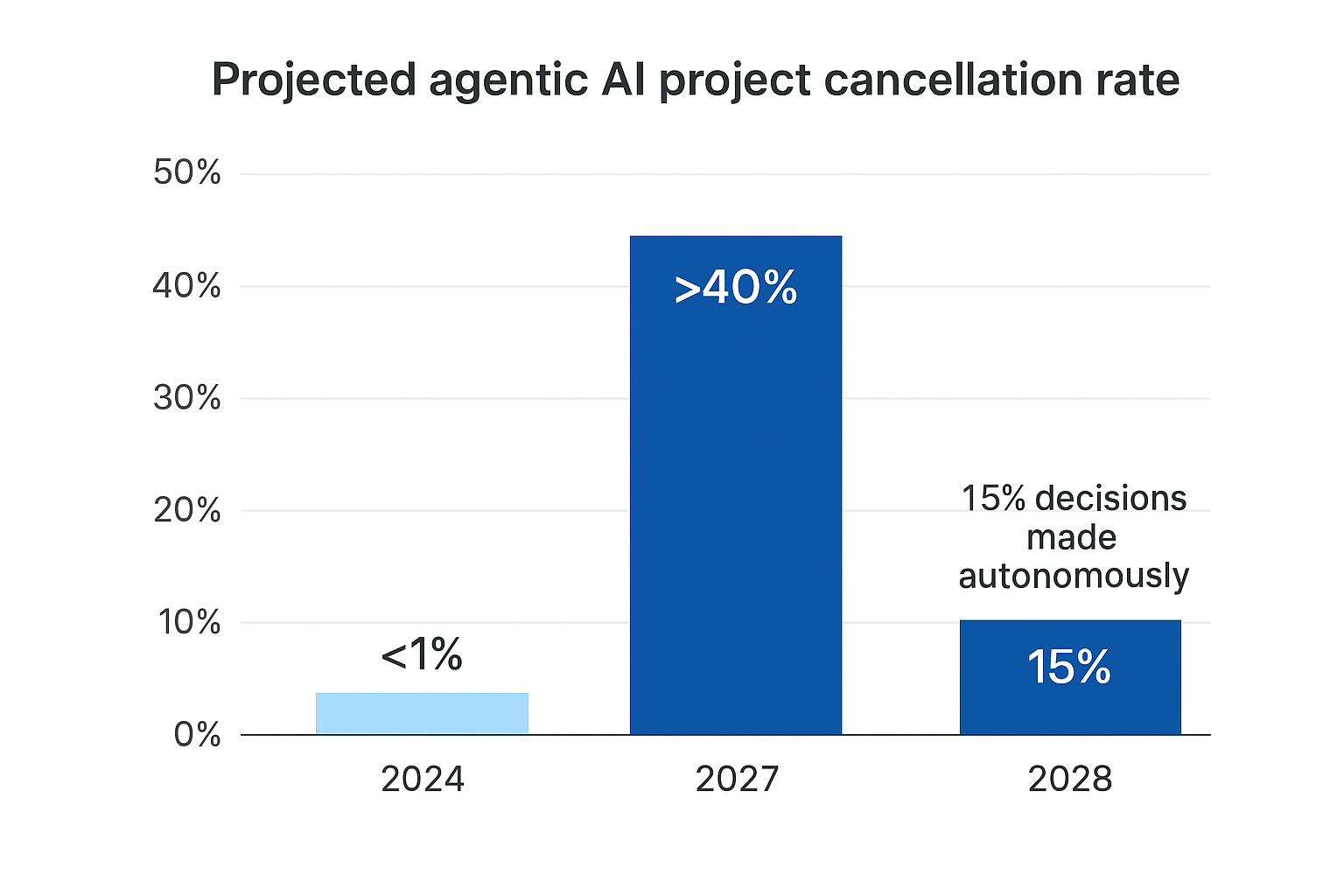
Gartner’s latest press release shows over 40% of agentic-AI initiatives will be cancelled by end of 2027.
Currently (2024–25) less than 1% of enterprise software uses agentic AI; by 2028 Gartner projects 33% will embed it.
Key survey stat: 19% of organizations report significant investments in agentic AI; 42% conservative investments; 8% none.
This data paints the picture: massive rise in investment + high expectations + stark failure risk.
Agentic AI — why projects fail and how to survive the shake-out
3. Why So Many Projects Will Fail
Here are the root causes behind the 40%+ failure prediction:
a. Misaligned use-cases & unclear ROI: Many projects chase “agentic” buzz without tying to real business value.
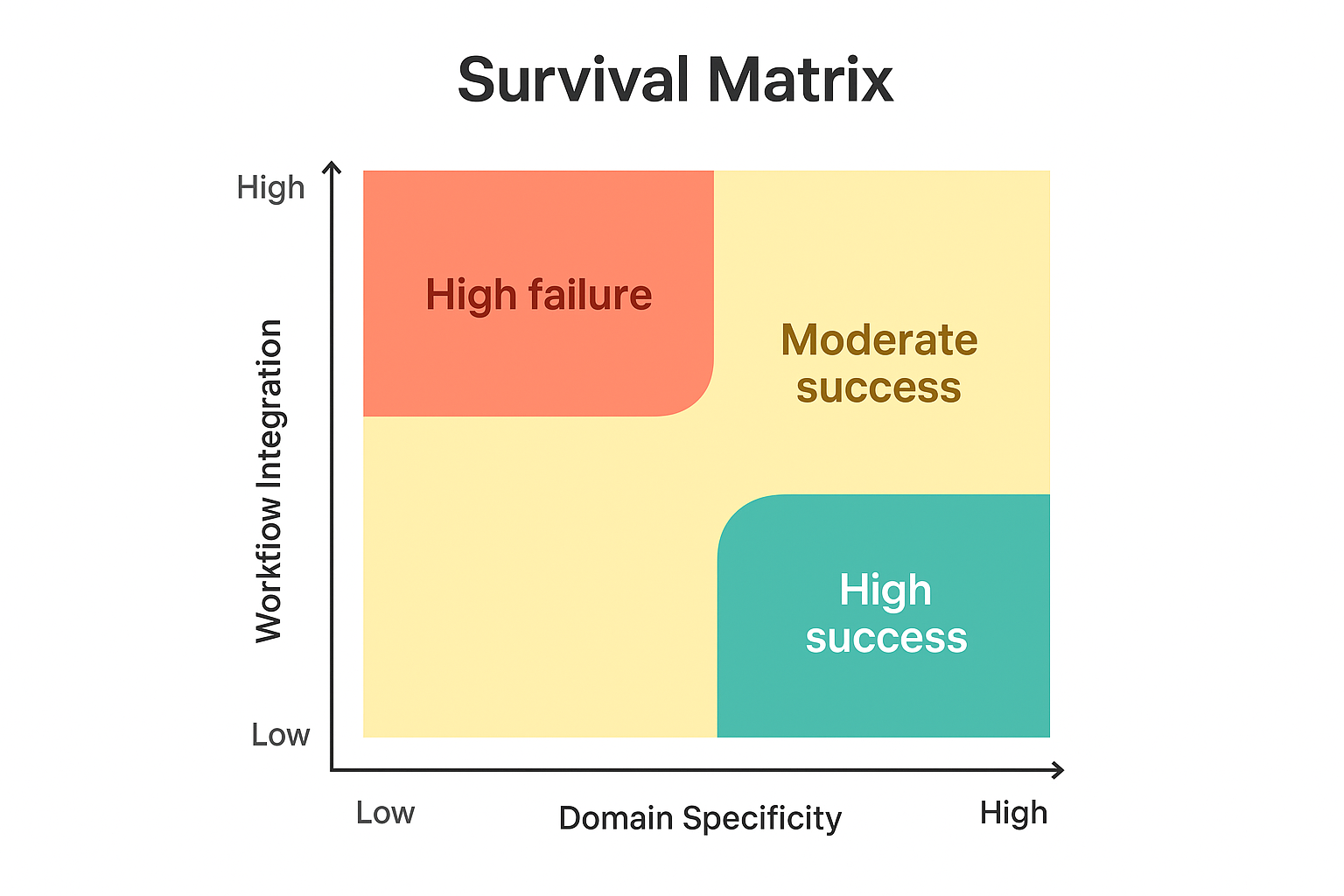
b. Insufficient domain specificity: Agents need deep knowledge of workflows; generic agents falter.
c. Workflow integration difficulties: Embedding an agent into legacy systems is hard; many skip this and build silos.
d. Governance & risk gaps (“agent‐washing”): Vendors mislabel products; organizations lack oversight frameworks.
e. Infrastructure & data readiness: Agentic AI demands clean, real-time data and robust architecture—most firms lack this.
“Many use-cases positioned as agentic today don’t require agentic implementations.” – Anushree Verma, Senior Director Analyst, Gartner.
4. Which Agentic AI Projects Will Survive?
Not all is doom. Some initiatives will survive—and thrive. The survivors share these traits:
High domain specificity & workflow integration: Agents built for finance, audit, supply-chain (rather than one-size-fits-all).
Clear business objectives + iterative delivery: Short cycles, measurable value, not “big bang” at first.
Strong governance, transparency & risk-management: Clear decision rights, audit trails, ethical frameworks.
Data foundation ready: Unified, trusted data fabric, real-time connectivity across systems.
5. The Industries & Use-Cases to Watch
Here are sectors where agentic AI is showing early promise:
Finance & accounting: Real-time reconciliation, contract abstraction, audit support.
Supply chain & logistics: Autonomous orchestration of inventory, routing, and supplier engagement.
Customer engagement: Multi-agent customer ecosystems that handle end-to-end inquiries and follow-through.
Each of these shows high domain specificity + clear workflow integration → better odds.
6. Practical Blueprint for Organisations
Here’s a step-by-step guide to avoid being in the “40% that fail”:
Select one high-impact, domain-specific problem — tie to business metric (e.g., time to close 20% faster).
Ensure data readiness — audit your data fabric, eliminate silos, establish real-time pipelines.
Embed agent/native integration — design process change, embed agent into workflows rather than bolt on.
Develop governance & risk frameworks — assign accountability, audit agent decisions, monitor drift.
Measure value over time — moving beyond headcount reduction, track accuracy, risk reduction, speed, decision-outcome.
Iterate rapidly — start small, learn fast, scale when value proven.
7. The Bigger Picture: Boom, Bust, Then Reset
Historically, every transformative tech cycle has a boom, a crash, and a rebuild: mainframe → PC → internet → cloud. Agentic AI may be in its early ‘hype → trough’ phase.
A high failure rate is not a sign of collapse—it’s a filter. The 40%+ that fail will refine the field for the 10% that become indispensable.
The question for businesses isn’t “Should we implement agentic AI?” but “Can we do it right?”
✅ Conclusion
Agentic AI holds enormous promise—but it’s also a pivot point. Companies can either lead the transformation or become part of the statistics. By focusing on domain specificity, real business value, data readiness and governance, you tilt the odds in your favour.
Because when the dust settles, the winners will not just have used an AI agent—they will have re-architected how work gets done.
“For a deeper look at how AI hype may be echoing past tech cycles, see our analysis here: What If AI Is the Next Dot-Com Bubble?”