
AI chatbot customer support automation has moved from a competitive differentiator to an operational necessity. For businesses handling high inbound query volume, the choice is no longer whether to deploy conversational AI — it’s whether to do it properly. This case study documents how A Square Solutions designed and deployed a customer support automation system that reduced inbound query load by 70%, cut response time by 60%, and transformed lead qualification from a manual process into an automated pipeline.
70%
Inbound queries automated
60%
Reduction in response time
24/7
Query handling capability
↑
Qualified lead capture rate
The Problem: Support Volume Outpacing the Team
📚 Related Services
The client — a service business with growing inbound enquiry volume — was facing a problem familiar to scaling companies: the support team couldn’t keep pace. Every query, regardless of complexity, required a human response. Repetitive questions about pricing, availability, service scope, and onboarding were consuming hours of team time that should have been directed at high-value activities.
Three specific operational failures were measurable. First, average response time was exceeding four hours — in a business context where prospects often make decisions within 30 minutes of first contact, this was directly costing conversions. Second, the support team was spending 60% of their time on queries that had identical or near-identical answers — a productivity drain with a straightforward automation solution. Third, there was no systematic lead qualification — the team was treating all inbound contacts identically, regardless of their commercial intent or readiness to buy.
System Architecture
The system we built operates across three functional layers: a conversational interface, an intelligence layer, and a CRM integration layer. Each is designed to work independently but combine into a unified automation system.
Knowledge Base Construction
Before building the chatbot, we audited the client’s existing support documentation, identified the 50 most common query types, and structured a knowledge base using these as the foundation. The knowledge base was stored in a vector database (Pinecone) enabling semantic search — so queries phrased in different ways still retrieve the correct answer.
LLM Integration with RAG
Rather than relying on a generic LLM to answer questions from its training data, we implemented Retrieval-Augmented Generation (RAG). Every query first retrieves the most semantically relevant knowledge base entries, which are then passed as context to the LLM — ensuring responses are grounded in the client’s specific information, not generic AI outputs.
Intent Classification and Routing
A lightweight classification model runs on every conversation turn, identifying query intent across three categories: informational (answer directly), complex (escalate to human), and commercial (route to sales). This triaging layer ensures the chatbot doesn’t attempt to handle conversations it isn’t equipped for.
CRM Integration via Webhook
When the intent classifier identifies a commercial query, the system captures the conversation context and contact details, creates a CRM record with a structured lead summary, and routes to the appropriate team member based on service type. The sales team receives a pre-qualified lead with full conversation context — no manual data entry required.
Widget Deployment
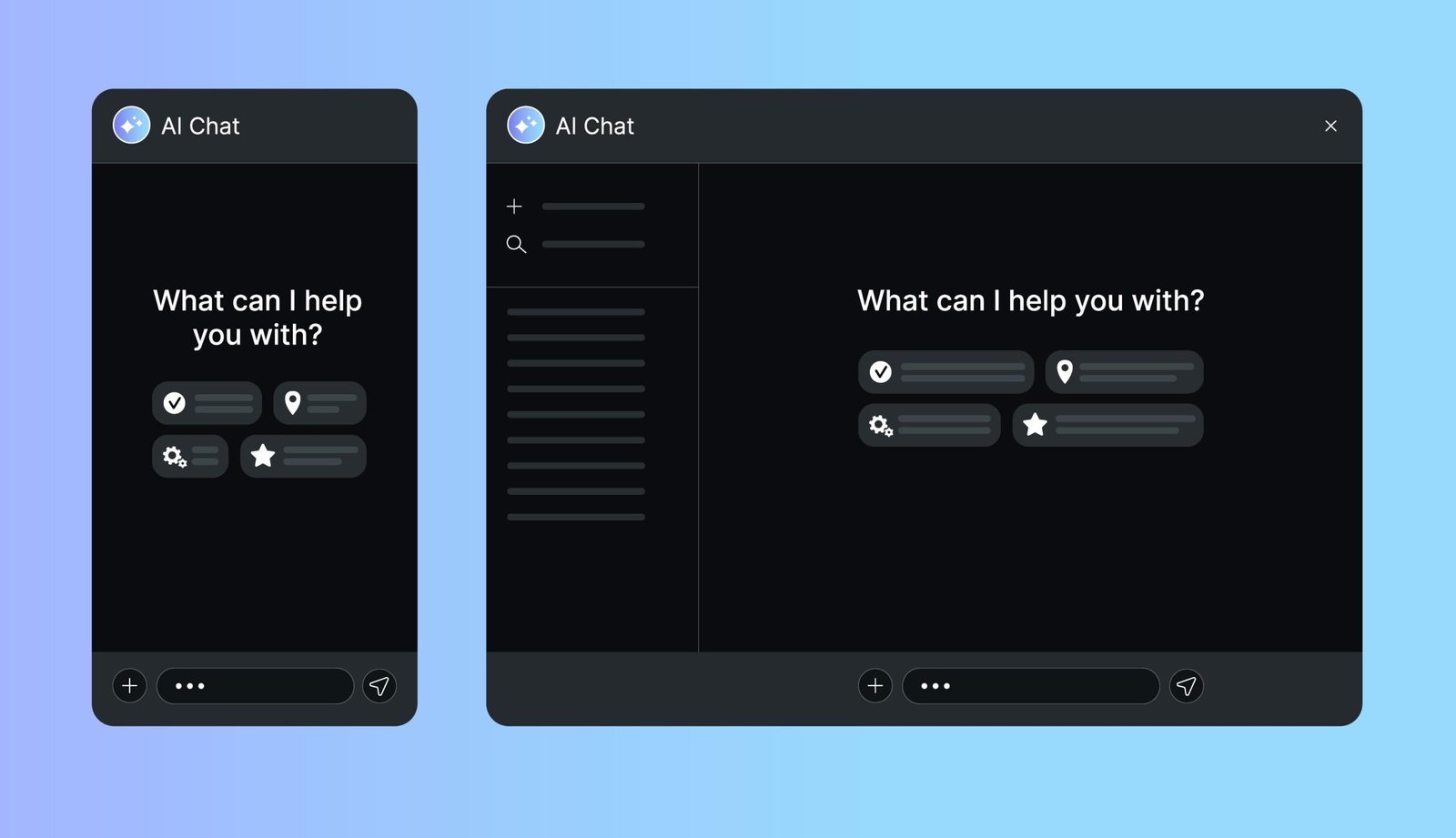
The chatbot is deployed as an embeddable JavaScript widget — compatible with WordPress, Webflow, custom HTML sites, and most major CMS platforms. Deployment requires a single script tag. The same widget architecture powers the Ask Our AI widget on the A Square Solutions website.
The Ask Our AI Widget — Our Own Implementation
The Ask Our AI widget you can see on the asquaresolution.com website is built on the same framework. It uses a Google Cloud-hosted conversational AI architecture with a knowledge base built from our service documentation, blog content, and capability library.
When a visitor asks about our services, pricing, or capabilities, the widget retrieves the relevant information from our knowledge base and delivers an accurate, contextual response — without requiring human intervention. For complex enquiries or visitors who want to discuss a specific project, the widget routes directly to our contact system. This is not a theoretical capability — it is running in production, handling visitor queries on this website right now.
The Google Cloud infrastructure powering the widget includes Cloud Run for serverless deployment, Vertex AI for the LLM inference layer, and Cloud Storage for knowledge base management. This architecture scales automatically with query volume and requires no manual infrastructure management — a critical operational advantage for a system that needs to run reliably 24 hours a day.
What 70% Automation Actually Means
The 70% automation figure requires context. It means that 70% of inbound queries were resolved by the chatbot without requiring human involvement — the customer received an accurate, helpful answer and the conversation ended. It does not mean the chatbot handled 70% of conversations and the rest were ignored — the 30% that required human escalation were routed immediately and with full conversation context.
The practical impact: the support team’s daily query volume fell by 70%. The hours previously consumed by repetitive answers were redirected to complex client work, sales conversations, and strategic activity. Average response time for the 30% requiring human attention actually improved — because the team had more capacity and each escalation arrived with full context, eliminating the back-and-forth typically required to understand the customer’s situation.
For businesses evaluating AI automation systems, the Pareto principle applies directly: 80% of support volume typically comes from 20% of query types. Automating those high-volume, low-complexity queries delivers the majority of the operational benefit — without requiring a sophisticated AI system to handle every edge case.
Volume
70% Queries Automated
Support team redirected from repetitive answers to high-value work
Speed
60% Faster Response
Automated queries resolved instantly, human escalations better resourced
Leads
CRM Auto-Population
Commercial queries automatically create qualified CRM records
Coverage
24/7 Operation
Queries handled outside business hours without overtime or on-call
“The AI chatbot built by A Square Solutions now handles customer interaction instantly, reducing response time and eliminating repetitive manual support.”
— Wasim Raza, Client
The system continues to improve over time. Every conversation generates data — which queries are most common, where the knowledge base needs updating, which escalation patterns indicate gaps in the automated coverage. This feedback loop is a fundamental advantage of AI-powered systems over static FAQ pages or human-only support: the system learns from usage and improves without requiring manual intervention.
🚀 A Square Solutions
Need a similar solution? We specialise in AI Chatbot & Workflow Automation — from strategy to live deployment.
Frequently Asked Questions
What type of AI powers the customer support chatbot?
The chatbot uses a large language model (LLM) architecture with a custom knowledge base built from the client’s support documentation, FAQ library, and historical query data. The system uses retrieval-augmented generation (RAG) to ensure responses are grounded in accurate, client-specific information rather than generic LLM outputs.
How does the chatbot integrate with CRM systems?
The chatbot integrates with CRM via API webhook architecture. When a conversation is classified as a qualified lead (based on intent signals in the dialogue), the system automatically creates a CRM record with the contact details, conversation summary, and lead qualification score — routing it to the appropriate sales team member.
What percentage of queries can an AI chatbot realistically automate?
In our implementation, 70% of inbound queries were automated within 60 days of deployment. This figure varies by industry and support complexity — simpler, high-volume query categories automate at higher rates. The critical metric is not automation percentage but resolution rate: whether automated responses actually resolve the customer’s need.
How is the A Square Solutions Ask Our AI widget built?
The Ask Our AI widget deployed on asquaresolution.com uses a Google Cloud-hosted conversational AI architecture with a custom knowledge base covering our services, blog content, and capability documentation. It handles initial visitor queries, qualifies leads, and routes complex enquiries to our team — the same framework we deploy for clients.
Reference Sources: Google Vertex AI | OpenAI Research | LangChain Documentation
💬 Have a question about this project?
Use the 🤖 Ask Our AI widget (bottom-right) — instant answers, 24/7.