AI Microscopic Surface Detection: How Machines Analyze Invisible Surfaces
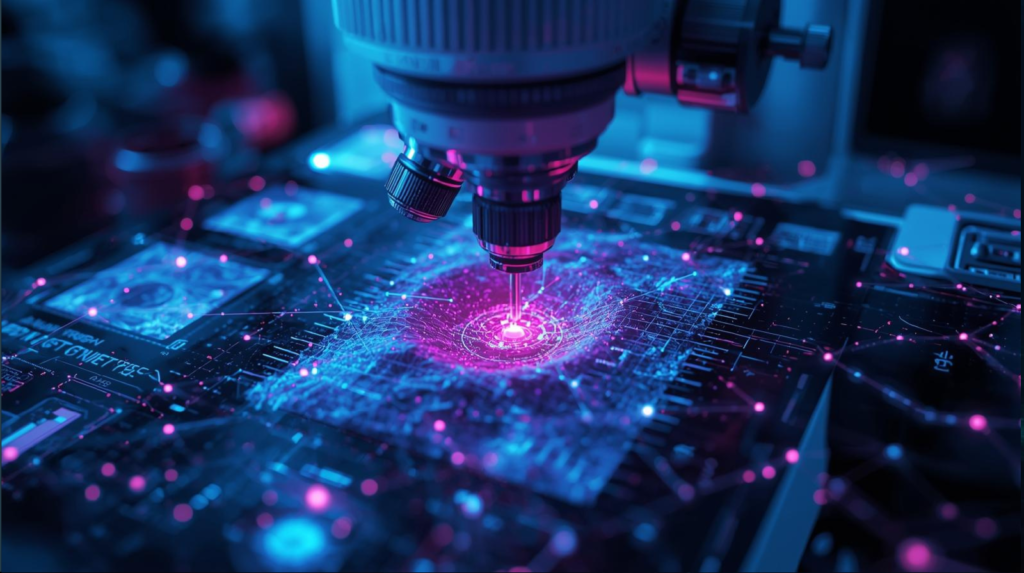
Artificial intelligence is transforming how machines perceive the physical world — not just at a human scale, but far beyond it. AI microscopic surface detection is an emerging field where machines analyze surface textures and patterns at micro and nano levels that are completely invisible to the naked eye. This capability is redefining precision in manufacturing, healthcare, robotics, and material science.
Traditional inspection methods struggle at microscopic scales due to limitations in human vision and conventional sensors. AI, combined with advanced imaging and computer vision, is changing that reality.
What Is Microscopic Surface Detection?
Microscopic surface detection refers to the analysis of surface structures at extremely small scales — often measured in micrometers or nanometers. These surfaces may appear smooth to humans but contain complex textures, defects, or patterns that can affect performance, durability, and safety.
With AI microscopic surface detection, machines learn to interpret these patterns using high-resolution imaging data, enabling automated and highly accurate surface analysis.
How AI Detects Microscopic Surfaces
AI does not “see” surfaces the way humans do. Instead, it processes data generated from advanced imaging tools such as electron microscopes, laser scanners, and optical sensors.
Using computer vision microscopic surface analysis, AI models:
Convert micro-scale images into numerical data
Detect patterns, irregularities, and anomalies
Classify surfaces based on learned features
Deep learning models, particularly convolutional neural networks (CNNs), excel at recognizing subtle variations in texture that would otherwise go unnoticed.
Role of Machine Learning and Computer Vision
Machine learning is the backbone of AI surface inspection. Models are trained on thousands of labeled microscopic images, allowing them to distinguish between acceptable surfaces and defective ones.
Key techniques include:
Feature extraction from micro-textures
Pattern recognition across multiple scales
Automated defect classification
These capabilities are increasingly used alongside robotics, enabling machines to make real-time decisions during inspection and manufacturing processes. Related advancements in human-machine coordination are discussed in this analysis of robot-human synchronization.
Key Applications of AI Microscopic Surface Detection
Manufacturing & Quality Control
AI ensures consistent inspection of micro-defects in semiconductors, precision components, and advanced materials — far faster than manual inspection.
Healthcare & Medical Diagnostics
In biomedical imaging, AI helps analyze tissue surfaces, implants, and cellular structures with unprecedented accuracy.
Robotics & Automation
Robotic systems equipped with AI vision can adapt their actions based on surface feedback, improving precision and safety in automated environments.
Material Science & Research
Researchers use AI to analyze surface properties that influence strength, conductivity, and durability. Ongoing materials science research increasingly relies on AI-driven analysis.
Recent Research and Breakthroughs
Recent advances in computer vision research have significantly improved micro-scale detection accuracy. AI models now combine multiple imaging modalities, allowing them to interpret surface data more holistically.
Breakthroughs in training reliability — such as those explored in this discussion on enhancing AI reliability — are making these systems more dependable for real-world deployment.
Challenges and Limitations
Despite its promise, AI microscopic surface detection faces several challenges:
High-quality labeled datasets are difficult to obtain
Imaging hardware can be expensive
Noise and variability at micro-scales can confuse models
Model bias may occur if training data is limited
Overcoming these challenges requires collaboration between AI researchers, engineers, and material scientists.
The Future of AI Microscopic Surface Analysis
The future of AI microscopic surface detection lies in autonomous inspection systems, smart factories, and advanced robotics. As AI models become more efficient and hardware costs decline, micro-scale analysis will become a standard capability across industries.
From detecting invisible defects to enabling next-generation materials, AI is unlocking a level of precision that was previously unattainable.
Conclusion
AI microscopic surface detection represents a major leap in how machines understand the physical world. By combining artificial intelligence, computer vision, and advanced imaging, machines can now analyze surfaces at scales humans cannot perceive.
As this technology matures, it will play a critical role in shaping the future of manufacturing, healthcare, robotics, and scientific discovery.

QR Codes in Digital Marketing 2026 | 2026

Agentic AI Systems 2026 | 2026

Small Business AI Toolkit 2026 | 2026

AI | 2026

Ancient DNA and AI | 2026