
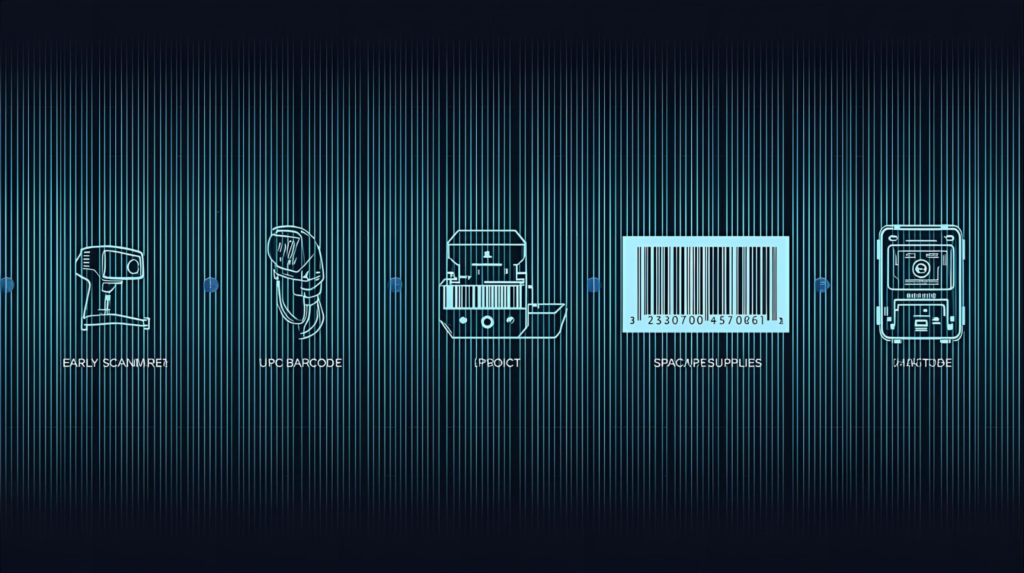
weird history barcode —
The Weird History of the Barcode: From Supermarkets to Space and Beyond
Today, barcodes track billions of products, manage medical safety, power logistics networks, and support modern digital systems like QR codes. Yet few people realize how strange, controversial, and unexpectedly futuristic this journey really is.
Prefer to have experts handle this? A Square Solutions offers professional our services for growing businesses.
How the Weird History of the Barcode Actually Began
The barcode was born in 1948, when graduate students Bernard Silver and Norman Joseph Woodland attempted to solve a basic retail problem: slow and error-prone inventory tracking.
Inspired by Morse code, Woodland’s earliest barcode design looked nothing like today’s black stripes. It used circular “bull’s-eye” patterns, allowing scanners to read codes from any direction.
Despite early patents, barcode technology struggled for decades. Scanners were expensive, computing power was limited, and retailers hesitated to standardize. It wasn’t until 1974, when a pack of Wrigley’s chewing gum became the first officially scanned product, that the barcode entered commercial reality.
That single scan quietly launched a retail revolution.
Supermarkets, Scale, and the Barcode Boom
Once supermarkets adopted the Universal Product Code (UPC), everything changed.
Barcodes enabled:
Faster checkout experiences
Accurate pricing
Automated inventory management
Real-time supply chain tracking
Retailers could suddenly understand consumer behavior at scale. Entire logistics ecosystems emerged around barcode scanning, laying the foundation for modern automation-driven digital systems used across industries today.
This transformation mirrors how modern tools—like our own Free QR Code Generator—now extend barcode principles into mobile-first, contactless environments.
Beyond Retail: When Barcodes Entered Medicine and Logistics
As barcode reliability improved, hospitals and logistics companies adopted it rapidly.
In healthcare, barcodes are used to:
Verify patient identities
Match medications accurately
Reduce fatal dosage errors
According to global healthcare standards bodies like GS1, barcode systems have become a cornerstone of patient safety and pharmaceutical traceability.
In logistics, barcodes power:
Global shipping networks
Warehouse automation
Real-time package tracking
Without them, modern e-commerce would simply collapse.
The Weirdest Turn: Barcodes in Space
One of the most surprising chapters in the weird history of the barcode is its role in space missions.
NASA uses barcode systems aboard the International Space Station (ISS) to:
Track thousands of tools and components
Organize scientific samples
Reduce human error in zero-gravity environments
Astronauts scan barcodes to instantly retrieve maintenance histories, usage logs, and location data. What began as a grocery store tool now helps humans survive and work beyond Earth.
NASA’s inventory management systems demonstrate how low-tech ideas can outperform complex alternatives when reliability matters most.
Cultural Panic, Myths, and the “Mark of the Beast”
Not everyone welcomed barcodes.
During the 1970s and 1980s, cultural backlash erupted. Some groups feared barcodes represented:
Mass surveillance
Dehumanization of consumers
Religious symbolism linked to apocalyptic beliefs
The infamous “mark of the beast” conspiracy reflected a deeper anxiety: technology moving faster than society’s ability to understand it.
Ironically, these fears resurfaced decades later with AI, facial recognition, and algorithmic decision-making—topics we explore in our analysis of how technology reshapes society and trust in the digital age.
From Lines to Squares: The Rise of QR Codes
Barcodes didn’t stop evolving.
The invention of QR codes expanded data capacity dramatically:
URLs
Contact details
Payments
Authentication
Event access
QR codes removed the need for physical scanners—smartphones became universal readers. This evolution directly led to tools like custom QR generators used today for marketing, networking, and automation.
👉 You can experiment with this evolution yourself using our Free QR Code Generator—a modern extension of barcode history
Barcodes, AI, and the Future of Tracking
The future of barcode technology is no longer just optical—it’s intelligent.
Emerging systems combine:
Barcodes + AI vision
Predictive inventory analytics
Blockchain-based verification
Smart supply chain automation
AI can now detect damaged codes, predict stock shortages, and optimize logistics routes automatically. Barcodes have become data gateways, not just labels.
This convergence mirrors broader trends in digital transformation where simple technologies scale through intelligence rather than complexity.
Why the Weird History of the Barcode Still Matters
The barcode’s story reveals a powerful lesson:
Transformative technology doesn’t always look revolutionary at first.
From skepticism and conspiracy to global dependence, the barcode followed a familiar path—one we now see repeated with AI, automation, and digital identity systems.
Understanding this history helps businesses, technologists, and societies respond more thoughtfully to emerging tools instead of reacting with fear or blind optimism.
Final Thoughts: A Quiet Technology That Changed Everything
The weird history of the barcode is not just about retail or scanners. It’s about how small innovations quietly reshape civilization.
From supermarket shelves to space stations, from paper labels to intelligent QR systems, barcodes prove that the most impactful technologies often operate invisibly—until the world can’t function without them.
2026 Strategic Resources:
- Welcome To The A Square Solution Blog
- Ddos Attack Takes Down Openais Chatgpt And Api Services
- New Diamond Bonding Technique Future Devices
🚀 A Square Solutions
We specialise in AI Deployment & Workflow Automation — helping businesses scale through AI and intelligent digital systems.
Frequently Asked Questions
What is The Weird History of the Barcode?
Today, barcodes track billions of products, manage medical safety, power logistics networks, and support modern digital systems like QR codes.
Why is The Weird History of the Barcode important in 2026?
Yet few people realize how strange, controversial, and unexpectedly futuristic this journey really is.
How does The Weird History of the Barcode work?
How the Weird History of the Barcode Actually Began The barcode was born in 1948 , when graduate students Bernard Silver and Norman Joseph Woodland attempted to solve a basic retail problem: slow and error-prone inventor
What should you know about The Weird History of the Barcode?
Inspired by Morse code , Woodland’s earliest barcode design looked nothing like today’s black stripes.
Sources: MIT Technology Review | TechCrunch
💬 Questions about this topic?
Use the 🤖 Ask Our AI widget (bottom-right) — instant answers, 24/7.
Need help with AI, web, or SEO?
A Square Solutions builds AI products, high-performance websites, and SEO systems. Book a free, no-obligation consultation.
Subscribe to our newsletter
Practical updates on AI, web, and SEO — no spam.