improving decision making —
AI for Improving Decision-Making: A Powerful Tool for Government
📚 Further Reading

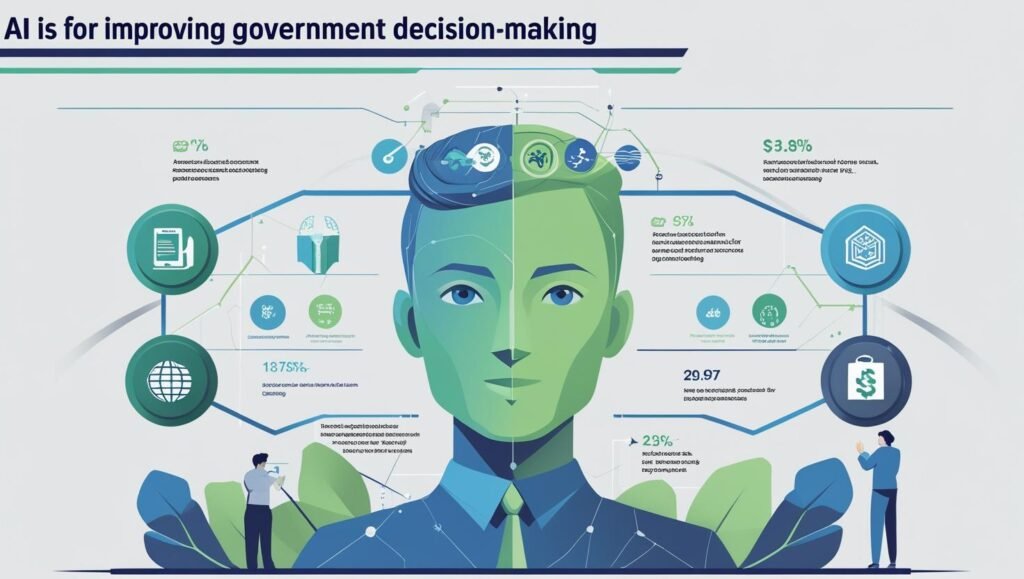
Artificial intelligence is enabling governments to move from reactive administration to data-driven decision-making. By analyzing large-scale datasets, predictive models can guide resource allocation, policy planning, and service delivery with far greater accuracy than traditional methods.
Here are a few examples of how AI can be used to improve decision-making in government:
- Allocating resources: AI can be used to analyze data on population needs, infrastructure, and economic development to identify the most efficient and effective way to allocate resources. For example, AI can be used to identify the best locations for new schools and hospitals, or to develop transportation plans that reduce congestion.
Real-world implementations of these models can be seen in digital-first nations such as Estonia’s AI-powered governance ecosystem.
- Designing public programs: AI can be used to analyze data on the effectiveness of existing public programs to identify areas for improvement. For example, AI can be used to identify students who are at risk of dropping out of school, or to develop programs that help people find employment.
Administrative intelligence is also improving operational workflows, as demonstrated by AI-driven tax processing automation.
- Developing new policies: AI can be used to analyze data on social and economic trends to identify potential problems and develop solutions. For example, AI can be used to predict the impact of climate change on different regions, or to develop policies that promote economic growth.
AI is further enabling citizen-centric experiences through personalization strategies discussed in AI-powered public service delivery.
In addition to these specific examples, AI can also be used to improve decision-making in government by:
- Identifying and mitigating risks: AI can be used to identify potential risks to public safety and security, and to develop plans to mitigate those risks. For example, AI can be used to identify areas that are at risk of flooding, or to develop plans to respond to cyberattacks.
- Improving transparency: AI can be used to make government data more accessible and transparent to the public. This can help to improve public trust in government and to ensure that decision-making is based on sound evidence.
- Empowering citizens: AI can be used to empower citizens to participate more actively in government decision-making. For example, AI can be used to develop tools that allow citizens to track the progress of legislation or to provide feedback on government services.
These transformations form part of a broader movement toward responsible innovation explored in our AI for social and environmental progress.
Overall, AI offers a number of potential benefits for improving decision-making in government. By providing insights into large amounts of data, AI can help government officials to make more informed and effective decisions. This can lead to better outcomes for citizens and businesses, and to a more efficient and effective government.
To understand how these same analytical capabilities are applied in commercial ecosystems, read our Digital Marketing and AI guide.
Here are a few additional benefits of using AI to improve decision-making in government:
- Reduced costs: AI can help to reduce the costs of government by automating tasks that would otherwise be performed by human employees.
- Improved accuracy: AI can help to improve the accuracy of government decision-making by reducing the risk of human error.
- Increased fairness: AI can help to ensure that government decisions are made in a fair and impartial manner by reducing the risk of bias.
- Improved public trust: AI can help to improve public trust in government by making government data more accessible and transparent.
At A Square Solutions, similar predictive frameworks are implemented through our AI-enabled digital solutions.
Why Data-Driven Governance Mirrors Enterprise Transformation
The technologies improving public-sector decisions—machine learning, predictive analytics, and intelligent automation—are the same tools organizations now use to forecast demand, personalize customer engagement, and optimize operational efficiency. This convergence shows how AI innovation often begins in large-scale systems before becoming standard in business environments.
As AI continues to develop, it is likely that we will see even more innovative ways to use it to improve decision-making in government. This is a positive development, as it has the potential to make government more efficient, effective, and fair.