

hidden social cost 2025 —
The Hidden Social Cost of AI in 2025 — And Why 2026 Will Be a Reckoning
📚 Further Reading
In 2025, artificial intelligence didn’t just accelerate innovation — it quietly reshaped society.
While headlines celebrated faster models, smarter agents, and cheaper automation, a deeper story unfolded beneath the hype.
AI systems entered workplaces, classrooms, hospitals, courts, and governments — often faster than society could adapt. The result wasn’t a dramatic collapse. It was something subtler and more dangerous: a growing social cost that went largely unnoticed.
This article explores the hidden social cost of AI in 2025 — and why 2026 will be a reckoning year, not a breakthrough year.
⚠️ 1. Invisible Job Displacement, Visible Anxiety
AI did not cause mass unemployment in 2025.
Instead, it created something more destabilizing: permanent uncertainty.
Roles didn’t disappear overnight — they eroded.
Junior positions vanished first.
Human judgment was downgraded to “override only.”
Workers didn’t lose jobs.
They lost career predictability.
This mirrors patterns we’ve already seen in automation-heavy sectors discussed in our analysis of AI governance and risk systems on asquaresolution.com.
Why this matters for society
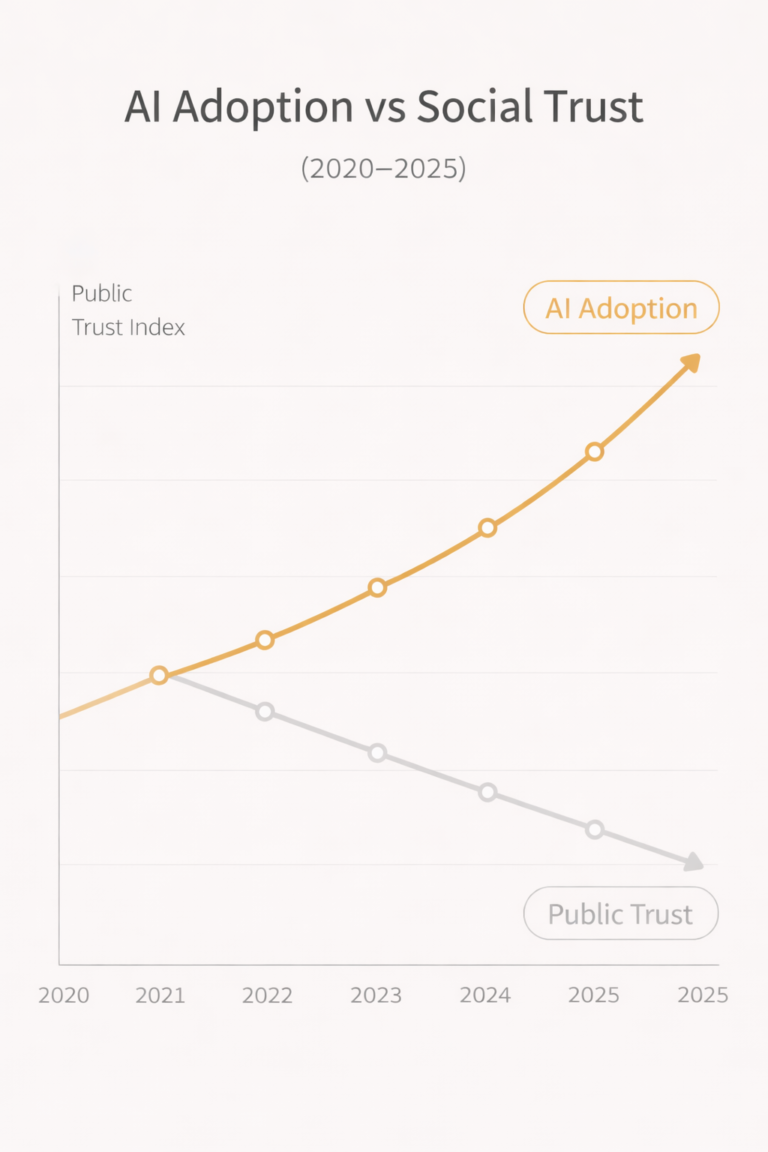
Economic anxiety spreads faster than job loss. By the end of 2025, millions were working alongside AI they didn’t trust — or understand.
🧑⚖️ 2. AI Made Decisions — Responsibility Became Fuzzy
Across finance, healthcare, hiring, and law enforcement, AI systems increasingly influenced outcomes — but accountability lagged behind.
When an AI:
denies a loan
flags a transaction
deprioritizes a patient
suppresses visibility online
Who is responsible?
In 2025, the answer was usually: no one clearly.
This accountability gap is one reason regulators globally are now accelerating AI frameworks — a shift already visible in discussions around AI risk management and governance.
🧠 3. Cognitive Dependency Became Normal
One of the least discussed social costs of AI in 2025 was mental offloading.
People increasingly relied on AI for:
decision framing
emotional validation
summarizing reality
This wasn’t laziness.
It was convenience scaling faster than critical thinking.
Psychologists warned of “confidence without comprehension” — people trusting AI outputs they couldn’t evaluate.
External reference (contextual): Research institutions like the Stanford Institute for Human-Centered AI have already flagged long-term cognitive dependency as a societal risk.
📉 4. Bias Didn’t Disappear — It Became Harder to See
AI systems in 2025 didn’t eliminate bias.
They standardized it.
Bias moved from:
visible prejudice → statistical probability
human intent → training data inertia
Because decisions came from “models,” they felt neutral — even when outcomes weren’t.
This made social harm:
harder to contest
harder to audit
harder to emotionally process
A key reason 2026 will be different is growing pressure for explainability and auditable AI systems.
🏛️ 5. Society Was Not Asked — It Was Updated
Perhaps the biggest hidden cost of AI in 2025 was lack of consent.
AI was:
deployed by corporations
integrated by institutions
optimized for efficiency
But rarely debated publicly.
Society didn’t opt in.
It was silently upgraded.
This gap is why 2026 will not be about faster AI — but about who decides how it’s used.
🔮 Why 2026 Will Be a Reckoning
2026 will mark a shift from capability obsession to consequence management.
Expect:
stricter AI accountability laws
mandatory transparency for high-risk systems
human-in-the-loop requirements
public pushback against opaque automation
AI will not slow down.
But society will push back harder.
🧭 The Path Forward: Tech That Serves Society
The solution is not less AI.
It is better alignment.
Key principles emerging for 2026:
Human override by default
Explainability as a requirement, not a feature
Social impact audits alongside technical benchmarks
Clear ownership of AI outcomes
Technology must scale responsibility at the same speed as intelligence.
✅ Conclusion
The hidden social cost of AI in 2025 wasn’t a single failure — it was a pattern of quiet compromises.
Convenience over consent.
Efficiency over empathy.
Automation over accountability.
2026 will be the year society demands balance.
Not because AI failed —
but because we finally noticed the bill.

QR Codes in Digital Marketing 2026 | 2026
20:42
QR Codes in Digital Marketing 2026
Agentic AI Systems 2026 | 2026
03:06
Agentic AI Systems 2026

Small Business AI Toolkit 2026 | 2026
09:59
Small Business AI Toolkit 2026
AI | 2026
09:58
AI

Ancient DNA and AI | 2026
09:58
Ancient DNA and AI

AI Arms Race in Defence | 2026
09:57
AI Arms Race in Defence
🚀 Need expertise in Ethical AI?
A Square Solutions delivers measurable results — from strategy to deployment.

🚀 A Square Solutions
We specialise in Ethical AI & Digital Strategy — helping businesses scale through AI and intelligent digital systems.
Frequently Asked Questions
What is The Hidden Social Cost of AI in 2025 — And Why 2026 Will Be a Reckoning?
In 2025, artificial intelligence didn’t just accelerate innovation — it quietly reshaped society.
Why is The Hidden Social Cost of AI important in 2026?
While headlines celebrated faster models, smarter agents, and cheaper automation, a deeper story unfolded beneath the hype.
How does The Hidden Social Cost of AI work?
AI systems entered workplaces, classrooms, hospitals, courts, and governments — often faster than society could adapt.
What should you know about The Hidden Social Cost of AI?
It was something subtler and more dangerous: a growing social cost that went largely unnoticed .
Sources: AI Now Institute | Electronic Frontier Foundation
💬 Questions about this topic?
Use the 🤖 Ask Our AI widget (bottom-right) — instant answers, 24/7.