breakthroughs ignored 2025 will —
Breakthroughs We Ignored in 2025 — But Will Rely On in 2026
📚 Further Reading
Prefer to have experts handle this? A Square Solutions offers professional our services for growing businesses.
Introduction: Progress Doesn’t Always Arrive With Applause
Not every breakthrough announces itself with headlines or hype. In 2025, much of the spotlight stayed fixed on loud innovations—AI launches, space missions, viral tech demos. But beneath that noise, quieter advances emerged across science and innovation.
These were not failures. They were breakthroughs we ignored in 2025—advances that didn’t feel revolutionary at the time, yet will quietly become indispensable in 2026.
History shows this pattern clearly: the most transformative science often starts as infrastructure, not spectacle.
1. Energy Storage Quietly Crossed a Threshold
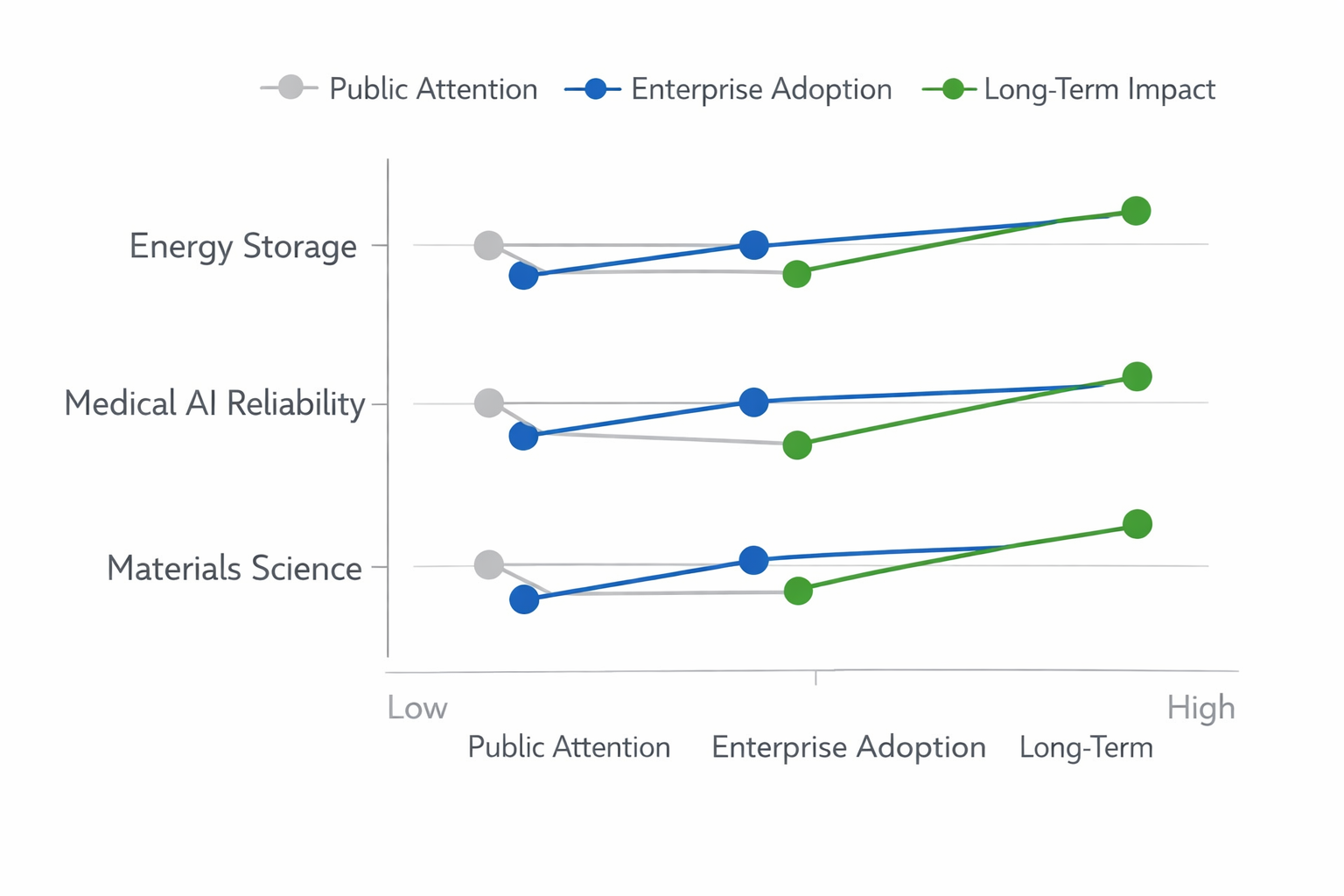
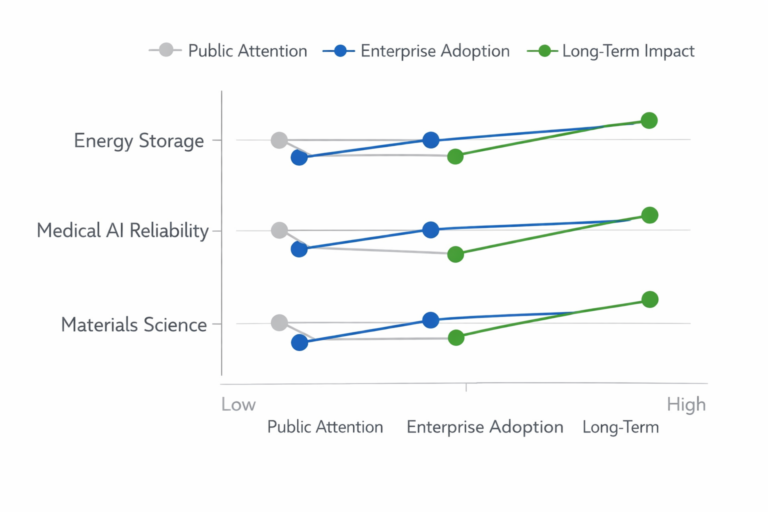
In 2025, energy headlines focused on climate targets and electric vehicles. What received less attention was steady progress in next-generation energy storage.
Advances in solid-state batteries, long-duration grid storage, and hydrogen containment didn’t trend on social media—but they solved problems that blocked clean energy scale for years.
These breakthroughs we ignored in 2025 will underpin:
More stable renewable grids
Safer electric transportation
Reduced dependency on fossil fuel peaker plants
By 2026, these systems won’t feel “new.” They’ll feel necessary.
2. Medical AI Became Less Flashy—and More Useful
While generative AI dominated attention, healthcare innovation moved in a different direction. In 2025, some of the most important progress happened in clinical reliability, not capability.
AI models became:
Better calibrated
More transparent
More conservative in high-risk decisions
This shift aligned with research on trustworthy AI in life-critical systems, where restraint matters more than raw prediction power. These understated improvements will shape diagnostics, triage systems, and hospital workflows throughout 2026.
3. Materials Science Solved “Unsexy” Problems
2025 delivered breakthroughs in materials science that didn’t sound exciting—but removed hard physical limits.
Examples include:
Stronger lightweight composites
Heat-resistant materials for data centers
More efficient semiconductor substrates
These advances matter because they enable everything else: faster computing, safer infrastructure, and lower energy loss.
By 2026, these materials won’t be news—they’ll be standard.
4. Climate Modeling Became More Precise
Another area among the breakthroughs we ignored in 2025 was climate modeling. Improvements in simulation resolution and data fusion allowed scientists to predict localized impacts with higher confidence.
This matters for:
Disaster preparedness
Agriculture planning
Urban infrastructure design
External authoritative source:
👉 (Nature – climate & earth science research)
In 2026, policy decisions will quietly depend on models refined in 2025.
5. Space Infrastructure Took a Back Seat—On Purpose
Unlike headline-grabbing missions, 2025 focused on:
Satellite redundancy
Orbital debris tracking
Ground-to-space data reliability
These infrastructure-first advances rarely go viral—but without them, future exploration collapses.
By 2026, these systems will make ambitious missions possible again.
Why These Breakthroughs Matter More Than Trends
Trends excite people. Breakthroughs sustain systems.
The breakthroughs we ignored in 2025 share three traits:
They improved reliability, not novelty
They reduced risk rather than increasing capability
They quietly enabled other innovations
These are the foundations every future technology stands on.
Conclusion: 2026 Will Reveal What 2025 Actually Gave Us
In hindsight, 2025 won’t be remembered for what went viral—but for what endured.
The breakthroughs we ignored in 2025 will quietly power grids, hospitals, data centers, and climate responses in 2026. Progress doesn’t always shout. Sometimes it just shows up—everywhere.

QR Codes in Digital Marketing 2026 | 2026
QR Codes in Digital Marketing 2026

Agentic AI Systems 2026 | 2026
Agentic AI Systems 2026

Small Business AI Toolkit 2026 | 2026
Small Business AI Toolkit 2026

AI | 2026
AI

Ancient DNA and AI | 2026
Ancient DNA and AI

AI Arms Race in Defence | 2026
AI Arms Race in Defence