
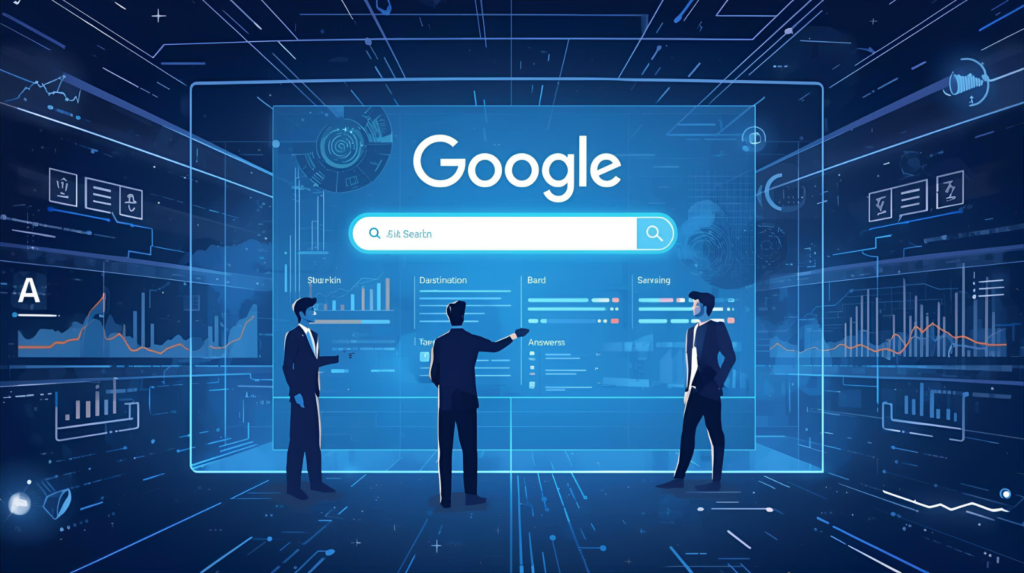
google search impact digital —
🔍 Google AI Search Impact on Digital Marketing in 2025
📚 Further Reading
In 2025, Google’s AI-powered search experience is changing the fundamentals of SEO, paid advertising, and content marketing. Marketers who adapt early will survive. Those who don’t will slowly disappear from search visibility.
🚨 Why Google AI Search Is Changing Everything
Google is increasingly showing AI-generated answers directly on the search results page, reducing the need for users to click traditional blue links.
According to Google’s own updates on its AI-powered search experience, the goal is to deliver faster, more accurate answers directly in search results, especially for informational queries.
For digital marketers, this means visibility does not always translate into traffic anymore. Understanding Generative Engine Optimization (GEO) is now the essential next step for marketers adapting to this shift. Understanding the mechanics of GEO — Generative Engine Optimization — is the strategic response to this shift, documented in full at AI Execution Lab.
📉 The Click Decline Problem Marketers Are Facing
Many websites are now experiencing a confusing trend:
Impressions are rising
Rankings look stable
But clicks are stagnating or declining
This happens because AI summaries often answer user queries instantly. As a result, users leave without visiting a website — a phenomenon now known as zero-click searches. If your AdSense revenue has dropped alongside organic traffic, our AdSense earnings recovery guide covers the key causes and fixes for 2026.
This pattern is already visible across AI, technology, and digital marketing niches, including competitive international markets.
🔄 How Digital Marketing Strategies Must Adapt in 2025
To survive the Google AI Search impact on digital marketing, brands must rethink their entire strategy.
What no longer works:
Thin, generic SEO blogs
Mass AI-generated content without originality
Writing only for keywords, not users
What still works:
Brand authority
Expert-driven content
Transactional and commercial intent keywords
This is why many agencies are now shifting toward AI-assisted but human-edited content strategies, rather than full automation.
🧠 Content Strategy in the AI Search Era
Content must now satisfy both humans and AI systems.
AI systems summarize the web. Humans decide trust.
High-performing content in 2025:
Explains why something matters
Adds expert opinion or analysis
Goes deeper than surface-level summaries
This trend explains why in-depth analysis posts like
“AI-generated content — How Machines Now Write Most of the Internet”
are gaining higher engagement and authority signals.
📊 SEO Is Not Dead — It’s Becoming Selective
SEO is evolving, not disappearing.
Instead of chasing volume, marketers must now focus on:
High-intent searches
Brand-led keywords
Decision-stage content
Businesses targeting international markets are already adapting to this shift. For example, agencies operating in Asia-Pacific markets are adjusting content to match AI-driven discovery patterns.
You can see this trend clearly in global markets like Japan, where AI adoption in marketing is accelerating rapidly.
💰 Paid Ads Are Becoming More Important Again
As organic clicks shrink, paid visibility is regaining importance.
Google Ads benefits from AI search changes because:
Commercial searches still trigger ads
Fewer organic results push users toward paid listings
Purchase-intent queries remain ad-driven
This makes PPC and SEO alignment critical in 2025. Businesses that rely only on organic traffic may struggle to scale.
🌍 What This Means for Businesses and Agencies
For businesses:
SEO alone is no longer enough
Branding and authority matter more than ever
For digital marketing agencies:
Clients must be educated about AI-driven search
Reporting should focus on conversions, not just traffic
Content must support real business outcomes
Agencies that adapt will gain trust. Those that promise “old-style SEO results” will lose credibility.
❓ FAQs: Google AI Search & Digital Marketing
Is SEO still relevant in 2025?
Yes, but only for high-quality, intent-driven, authoritative content.
Does Google AI Search reduce website traffic?
For informational queries, yes. For commercial queries, strong websites still benefit.
How can marketers protect their traffic?
By building brand authority, focusing on transactional keywords, and integrating paid advertising with SEO.
🔮 Final Thoughts
The Google AI Search impact on digital marketing marks the end of passive SEO and the beginning of strategy-driven marketing.
AI is not killing digital marketing.
It is filtering out low-value content.
Marketers who evolve with AI will grow faster.
Those who ignore it will slowly lose relevance.
🚀 Need expertise in SEO Engineering?
A Square Solutions delivers measurable results — from strategy to deployment.
A Square Solutions specialises in SEO Engineering & Digital Growth Systems. Explore our work or get in touch.
🚀 A Square Solutions
We specialise in SEO Engineering & Digital Growth Systems — helping businesses scale through AI and intelligent digital systems.
Frequently Asked Questions
What is 🔍 Google AI Search Impact on Digital Marketing in 2025?
In 2025, Google’s AI-powered search experience is changing the fundamentals of SEO, paid advertising, and content marketing.
Why is Google AI Search Impact on Digital important in 2026?
Those who don’t will slowly disappear from search visibility.
How does Google AI Search Impact on Digital work?
🚨 Why Google AI Search Is Changing Everything Google is increasingly showing AI-generated answers directly on the search results page , reducing the need for users to click traditional blue links.
What should you know about Google AI Search Impact on Digital?
According to Google’s own updates on its AI-powered search experience, the goal is to deliver faster, more accurate answers directly in search results, especially for informational queries.
For the longer arc of how search is evolving from blue links to AI-generated answers, see the search engine's endgame. For marketing strategy in the context of these changes, see digital marketing in the age of AI.
The same audience is increasingly using ChatGPT Search for business research: see how to appear in ChatGPT Search results.
Sources: Google Search Documentation | Moz SEO Guide
💬 Questions about this topic?
Use the 🤖 Ask Our AI widget (bottom-right) — instant answers, 24/7.